
If you’re looking for e-wastepickup.com alternatives, the short answer is this: Usedcartridge is the strongest choice for U.S. businesses that need on-site data destruction, audit-ready documentation, and certified chain-of-custody. For retail drop-off of household items, Best Buy works fine. For batteries specifically, Call2Recycle is the go-to. For locating certified local recyclers, Earth911 is a solid starting point. Large-scale enterprise IT asset recovery with national logistics is where providers like Electronic Recyclers International (ERI) and Sims Lifecycle Services operate.
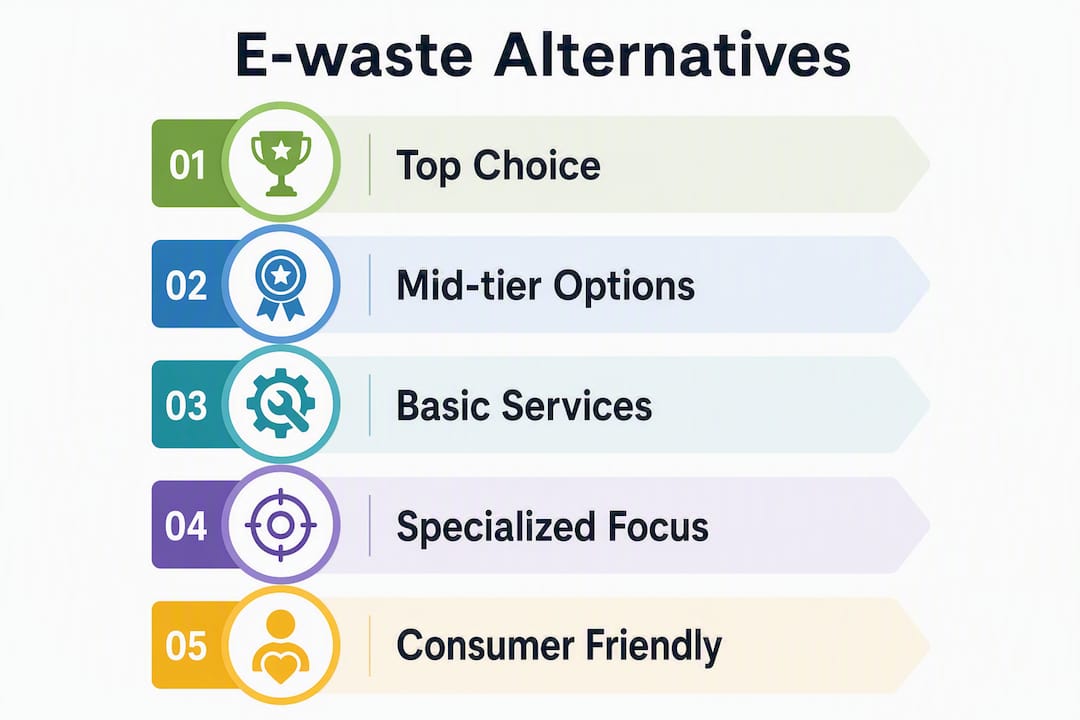
Here’s the shortlist with one-line verdicts:
- Usedcartridge — Best for B2B clients needing on-site destruction, Certificates of Destruction, and compliance-ready pickup across the U.S.
- Electronic Recyclers International (ERI) — Best for large enterprises requiring nationally scaled ITAD with R2/e-Stewards certification.
- Sims Lifecycle Services — Best for multi-site organizations that want asset recovery combined with remarketing and documented downstream handling.
- Best Buy recycling drop-off — Best for households or small offices recycling individual consumer electronics without data-destruction requirements.
- Call2Recycle — Best for businesses or consumers disposing of rechargeable batteries and small battery-powered devices.
- Earth911 — Best as a locator tool to find certified recyclers near you when you need a regional or local option.
The three factors that should drive your decision: what data-destruction method and documentation you need (Certificate of Destruction vs. none), whether you need scheduled business pickup or can use retail drop-off, and whether your volume and asset mix qualify for free pickup or will trigger per-item fees.
Pro Tip: If your organization handles regulated data under HIPAA, FERPA, or similar frameworks, lead with data-destruction requirements when vetting any provider. Coverage and price are secondary to whether you’ll get a signed CoD and an auditable chain-of-custody manifest.
Table of Contents
- How do these e-wastepickup.com alternatives compare at a glance?
- What does each alternative actually offer?
- How do you pick the right e-waste recycling partner?
- Software wiping versus physical destruction: which does your data actually need?
- What do e-waste providers typically accept, and what gets rejected?
- When should you choose Usedcartridge over other alternatives?
- Key Takeaways
- Why this shortlist was built the way it was
- Usedcartridge: secure pickup and certified disposal for U.S. businesses
- Useful sources and standards for e-waste compliance
How do these e-wastepickup.com alternatives compare at a glance?
| Provider | Service coverage | Pickup availability | Data destruction | Certifications | Pricing model | Best for |
|---|---|---|---|---|---|---|
| Usedcartridge | National (U.S.) | Scheduled business pickup; on-site service | On-site physical shredding; certified wiping; CoD issued | R2 / e-Stewards compliant; audit-ready chain-of-custody | Quote-based; asset recovery may offset costs | B2B, regulated data, audit-readiness |
| ERI | National (U.S.) | Scheduled business pickup; drop-off at facilities | On-site and off-site shredding; certified wiping; CoD | R2v3 / e-Stewards certified | Volume pricing; asset recovery credits available | Large enterprise ITAD, high-volume |
| Sims Lifecycle Services | National (U.S.) | Scheduled business pickup; logistics coordination | Certified wiping; physical destruction; CoD | R2 / ISO certified | Volume/contract pricing; remarketing offsets | Multi-site organizations, asset remarketing |
| Best Buy drop-off | National (retail stores) | In-store drop-off only | None (no data destruction service) | Retailer program; no ITAD certification | Free for most items; per-item fee for some | Households, small offices, consumer devices |
| Call2Recycle | National (drop-off network) | Drop-off at retail/collection points | None | EPA-recognized; stewardship program | Free for consumers at drop-off points | Batteries, small battery-powered devices |
| Earth911 | National (locator tool) | Varies by listed recycler | Varies by listed recycler | Varies by listed recycler | Varies by listed recycler | Finding a certified local recycler |
What does each alternative actually offer?
Usedcartridge
At a glance: A U.S.-based B2B provider offering scheduled pickup, on-site data destruction, IT asset recovery, and audit-ready documentation for businesses and organizations.
Core services:
- Scheduled business pickup with on-site physical destruction options
- Certified hard drive wiping and shredding with a Certificate of Destruction issued per device
- IT asset recovery with value assessment and potential payout for modern equipment
- Electronic waste recycling covering computers, servers, laptops, solar panels, and more
- Chain-of-custody manifests and compliance documentation for regulated industries
Pricing: Quote-based. Modern IT assets with resale value can qualify for free pickup or a payout. Obsolete or broken equipment, CRT monitors, and certain batteries typically carry disposal fees.
Pros: On-site destruction eliminates data-breach risk during transit; CoD issued per device; designed for compliance-heavy environments; handles both recycling and asset recovery in one engagement.
Cons: Not designed for single-item household drop-offs; pricing requires a quote rather than a published rate card.
Best for: IT departments, facility managers, and procurement leads at businesses or organizations with regulated data, multi-device cleanouts, or compliance reporting requirements.
Electronic Recyclers International (ERI)
At a glance: One of the largest certified e-waste recyclers in the U.S., with processing facilities across the country and both R2v3 and e-Stewards certification.
Core services:
- Scheduled business pickup and facility drop-off
- On-site and off-site hard drive shredding; certified wiping to NIST 800-88
- Certificate of Destruction and chain-of-custody documentation
- IT asset remarketing alongside recycling
Pricing: Volume-based contracts; asset recovery credits can reduce net cost for modern equipment mixes.
Pros: Nationally recognized certifications; multiple processing facilities reduce transport distance; handles very large volumes.
Cons: Primarily enterprise-focused; smaller organizations may find minimum volume thresholds or contract terms less flexible.
Best for: Large enterprises running multi-site IT refresh cycles or decommissioning data centers.
Sims Lifecycle Services
At a glance: A global ITAD and recycling provider with U.S. operations, combining asset remarketing with certified recycling and destruction.
Core services:
- Scheduled pickup and logistics coordination for multi-site clients
- Certified wiping and physical destruction with CoD
- Asset remarketing to recover value from equipment with resale potential
- R2 and ISO-certified processing
Pricing: Contract and volume pricing; remarketing revenue can significantly offset disposal costs when the asset mix includes recent-generation equipment.
Pros: Strong remarketing capability; consistent documentation across multiple locations; suits organizations with ongoing IT refresh programs.
Cons: Engagement model is better suited to larger, ongoing programs than one-time cleanouts.
Best for: Organizations with multi-state operations that want a single vendor handling both asset recovery and certified disposal. National processors with consistent documentation across sites are especially valuable for this use case.
Best Buy recycling drop-off
At a glance: A retail drop-off program available at Best Buy stores nationwide, designed for consumers recycling individual household electronics.
Core services:
- In-store drop-off for TVs, computers, phones, and small appliances
- Per-household limits apply for certain items (e.g., TVs capped per day)
- No data destruction service; no CoD issued
Pricing: Free for most small electronics; per-item fees apply for some larger items like TVs.
Pros: Widely accessible; no appointment needed for most items; free for common consumer devices.
Cons: No data destruction, no certification, no CoD. Per-household limits restrict volume. Retail and battery-collection programs are suited to household quantities, not enterprise IT asset recovery or certified destruction needs.
Best for: Households and very small offices recycling individual consumer devices with no sensitive data concerns.
Call2Recycle
At a glance: A nonprofit battery stewardship program with a national network of drop-off locations at retail stores and municipal sites.
Core services:
- Drop-off collection for rechargeable batteries (lithium-ion, NiMH, and others) and small battery-powered devices
- EPA-recognized stewardship program
- No data destruction or CoD
Pricing: Free for consumers at drop-off points; business collection programs available with separate terms.
Pros: Extremely accessible; handles battery types that many general recyclers won’t accept; nonprofit model with transparent reporting.
Cons: Scope is limited to batteries and small devices. Not appropriate for IT asset recovery, bulk electronics, or any data-destruction requirement.
Best for: Businesses or households disposing of rechargeable batteries or small battery-powered tools and devices.
Earth911
At a glance: A recycling locator tool that helps users find certified recyclers near them by material type and ZIP code.
Core services:
- Search database for local and regional recyclers by material
- Covers electronics, batteries, appliances, and more
- Recycler quality and certifications vary; Earth911 itself does not perform recycling
Pricing: Free to use as a locator; recycler pricing varies.
Pros: Useful for finding regional options not covered by national programs; broad material coverage.
Cons: Earth911 does not vet every listed recycler for R2 or e-Stewards certification. You must independently confirm certifications, CoD availability, and data-destruction capabilities with any recycler you find.
Best for: Individuals or businesses looking for a starting point to identify local recyclers, especially for materials outside standard ITAD programs.
How do you pick the right e-waste recycling partner?
Start with data destruction. Before you evaluate coverage, price, or logistics, confirm what destruction method a provider offers and what documentation you’ll receive. That single decision eliminates most of the wrong options immediately.
Questions to ask every vendor:
- Do you offer on-site physical destruction, or is destruction performed off-site after transport?
- Do you wipe drives to NIST 800-88 standards, and will you provide a written statement confirming the method?
- Will I receive a Certificate of Destruction for each device, or a batch-level CoD?
- Can you provide a chain-of-custody manifest and downstream partner audit documentation?
- What certifications do you hold: R2v3, e-Stewards, ISO 14001?
- What is your insurance coverage for data-breach liability during transport?
Red flags to watch for:
- No Certificate of Destruction offered, or CoD is optional rather than standard
- Vague answers about downstream partners (“we work with certified facilities” without naming them)
- No R2 or e-Stewards certification, or certifications that can’t be independently verified
- Requests to commingle your sensitive IT assets with general waste streams
- Pricing that is entirely verbal with no written inventory assessment or quote
Pricing signals: Asset recovery programs may offset pickup costs when your equipment mix includes modern, resalable hardware. Expect fees for CRT monitors, lead-acid batteries, obsolete or broken equipment, and bulky items like large-format displays. Always request an itemized inventory assessment before signing, and ask for a sample CoD to confirm the format and level of detail.
Pro Tip: Request a sample Certificate of Destruction and a redacted chain-of-custody manifest from any vendor before contracting. A provider that can’t produce these on request almost certainly can’t produce them after the job either.
A short procurement checklist:
- Confirm R2v3 or e-Stewards certification (ask for the certificate number and verify it independently).
- Request a written inventory assessment and itemized quote before scheduling pickup.
- Confirm CoD format: per-device serial number tracking is stronger than batch-level documentation.
- Ask for downstream partner names and their certifications.
- Get liability and insurance terms in writing before equipment leaves your facility.
Software wiping versus physical destruction: which does your data actually need?
The answer depends on your data-sensitivity level, not on what’s cheapest or most convenient.

Certified software wiping to NIST 800-88 standards is auditable and appropriate for low-to-moderate risk hardware: general business workstations, non-regulated data, and equipment being remarketed. NIST 800-88 defines three methods (Clear, Purge, and Destroy) with Purge-level wiping sufficient for most enterprise drives not subject to strict regulatory audit.
Physical destruction, whether on-site shredding or degaussing followed by shredding, is the right call for regulated records under HIPAA, FERPA, or similar frameworks, for drives containing intellectual property, and for any situation where an audit trail must be irrefutable. Certified recyclers offering on-site shredding for HDDs and SSDs alongside NIST 800-88 wiping position these services as non-negotiable for regulated data environments. Once a drive is physically shredded on your premises, there is no chain-of-custody gap to defend.
Required trust signals from any provider you hire:
- R2v3 or e-Stewards certification (independently verifiable)
- Written NIST 800-88 wiping statement specifying the method used (Clear, Purge, or Destroy)
- Certificate of Destruction with device-level serial number tracking
- Documented chain-of-custody manifest from pickup through downstream processing
- Third-party audit reports confirming downstream partner compliance
Reputable recyclers build R2v3-compliant processes around CoDs and chain-of-custody documentation specifically to help clients avoid EPA penalties and support sustainability reporting. That’s not marketing language; it’s the operational baseline for any provider worth contracting.
Pro Tip: For drives leaving your site, combine NIST 800-88 Purge-level wiping with on-site shredding and obtain a per-device CoD. That combination covers both the security requirement and the audit expectation, regardless of which regulator is reviewing your records.
Request separate manifests for customer-separated processing streams. Commingling sensitive IT assets with general e-waste is one of the most common compliance gaps, and it’s entirely preventable with the right contractual language upfront.
Certification matters: R2v3-compliant processes include CoDs and chain-of-custody documentation to support regulatory compliance and corporate sustainability reporting.
What do e-waste providers typically accept, and what gets rejected?
Knowing what’s in scope before scheduling a pickup saves time and avoids surprise fees.
Commonly accepted items:
- Desktop computers, workstations, and servers
- Laptops and tablets
- Monitors (LCD/LED; CRT monitors are often accepted but typically carry a fee due to lead content)
- Printers, copiers, and multifunction devices
- Networking equipment: routers, switches, and access points
- Mobile phones and smartphones
- Rechargeable batteries (lithium-ion, NiMH) through appropriate programs
- Power tools with battery packs
- Keyboards, mice, and peripheral devices
Common exclusions or special-handling items:
- Household hazardous waste (paint, chemicals, non-electronic materials)
- Sealed lead-acid batteries: accepted by some providers, excluded by others; always confirm
- Solar panels: accepted by specialized providers like Usedcartridge but excluded from most retail drop-off programs
- Large appliances (refrigerators, washers): outside scope for most ITAD providers; check municipal programs
- CRT televisions: accepted by some ITAD providers and certain retail programs with per-item limits, but fees are common
- Items requiring HazMat certification for transport
Retail drop-off programs like Best Buy accept a narrower range than ITAD providers and impose per-household daily limits on some categories. For computer monitor disposal and larger items, container-based commercial collection is often the more practical route for businesses with ongoing volume.
Pro Tip: Before pickup day, segregate items by category: data-bearing devices in one group, peripherals in another, batteries separately. Label each group clearly. This speeds the intake process, reduces the chance of commingling, and makes the resulting manifest cleaner for your compliance records.
When should you choose Usedcartridge over other alternatives?
Choose Usedcartridge when your situation involves any of the following:
- IT asset recovery: — Modern equipment in your cleanout may have resale value. Usedcartridge assesses assets and can offset disposal costs through recovery payouts.
When a different option makes more sense:
Before signing with any provider, verify CoD format, chain-of-custody documentation, and certifications. A provider that can’t show you a sample CoD before the job almost certainly won’t produce a useful one after.
Key Takeaways
The strongest e-wastepickup.com alternative for U.S. businesses with regulated data is Usedcartridge, which combines on-site destruction, per-device Certificates of Destruction, and audit-ready chain-of-custody documentation in a single B2B engagement.
| Point | Details |
|---|---|
| Lead with data destruction | Confirm on-site vs. off-site destruction and CoD format before evaluating price or coverage. |
| Match provider to use case | Retail drop-off (Best Buy) suits households; Call2Recycle handles batteries; ITAD providers handle business volume and compliance. |
| Verify certifications independently | R2v3 and e-Stewards certificates are publicly verifiable; always confirm before contracting. |
| Pricing follows asset value | Modern equipment may qualify for free pickup or a payout; CRTs, broken gear, and batteries typically carry fees. |
| Usedcartridge for B2B compliance | On-site destruction, per-device CoD, and IT asset recovery make it the recommended option for audit-ready business disposal. |
Why this shortlist was built the way it was
Most e-waste comparison articles treat all providers as roughly equivalent and let the reader figure out the rest. That’s not useful when the stakes include a data breach or a failed compliance audit.
The providers on this list were selected because they represent meaningfully different operational models: on-site destruction versus retail drop-off, certified ITAD versus battery stewardship, national scale versus local search. The goal was a shortlist where each entry serves a genuinely different need, not five versions of the same service.
Usedcartridge sits at the top of that list for business clients because the combination of on-site destruction, per-device CoD, and IT asset recovery in a single engagement is rare. Most providers offer one or two of those; few offer all three with the documentation depth that regulated industries require. If your organization has ever had an auditor ask for chain-of-custody records and come up empty, you already know why that combination matters.
Usedcartridge: secure pickup and certified disposal for U.S. businesses
Businesses that need more than a drop-off bin get a different kind of service with Usedcartridge. On-site physical destruction means drives never leave your building intact. Every device gets a Certificate of Destruction with serial-number-level tracking, and the chain-of-custody manifest is audit-ready from day one.


The service covers the full scope: e-waste recycling and pickup for computers, servers, laptops, and solar panels; IT asset recovery with a value assessment that can offset your disposal costs; and equipment destruction with documentation that satisfies HIPAA, FERPA, and corporate governance requirements. No guessing at what your assets are worth and no chasing paperwork after the fact.
Request a quote or schedule an on-site assessment at usedcartridge.com/it-asset-recovery-disposition-quote to get a written inventory evaluation and confirm whether your asset mix qualifies for free pickup.
Useful sources and standards for e-waste compliance
These are the primary standards and resources referenced throughout this article. Each is worth bookmarking if you’re building a vendor vetting process or procurement policy.
| Resource | Why it matters |
|---|---|
| NIST SP 800-88 (Guidelines for Media Sanitization) | The federal standard defining Clear, Purge, and Destroy methods for data sanitization; use it to specify wiping requirements in vendor contracts. |
| R2v3 Standard (Responsible Recycling) | The leading certification for electronics recyclers; independently audited and publicly verifiable by certificate number. |
| e-Stewards Certification | An alternative recycler certification with strong downstream accountability requirements; verifiable at the e-Stewards registry. |
| Best Buy Recycling Program | Official program page with accepted items, per-household limits, and store locator for retail drop-off. |
| Call2Recycle Drop-Off Locator | Find battery drop-off locations by ZIP code; covers rechargeable batteries and small battery-powered devices. |
| Earth911 Recycling Locator | Search for certified local recyclers by material type and ZIP code; verify certifications independently before use. |
| Usedcartridge: data destruction guide | Practical guidance on destruction methods, NIST standards, and CoD requirements for business procurement. |
| Environmental impact of improper disposal | Community-level framing on why certified disposal matters beyond compliance, useful for sustainability reporting context. |