
End-of-life IT equipment is defined as hardware or software that an original equipment manufacturer (OEM) no longer produces or sells, marking the start of a critical transition in the IT asset lifecycle. The industry standard term for this phase is EOL, and it is distinct from End-of-Support (EOS), which signals the complete cessation of technical assistance and security patches. Understanding what end-of-life IT equipment means is not optional for IT professionals and business leaders. Unmanaged EOL assets expose organizations to data breaches, compliance failures, and operational disruptions that carry real financial and legal consequences.
What is end-of-life IT equipment, and how does it differ from end-of-support?
EOL IT equipment is hardware or software no longer produced, sold, or actively supported by the OEM. EOL signals the end of sales and production. EOS signals the end of everything else, including security patches, bug fixes, and technical support. These two milestones are related but not identical, and confusing them leads to poor planning decisions.
The timeline between EOL and EOS varies by vendor and product category. A manufacturer may stop selling a server model while continuing to issue security updates for several more years. Once EOS arrives, that same server receives no further patches. That gap is where most organizations underestimate their risk.
| Milestone | What stops | Primary risk |
|---|---|---|
| End-of-Life (EOL) | Production and new sales | Reduced vendor investment in the product |
| End-of-Support (EOS) | All patches, updates, and support | Active security vulnerabilities go unaddressed |
| Post-EOS operation | Vendor relationship ends entirely | Compliance violations and breach exposure |
EOL does not mean immediate obsolescence. A device can remain fully operational after its EOL date. The risk increases gradually as the EOS date approaches and then rises sharply once all support ends. IT leaders who treat EOL as a hard shutdown date often retire equipment too early. Those who ignore it entirely operate unsupported infrastructure without realizing it.
Key distinctions to keep in mind:
- EOL ends the commercial relationship between buyer and vendor for new units.
- EOS ends the technical relationship, including all security maintenance.
- Post-EOS operation means running equipment with known, unpatched vulnerabilities.
- The EOS date, not the EOL date, marks the point of maximum operational risk.
Why does EOL equipment create security, compliance, and operational risks?
Poorly managed EOL equipment increases security vulnerabilities, drives unexpected costs, and creates operational friction across the organization. Once a device passes its EOS date, every newly discovered vulnerability in that system goes unpatched permanently. Attackers actively target known EOL systems because the exposure is predictable and permanent.

Compliance is the second major pressure point. Regulations including HIPAA, GDPR, and the Payment Card Industry Data Security Standard (PCI DSS) require organizations to maintain systems with current security controls. Running post-EOS equipment in environments that process personal or financial data is a direct compliance violation in most regulatory frameworks. Auditors treat unsupported systems as evidence of negligence, not just technical debt.
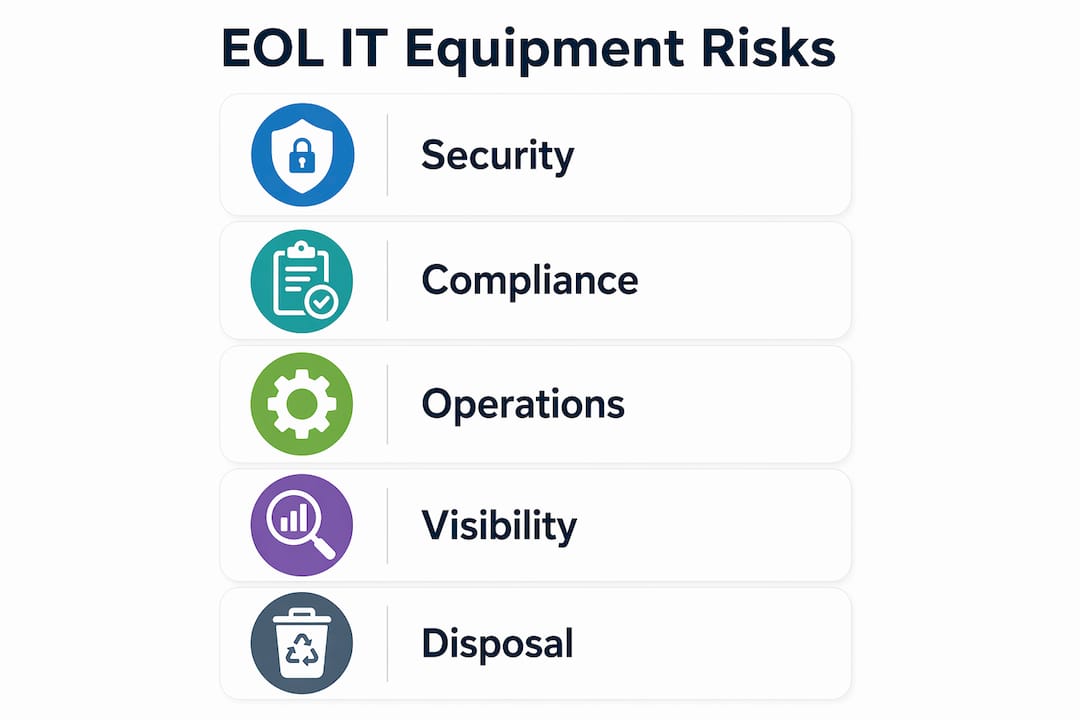
Operational disruptions are the third risk category. Vendors stop producing replacement parts for EOL hardware. Third-party repair options become scarce. When a critical component fails in a post-EOS server, the organization faces an unplanned outage with no vendor support path. That scenario is far more expensive than a planned retirement.
Asset visibility is the foundation of managing these risks. Organizations that lack a current inventory of their IT assets cannot identify which devices are approaching EOL or have already passed EOS. Lifecycle visibility and formalized retirement policies prevent costly data breaches and allow teams to act before risk becomes incident.
Pro Tip: Build a data sensitivity classification into your asset inventory. Tag each device by the type of data it processes or stores. That classification drives every downstream decision, from sanitization method to disposal channel, and reduces the chance of over-disposing functional equipment or under-securing sensitive assets.
What are the best practices for managing end-of-life IT assets?
Secure asset retirement follows a defined sequence: identify assets, classify by data sensitivity, apply proper sanitization, verify outcomes, and maintain auditable records. Skipping any step creates liability. The process is not a one-time event. IT asset disposal (ITAD) is a continuous program tied to the full lifecycle of every device in the organization.
A formal retirement policy is the starting point. Without a written policy, retirement decisions get made inconsistently by different teams, creating gaps in documentation and data security. The policy should define EOL and EOS thresholds, assign ownership for retirement decisions, and specify approved disposal channels.
Follow these steps when retiring end-of-life IT assets:
- Audit your inventory. Confirm which assets are approaching or have passed their EOL or EOS dates. Use asset management software that tracks vendor lifecycle milestones and sends alerts before critical dates.
- Classify by data sensitivity. Separate devices that stored or processed sensitive data from those that did not. High-sensitivity assets require certified data destruction. Lower-sensitivity assets may qualify for resale or donation after standard sanitization.
- Apply certified data sanitization. Certified data wiping or physical destruction is required for any device that held business, customer, or regulated data. Software-based wiping methods must meet standards such as NIST SP 800-88. Physical destruction, including shredding or degaussing, is appropriate for drives that cannot be reliably wiped.
- Document the chain of custody. Record every step from decommissioning to final disposition. Chain of custody documentation is the primary defense against regulatory fines when an asset is mishandled downstream.
- Choose a disposition path. Options include resale to secondary markets, donation to qualified organizations, recycling through certified e-waste processors, or physical destruction. Each path has different documentation requirements and financial outcomes.
- Obtain certificates of destruction or recycling. ITAD as a continuous program requires certificates for each sanitized or destroyed asset. These certificates prove no unauthorized data access occurred and satisfy auditor requests.
Pro Tip: Schedule quarterly EOL reviews rather than waiting for devices to fail or audits to flag them. Proactive reviews give your team time to plan budgets, select disposal vendors, and complete documentation without the pressure of an incident or compliance deadline.
Reviewing your electronics disposal planning steps before assets reach EOS gives your organization the lead time to execute each step correctly.
How do regulations and standards shape IT equipment disposal?
Regulatory requirements for retiring IT equipment operate at multiple levels. Federal agencies, state governments, and industry bodies each impose distinct obligations. Understanding which rules apply to your organization is the first step in building a compliant disposal process.
Key regulatory frameworks affecting IT equipment disposal methods include:
- EPA guidelines govern the disposal of hazardous materials found in electronics, including lead, mercury, and cadmium. Improper disposal of these materials carries civil penalties.
- State e-waste laws vary significantly. California, New York, and more than two dozen other states have enacted electronics recycling mandates that require manufacturers and consumers to use certified collection programs.
- HIPAA requires covered entities and business associates to destroy protected health information on any device before disposal, using methods that render the data unrecoverable.
- GDPR applies to any organization processing personal data of EU residents, regardless of where the organization is based. Article 5 requires that personal data be protected throughout its lifecycle, including at disposal.
- PCI DSS requires that cardholder data be rendered unrecoverable on any media before disposal, using approved destruction methods.
Environmental certifications add another layer of accountability. Recyclers certified under R2 (Responsible Recycling) or e-Stewards standards meet documented requirements for data security, worker safety, and environmental protection. Using a certified recycler protects your organization from downstream liability if a vendor mishandles equipment after pickup.
| Regulation or standard | Primary requirement | Applies to |
|---|---|---|
| EPA guidelines | Safe disposal of hazardous materials | All organizations |
| State e-waste laws | Use of certified collection programs | Varies by state |
| HIPAA | Certified destruction of health data | Healthcare and business associates |
| GDPR | Data protection through full lifecycle | Organizations handling EU personal data |
| R2 / e-Stewards | Certified recycler accountability | Recycling vendors |
Compliance ties directly into organizational risk management. A documented, regulation-aligned disposal process reduces audit exposure, protects brand reputation, and demonstrates due diligence to regulators and customers. Integrating regulatory requirements into your asset retirement policy from the start is far less costly than retrofitting compliance after a violation.
Reviewing safe disposal of IT assets through the lens of current regulations helps IT leaders build policies that hold up under scrutiny.
Key Takeaways
End-of-life IT equipment requires a structured, documented retirement process to protect data, maintain compliance, and avoid operational risk.
| Point | Details |
|---|---|
| EOL vs. EOS distinction | EOL ends production; EOS ends all support, including security patches, marking peak risk. |
| Data sensitivity classification | Tag every asset by data type before disposal to determine the correct sanitization method. |
| Chain of custody documentation | Maintain unbroken records from decommissioning to final disposition to satisfy auditors. |
| Regulatory compliance | HIPAA, GDPR, PCI DSS, and state e-waste laws each impose specific disposal obligations. |
| Proactive lifecycle reviews | Quarterly EOL audits prevent rushed retirements and reduce breach and compliance exposure. |
The lifecycle gap most IT leaders underestimate
After working with organizations across multiple industries on IT asset retirement, the pattern I see most often is not ignorance of EOL dates. It is the gap between knowing a device is approaching EOS and actually doing something about it. Teams log the date, set a calendar reminder, and then let the quarter pass because the device is still working fine.
That logic is understandable. A functioning server feels like a solved problem. But the risk profile of that server changes the moment its EOS date passes, regardless of whether it crashes. Attackers do not wait for hardware to fail. They exploit the predictable window when a system is known to be unpatched.
The growth of third-party support providers has given some organizations a middle path, paying specialized vendors to extend support contracts beyond the OEM’s EOS date. That option has real value in specific situations, particularly for legacy systems tied to critical applications. But third-party support is not a substitute for a retirement plan. It is a delay tactic, and it needs a defined endpoint.
The future of EOL management points toward automation. Asset management platforms that pull vendor lifecycle data and trigger alerts at configurable thresholds are becoming standard in mature IT organizations. The organizations that build those workflows now will spend less time firefighting and more time making deliberate decisions about IT hardware recycling and asset recovery. Proactive lifecycle management is not a best practice. It is a business requirement.
— Keith
Usedcartridge makes EOL equipment retirement straightforward
When end-of-life IT assets reach their final stage, the disposal process needs to be secure, documented, and compliant with environmental and data privacy regulations.

Usedcartridge provides certified e-waste recycling and data destruction services built for organizations managing IT asset lifecycles at scale. From on-site hard drive destruction to full equipment destruction with certificates of sanitization, every service is designed to satisfy audit requirements and protect sensitive data through the final step. Usedcartridge also offers free quotes and pickup options, making it practical for IT teams to retire assets without adding administrative burden. Responsible disposal of end-of-life technology does not have to be complicated when the right process is already in place.
FAQ
What is end-of-life IT equipment?
End-of-life IT equipment is hardware or software that an OEM no longer produces or sells. It signals the start of a transition toward reduced and eventually zero vendor support.
What is the difference between EOL and EOS?
EOL ends production and sales of a product. EOS ends all technical support, including security patches, and marks the point of highest operational and compliance risk.
Does EOL equipment need to be retired immediately?
EOL equipment does not need immediate retirement, but it requires active monitoring. Risk increases steadily as the EOS date approaches and rises sharply once all support ends.
What data destruction methods meet regulatory requirements?
NIST SP 800-88 compliant software wiping and physical destruction methods such as shredding or degaussing meet the requirements of HIPAA, GDPR, and PCI DSS for data-bearing devices.
How do I prove compliant disposal to an auditor?
Maintain a chain of custody record from decommissioning to final disposition, and obtain certificates of destruction or recycling from your disposal vendor for every asset processed.