
Remote sites make e-waste harder because distance, low volumes and poor connectivity push up the cost and risk of every pickup. The fix is to plan around those limits. Inventory each site before collection, handle batteries as regulated materials, consolidate nearby sites into fewer trips, and settle data destruction before equipment leaves the building. Recycle for Life is a B2B company that picks up from businesses in Southern California, from San Diego County to Los Angeles County.
TL;DR
- Remote-site e-waste fails most often at the planning stage: missing inventories, mixed batteries and half-empty trips.
- Record make, model, serial numbers, quantity, condition and pickup date for every site before collection.
- Lithium batteries and devices containing them are regulated hazardous materials in transport, so pack and separate them deliberately.
- Grouping nearby sites into one route cuts trips, cost and emissions.
- Recycle for Life provides free pickup for businesses in San Diego County through Los Angeles County. We are pickup only.
Table of Contents
- Why remote sites change the problem
- Build the inventory before anyone schedules a truck
- Handle batteries and regulated parts first
- Consolidate sites into fewer trips
- Protect data before the truck arrives
- What to ask any recycler
- Schedule a pickup for your sites
- FAQ
- Sources
Why remote sites change the problem
A downtown office can fill a truck in one visit. A field office, a warehouse at the edge of a county, a cell-tower shelter or a branch with ten laptops cannot. Distance, small volumes and thin staffing combine, and equipment sits in closets for years.
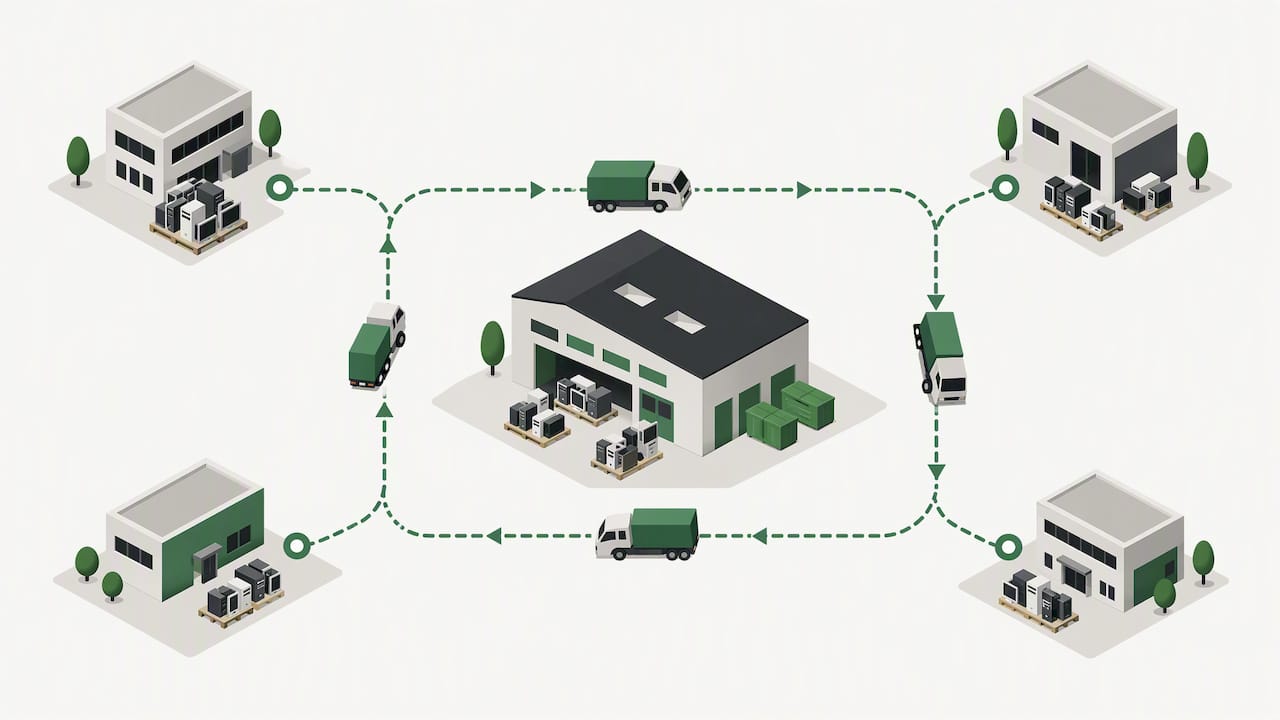
The most extreme example in the US is Alaska. EPA describes how rugged terrain and permanent snow and ice limit ground transport, leaving many communities dependent on costly, infrequent barge and air shipments. Its Backhaul Alaska example ran a hub-and-spoke model with a central control tower in Anchorage directing collection. Material from a community moved to Nome, then by barge or air to Anchorage, where it was combined in metal cargo containers for shipment to Seattle.
Your sites are probably not on a barge route, but the logic carries over. A hub-and-spoke approach works for Southern California too: one coordinator, one schedule, and each site feeding a predictable route.
EPA’s research with rural Alaska communities adds a lesson on cost. Backhaul shipping can still be expensive, limited staffing makes coordination difficult, and people need training to pack safely. Those are the same weak points a multi-site business faces, at smaller scale.
Build the inventory before anyone schedules a truck
Most failed pickups come from a vague description such as “some old computers.” EPA’s guidance for federal electronics says to document manufacturer and model, serial numbers, quantity, recycler, condition and pickup date before sending equipment out. It is a good template for any business.
For each remote site, keep a simple sheet with:
- Equipment type (laptops, desktops, servers, networking gear, monitors, UPS units, solar panels).
- Quantity and, for anything holding data, the serial numbers.
- Condition of the equipment.
- Where the equipment is stored and who can give access.
- The best pickup window for the site.
Connectivity matters here. EPA’s January 2025 rural Alaska research found remote programs need inventory tools that work offline and synchronize later, with photos, geotags and status records. A phone photo of the stack and a shared spreadsheet get you most of the way.
Assign ownership too. The ITU recommends large organizations give specific departments and individuals clear responsibility for each e-waste type, so IT and facilities do not each assume the other has it. If your IT function is thin, managed IT infrastructure benefits are worth a look, since someone has to own the asset list at every location. Our electronics disposal planning steps walk through a full checklist.
Handle batteries and regulated parts first
Batteries are the item that turns a routine pickup into a compliance question. Under federal rules, universal waste covers batteries, lamps and other listed items, and shipments that meet DOT hazardous-materials definitions must follow DOT packaging, labeling and marking rules. Small quantity handlers of universal waste may also only send it to another handler or a destination facility, so a site cannot hand it to just anyone.
For lithium specifically, DOT states that lithium batteries and devices containing them are regulated hazardous materials and must be packed to prevent short-circuiting, shifting or accidental activation. Damaged, defective or recalled batteries face stricter requirements and should not be shipped if you suspect damage.
In practice at a remote site:
- Keep battery-bearing items (laptops, UPS units, handheld scanners) apart from general electronics.
- We do not pick up swollen, leaking or damaged batteries; those need a licensed hazardous-waste handler.
- Store cool and dry, away from foot traffic. Our guide to lithium battery storage safety covers the storage side.
- Tape or bag terminals as the DOT sheet describes, and do not stack loose batteries in one box.
Check with your environmental compliance contact which category applies. Our business e-waste recycling page covers what we accept.
Consolidate sites into fewer trips
The biggest cost lever is trip count. EPA SmartWay advises reviewing weight, volume, handling needs and delivery windows, because consolidating shipments can reduce costs and carbon emissions when fewer trucks are used. In its case example, a company cut less-than-truckload shipments from 75% to 27% and saved $800,000 in a year while keeping on-time delivery at 97.8%. That is freight, not e-waste, but the principle holds for retired IT.
The Federal Highway Administration makes a similar point: consolidation takes planning and coordination, yet reduces the number of shipments and their traffic impact, and reservation systems can shorten loading times.
For a Southern California business, that translates into:
| Situation | What works |
|---|---|
| Several small sites in one county | Pick one date, one contact per site, one route |
| One distant site with little equipment | Hold the items until a refresh or closure adds volume |
| Office refresh across counties | Stage equipment at the largest site, then schedule pickups by region |
| Site closure | Book a dedicated pickup once the inventory is complete |
Waiting has limits. Equipment with data, or batteries in poor condition, should not sit for a year. Our e-waste pickup cost page and the article on free e-waste pickup for businesses explain how that applies to you.
Protect data before the truck arrives
A remote closet often holds old drives nobody has tracked. Settle two questions for every site: which devices hold data, and how it will be destroyed.
Private organizations often borrow the same framework when writing policy.
At Recycle for Life, on-site hard drive destruction uses a pneumatic punch, and your team can watch it happen. The drives are destroyed afterward. Hard drive destruction is free for 50 or more drives. If a site has fewer, combine drives from several locations to reach that threshold. See our hard drive destruction and witnessed hard drive destruction pages for the process.
What to ask any recycler
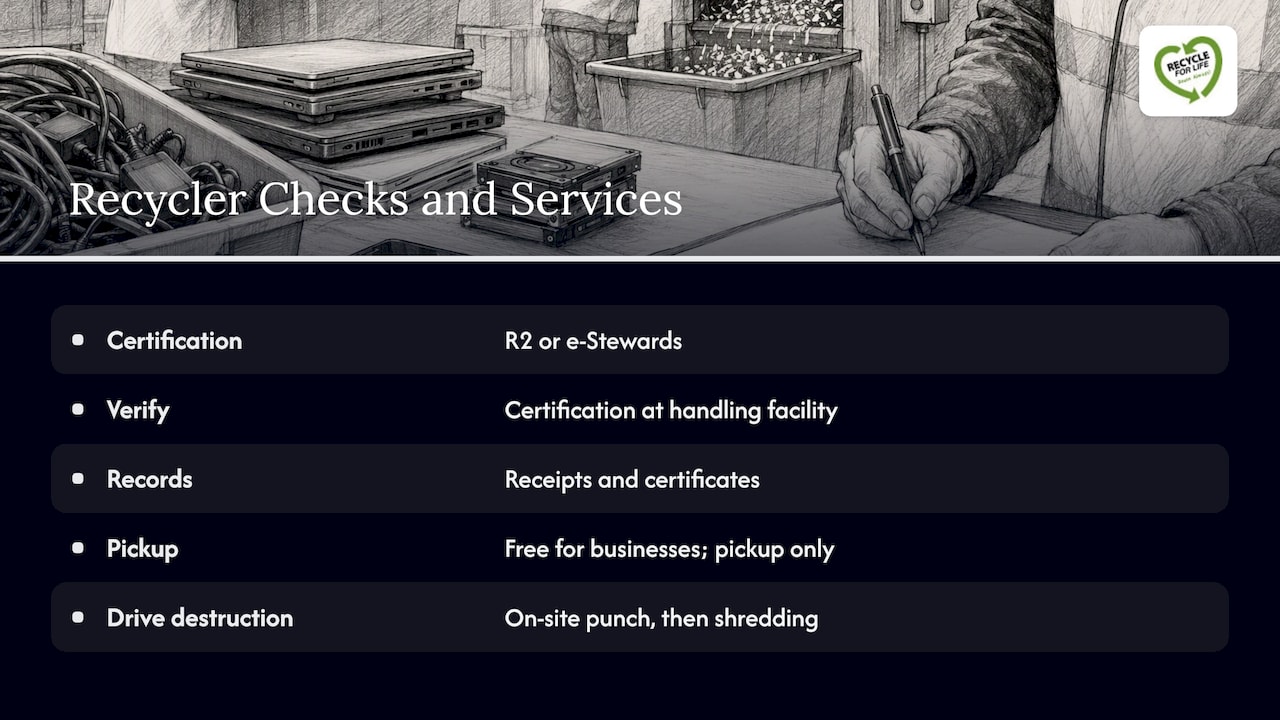
Ask for a Certificate of Recycling within 3 days of every pickup (and a Certificate of Destruction when drives are destroyed) for your files.
Recycle for Life is a DTSC and EPA registered company and is subject to auditing. We provide a Certificate of Recycling within 3 days of every pickup (and a Certificate of Destruction when drives are destroyed) for compliance needs. Our guide to why audit IT asset disposal shows what to keep.
Our perspective Remote sites rarely fail because of one big mistake. They fail because the equipment is nobody's job. A pallet of old laptops sits in a branch office, the batteries age, and the drives are forgotten until an audit. We built our service around removing that friction. We are a B2B company, pickup is free for businesses, and we serve San Diego County through Los Angeles County. We are pickup only, so you never have to find a vehicle or a drop point. When drives are the concern, we can destroy them on-site with a pneumatic punch on request, and your people are welcome to watch; the drives then go to an EPA-registered, DTSC-audited facility for final destruction. Our advice: get a simple inventory from each location, group nearby sites, and keep any damaged batteries out of the pickup. That is usually all it takes.
Schedule a pickup for your sites
Recycle for Life picks up e-waste from businesses across San Diego County to Los Angeles County at no charge, including computers and other IT assets. Solar panel recycling is $0.55 per pound. Send your site list and we will plan the route. See our computer recycling page or contact us through our main site.

FAQ
Do you pick up from small or remote business locations?
Yes, within San Diego County through Los Angeles County. We pick up from businesses only, and pickup is free. Grouping nearby locations on one date makes scheduling easier for everyone.
Can I watch my hard drives being destroyed?
Yes. On-site destruction uses a pneumatic punch, and your team can watch. The drives are destroyed afterward. Destruction is free for 50 or more drives.
What should I do with lithium batteries from a branch office?
Keep them separate from other electronics, and protect the terminals. DOT classifies lithium batteries as hazardous materials in transport, so damaged ones need special handling.
What paperwork do I get?
We provide a Certificate of Recycling within 3 days of every pickup (and a Certificate of Destruction when drives are destroyed) to support your compliance needs. Recycle for Life is a DTSC and EPA registered company subject to auditing.
Sources
- Battery Collection in Action Case Study: Backhaul Alaska (EPA)
- Community-Based Research in Rural Alaska Native Communities (EPA)
- Preparing to Recycle Used Federal Electronic Equipment (EPA)
- End of life management for ICT equipment (ITU)
- 40 CFR Part 273, Standards for Universal Waste (eCFR)
- Check the Box for Lithium Batteries (US DOT)
- Hazardous Waste Transportation (EPA)
- SmartWay Less-than-Truckload Freight Consolidation (EPA)
- Primer for Improved Urban Freight Mobility and Delivery (FHWA)
- Media Sanitization Considerations for Federal Electronics (EPA)
- Checklist for the Selection of an Electronics Recycler (EPA)