
A compliant solar panel decommissioning plan documents the removal scope, a detailed cost estimate, and financial assurance, and regulators often want all three before construction or at a set project milestone. Start by identifying your permitting authority, commission an independent cost estimate, and choose an assurance instrument the regulator accepts. Then calendar every update deadline so the plan never goes stale.
TL;DR:
- North Carolina requires utility scale projects of 2 MW AC or more to register, submit an engineer prepared plan, and update assurance every five years.
- A New York snapshot put estimates near $50,000 per MW AC before salvage or contingencies; NYSERDA’s example adds a 15% contingency, not a universal rate.
- Regulators may discount salvage in initial assurance; use an independent estimate, document values with quotes or recycler agreements, and show gross, salvage, and net costs.
- Generators must test panels before disposal; modules above the 5.0 mg/L lead limit under TCLP require hazardous waste management, with results kept for closeout.
- Many programs require cost and assurance reviews about every five years; some laws also require cessation notice within 30 days and completion within 12 months.
Table of Contents
- What must a solar decommissioning plan include?
- How do you decommission a solar project step by step?
- How do you estimate costs and choose financial assurance?
- Which regulators require a plan, and who must comply?
- How do hazardous-waste rules apply to retired panels?
- How should you treat salvage value in the cost estimate?
- How often should you update the plan and what records should you keep?
- What environmental assessment applies during decommissioning?
- What health and safety protocols apply to solar decommissioning?
- How do you handle data security for solar control systems?
- What logistics and transportation rules apply to hazardous components?
- How long does decommissioning take from planning to restoration?
- What do successful decommissioning plans look like in practice?
- Plan decommissioning like any other lifecycle cost
- How we help with panel recycling, transport, and documentation
- FAQ
- Sources
- Where to find your regulator’s requirements
What must a solar decommissioning plan include?
Reviewers may use different checklists, depending on the jurisdiction. Minnesota’s draft decommissioning plan guidance is a useful template because it spells out each element, and it applies equally well as a model for other jurisdictions. Build your plan around these parts:
- Project description: nameplate MW, acreage, panel and inverter models, gen-tie lines, and any battery storage on site.
- Scope and sequencing: which components come out, how deep foundations and cables are removed, where temporary staging happens, and what the restored site looks like.
- Cost estimate: a task-level breakdown showing gross and net amounts, contingency, and the salvage assumptions behind the net figure.
- Financial assurance: the instrument type, the legal entity behind it, when it is posted, and how the regulator can draw on it.
- Triggers and schedule: the events that start decommissioning, such as permanent cessation of generation, and the window for finishing the work.
- Roles and documentation: who is responsible (owner, operator, contractors) and which permit notifications go to which agency.
The Minnesota guidance also asks you to identify hazardous or regulated materials and to update the plan periodically. Treat that as a standing requirement even where your own permit is silent. A plan that names its materials up front is far easier to defend later.
How do you decommission a solar project step by step?
Write this sequence into the plan so contractors and inspectors share the same expectations. Your contractor may refine it, but the order should hold.
- Assess the site and triage materials. Map every asset, flag hazardous components, and sort panels into reuse candidates and recycling streams. Our PV module recycling plan explains how to triage modules that still perform well.
- Disconnect and isolate. Coordinate with the utility, de-energize the system, and complete electrical isolation to utility and National Electrical Code requirements before anyone touches a string.
- Dismantle in a planned order. Remove modules first, then racking, inverters, cabling, and the balance of system. Working in sequence limits breakage and rework.
- Sort on site. Set up a temporary sorting area that separates reusable modules, recyclable metals, batteries, and residues that cannot be recycled.
- Restore the land. Regrade, control erosion, revegetate, and schedule a final inspection with the regulator.
Pro Tip: Photograph and log each array block before removal. That record settles later disputes about damage, quantities, and restoration scope.
Our step-by-step disposal guide goes deeper on the packaging and handoff steps.
How do you estimate costs and choose financial assurance?
A defensible estimate starts with line items, not a lump sum. Build it from these components:
- Mobilization and demobilization
- Heavy equipment and labor
- Transport to recyclers or disposal sites
- Recycling and disposal fees
- Permits and agency fees
- Site remediation and restoration
- Project management and engineering oversight
Minnesota guidance calls for a detailed estimate showing gross and net costs, including salvage assumptions. The logic is simple: assurance exists for the worst case, where the owner is gone and the scrap market is weak. For scale, a New York snapshot of 2021–2024 projects reported an average decommissioning estimate of about $50,000 per MW-ac before contingencies or salvage. Your site will differ with access, geography, and disposal fees, so treat that as context rather than a budget.
Add a contingency. Model guidance from NYSERDA uses a 15% contingency as its example. Use the 15% contingency shown in the NYSERDA example.
Commonly accepted assurance instruments include:
- Surety or performance bonds: a third party guarantees the work will be funded.
- Irrevocable letters of credit: a bank commits funds the regulator can draw.
- Escrow or trust accounts: cash set aside and controlled for decommissioning.
- Financial assurance: confirm which instruments your jurisdiction accepts.
Timing varies. Some states require assurance before construction, while others allow staged posting with full funding by a mid-life milestone. Many require recalculation about every five years. Confirm which rule governs your permit before you pick an instrument.
Which regulators require a plan, and who must comply?
Decommissioning requirements usually ride on project approvals. A federal and state policy survey found that policies commonly target utility-scale projects, often tie the plan to permit conditions, and differ on when assurance must be posted. The Bureau of Land Management and a growing number of states make a plan a permit condition.
A few representative examples show the range:
- Maine: state law explicitly requires financial assurance for restoration.
- North Carolina: owners of utility-scale projects of 2 MW AC or more must register with the state, submit a plan, and establish financial assurance by statutory deadlines under the state’s decommissioning program. The enabling statute calls for an engineer-prepared plan and five-year assurance updates.
- Minnesota and New York: plan submission, and in some permit paths a third-party cost estimate, are part of the process.
Use this checklist to confirm where you stand:
- Identify every jurisdiction: state, county, and any federal land manager.
- Confirm whether your project clears the size or acreage threshold.
- Note the permit-specific deadline for filing and for posting assurance.
- Capture registration forms and fees.
- Calendar every update and renewal date.
Our overview of solar panel disposal laws covers the wider legal picture for U.S. businesses.
How do hazardous-waste rules apply to retired panels?
Under federal rules, the party that generates the waste must decide whether it is hazardous. EPA’s end-of-life guidance says generators must make that determination before disposal, and panels that fail the Toxicity Characteristic Leaching Procedure (TCLP) must be managed as hazardous waste under 40 CFR Parts 262–268. EPA’s frequently asked questions warn against assuming panels are non-hazardous by default, because undocumented testing creates compliance and liability risk.
The regulatory limit for lead in the TCLP extract is 5.0 mg/L, and panels above it carry specific hazardous waste codes such as D008 for lead.
Practical steps that keep costs down:
- Sample and test representative panels, and keep the lab reports.
- Check whether a transfer-based recycling exclusion applies to your shipment. If you cannot confirm it, treat the material conservatively.
- Separate reusable, undamaged modules from broken ones so one damaged lot does not taint the whole inventory.
- Route recyclable panels to a qualified recycler. EPA’s solar panel recycling page describes the process: frame and junction-box removal, glass and wafer separation, and recovery of specialty metals. It also points to DOE and industry directories, including Earth911, for recycler listings.
We explain the paperwork side in our guide to solar panel waste classification.
How should you treat salvage value in the cost estimate?
Salvage can offset decommissioning cost, but regulators often discount it or bar it from the initial assurance amount. Independent third-party estimates carry more weight than owner-prepared figures. To make your estimate defensible:
- Break salvage out by component, such as steel racking, copper cable, and aluminum framing.
- Document each valuation with market quotes or written recycler agreements.
- Show the gross cost, the salvage credit, and the net cost side by side.
- Attach calculation worksheets, assumptions, and vendor quotes to the submission.
- Date every quote so reviewers can see which market it reflects.
Metal prices move, and recycler terms change. Because the industry has few projects at end of life, there are no standard cost benchmarks, which makes your documentation the main evidence a reviewer has. A estimate backed by quotes survives scrutiny far better than one resting on round numbers.
How often should you update the plan and what records should you keep?
Plan on revisiting the plan and the assurance amount on a regular cadence. Practitioner guidance from EPRI stresses periodic review, for example every five years, to capture inflation, recycling technology, and salvage market shifts. Keep this routine:
- Update the cost estimate and assurance amount about every five years, or sooner if your permit says so.
- Notify the regulator when operations cease. Some statutes call for notice within 30 days and completion within 12 months, so check your own permit.
Auditors and permit officers ask for these records at closeout. Missing paperwork can delay the release of your bond.
What environmental assessment applies during decommissioning?
Decommissioning is ground disturbance, so most permitting authorities want to know how you will limit its effects. Requirements vary by jurisdiction and by whether federal land or federal permits are involved, so confirm the scope with your agency before you write the plan. The Minnesota guidance already ties the plan to identifying regulated materials, which gives you a natural starting point.
Expect reviewers to ask about:
- Soil and erosion: how you will control runoff while panel foundations, trenches, and access roads are disturbed, and how you will regrade afterward.
- Water: stormwater controls, and any work near wetlands or streams.
- Habitat and vegetation: nesting seasons, protected species, and the revegetation mix you will plant to match surrounding land or the agreed end use.
- Waste: how hazardous and non-hazardous material streams are identified, tested, and tracked.
- Dust, noise, and traffic: truck routes, hours of work, and community notice.
Write these controls into the plan itself rather than promising a separate study later. A short environmental section with named measures, such as silt fencing, seed mixes, and seasonal work windows, reads as credible and reduces comment cycles. If the project sits on land with federal involvement, ask the lead agency early whether a formal review applies, because that can add months to the schedule.
What health and safety protocols apply to solar decommissioning?
Taking down a solar array puts crews near live electricity, heavy lifts, and fragile glass at the same time. Your safety plan should say how each hazard is controlled before work starts.
- Electrical: treat every module as energized in daylight. Use lockout and tagout at the combiner boxes and inverters, verify de-energization with a meter, and use insulated tools and rated gloves. Work to the utility’s isolation requirements and the National Electrical Code.
- Glass and sharp edges: broken modules cut. Require cut-resistant gloves, eye protection, and a defined handling method for cracked panels so they do not spread fragments.
- Lifting and ergonomics: modules are awkward and heavy. Use lifting aids, two-person carries where needed, and pallet jacks or telehandlers for stacks.
- Heat and weather: schedule breaks and hydration in summer, and stop work for lightning or high wind, since a panel can act like a sail.
- Batteries and stored energy: treat any battery storage as a separate hazard with its own isolation procedure and fire response plan.
- Training and oversight: hold a daily briefing, name a site safety lead, and keep incident reports.
Apply the Occupational Safety and Health Administration’s general construction requirements as the baseline, and confirm site-specific rules with your safety officer or counsel. Record the plan in a written site safety plan that contractors sign. The more specific it is, the faster your insurer and owner will approve the work.
How do you handle data security for solar control systems?
A modern solar site is also an IT site. Monitoring systems, data loggers, inverter controllers, gateways, and sometimes storage controllers hold configuration files, network credentials, and operating data. When you pull that equipment, you are retiring electronics that may still hold information you do not want to leak.
Build these steps into the plan:
- Inventory the digital assets. List every device with memory: SCADA servers, site controllers, routers, cameras, and any laptops used for commissioning.
- Revoke access first. Remove vendor accounts, rotate shared passwords and keys, and cut remote connections before physical removal begins.
- Back up what you need. Export operating records the owner must retain for audits or warranty claims.
- Sanitize or destroy storage media. Wipe or physically destroy drives that held configuration or customer data, and keep a certificate.
We handle this side of decommissioning directly. Our onsite data destruction service and hard drive destruction service cover the controller and server hardware that comes out of a solar site, and we provide a Certificate of Destruction you can file with your closeout records.
What logistics and transportation rules apply to hazardous components?
Logistics decides whether decommissioning stays on budget. Plan haul routes, staging space, and carrier capacity before the first module comes down, and match each material stream to a destination you have already vetted.
Key planning points:
- Segregate streams at the source. Reusable modules, tested non-hazardous panels, panels managed as hazardous waste, metals, batteries, and electronics should each have their own labeled staging area.
- Packaging. Use pallets, edge protection, and wrapping that keeps glass intact. Intact panels are cheaper to move and easier to recycle.
- Receiving facilities. Verify that the recycler or disposal site is authorized for the material you are sending, and get its acceptance in writing.
- Batteries. Lithium and other batteries have their own packaging and transport requirements, so handle them separately from panels.
Our recycling workflow guide for businesses, written in Spanish, lays out staging and recycler coordination in detail. Treat transport rules as shipment-specific and confirm them with your regulator and carrier before you book trucks.
How long does decommissioning take from planning to restoration?
Timelines depend on project size, access, season, and how many material streams you manage, so no single figure fits every site. What holds across projects is the order of phases and the fact that planning starts long before the first bolt is removed. DOE guidance on the PV life cycle notes that PV systems typically last 20–30 years and that decommissioning should be planned at procurement and written into contracts.
A typical project moves through these phases:
- Plan and permit (start at project design, refresh near the end). Draft the plan, secure assurance, and update the estimate as the end of life approaches.
- Pre-removal preparation. Hold the regulator notice, hire contractors, complete hazardous-waste testing, and line up recyclers and transport.
- Disconnect and dismantle. Isolate the system, then remove modules, racking, and electrical equipment in sequence.
- Haul and process. Move materials to recyclers, disposal sites, or resale buyers and collect receipts.
- Restore and close out. Regrade, revegetate, pass final inspection, and submit records so the assurance can be released.
Weather windows matter, because grading and seeding go better in the right season. Statutory deadlines also shape the schedule, so check the requirements for your project. Build float into the plan for permit comment periods, recycler capacity, and inspection scheduling.
What do successful decommissioning plans look like in practice?
Because few large projects have reached the end of their lives, the best evidence today is in the frameworks regulators have already published. Studying them shows what a plan that passes review looks like.
- North Carolina’s registered program. The state requires owners of projects of 2 MW AC or more to register, submit an engineer-prepared plan, and post assurance, with updates every five years. A plan that states the scope, shows the cost breakdown, and names the assurance instrument maps cleanly onto those requirements.
- Minnesota’s plan guidance. The Public Utilities Commission guidance recommends task-level cost breakdowns and independent cost estimates, and it expects a plan before construction. A developer who builds that estimate early avoids last-minute redesign.
- New York’s model language. NYSERDA’s guidance calls for diagrams of structures, removal of all above-ground infrastructure, a contingency, and surety. Plans that include drawings alongside the narrative give local officials something concrete to approve.
The common thread is preparation. Successful plans pair a documented scope with an independent estimate, a named assurance instrument, and a defined update schedule. They also settle the hazardous-waste question with test results instead of assumptions, and they name the recyclers who will take the material. If you are building your first plan, borrow the structure of these programs even where your own jurisdiction asks for less. A plan that already meets the strictest reviewer will hold up everywhere else.
Plan decommissioning like any other lifecycle cost
Decommissioning is not a surprise. It is a predictable cost that arrives on a known schedule, and the owners who treat it that way come out ahead. Put it in the financial model on day one, update the number every few years, and make conservative assumptions rather than hopeful ones. A lower salvage assumption costs a little more in assurance today and protects the owner, the landowner, and the community if conditions change.
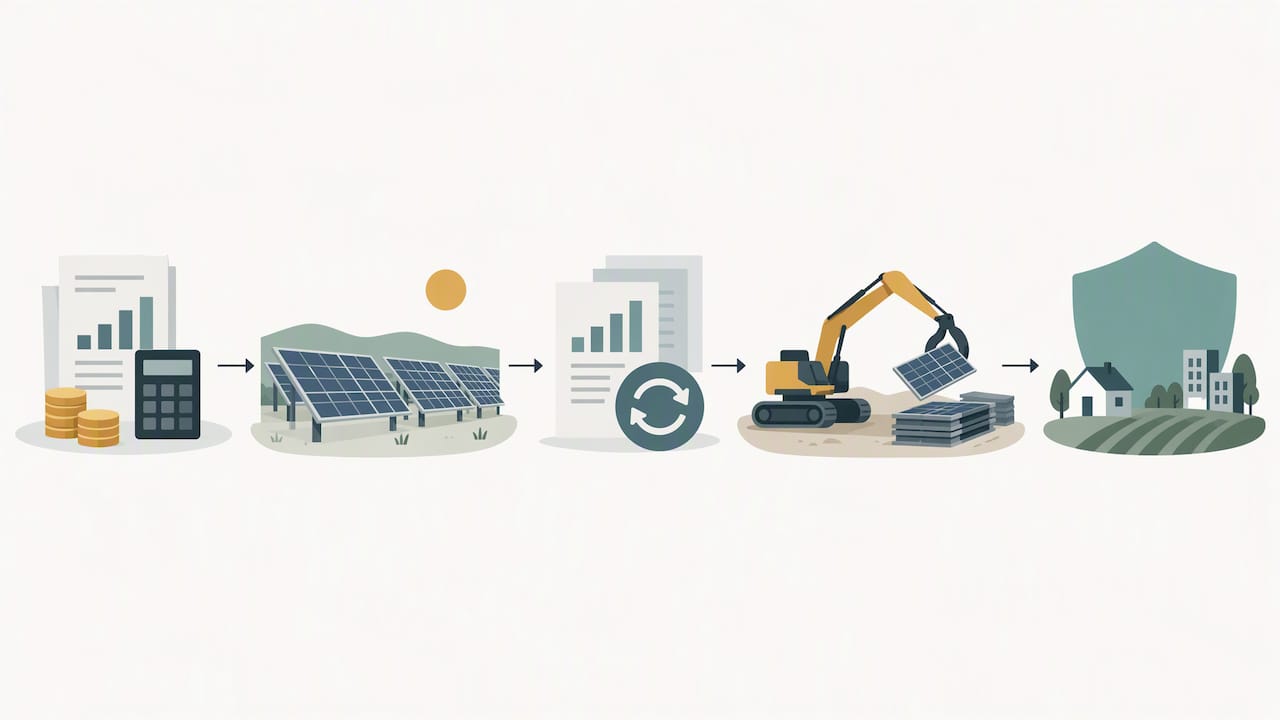
The hazardous-waste decision deserves the same discipline. A documented determination, a signed contract with a reputable recycler, and a clean paper trail are worth far more than a few dollars saved on testing. Independent cost estimates also protect you: they show a regulator that the number was not tuned to look small.
Where we land is simple: the projects that get into trouble are the ones that treat the plan as a filing and not a working document.
How we help with panel recycling, transport, and documentation
When your plan reaches the point of moving material, we help you finish the job with a paper trail a regulator will accept. We offer solar panel collection and recycling for businesses, alongside our wider recycling services and IT asset recovery, so one team can handle the panels and the electronics that come off the same site.
Here is how we work with you:
- Request a quote describing your site, panel count, and timeline.
- We schedule pickup and coordinate handling that respects hazardous-waste rules where they apply.
We may be a good fit when you need on-site handling, logistics that account for hazardous-waste requirements, or documentation your regulator will ask for. Pricing is available on request.

Ready to line up recycling for your project? Request a quote and tell us your site details and removal window.
FAQ
Why are people getting rid of their solar panels?
Most panels leave service because the system reaches the end of its performance period, which for PV systems is typically 20–30 years. Others come down for repowering, damage, or site redevelopment. Planning for these options early keeps reuse and recycling on the table.
What is the 33% rule in solar panels?
Rules of thumb vary by jurisdiction, so rely on your permit conditions and your state’s published requirements instead of a general percentage.
How much does it cost to decommission solar panels?
Cost depends on site access, geography, and disposal fees, and the industry lacks standard benchmarks. One New York snapshot reported an average estimate of about $50,000 per MW-ac before contingencies or salvage. Get a site-specific independent estimate for your plan.
Do panels have to be tested before disposal?
Yes, generators must make a hazardous-waste determination before disposal. EPA says panels failing the TCLP must be managed as hazardous waste. Keep the test results with your closeout records.
How often must the plan be updated?
Many programs require updates to the plan and assurance amount about every five years, and North Carolina’s statute says so explicitly. Check your own permit for the exact interval.
Sources
- Nccleantech
- Epa
- DECOMMISSIONING PLAN GUIDANCE FOR SOLAR, ENERGY STORAGE, AND WIND GENERATING FACILITIES PERMITTED BY THE MINNESOTA PUBLIC UTILITIES COMMISSION
Where to find your regulator’s requirements
Start with the primary sources, since requirements differ by jurisdiction. EPA’s solar panel recycling page and DOE’s end-of-life management resources cover federal guidance, and the state programs cited above show how permit authorities write their rules. Confirm your obligations with your permitting authority or legal counsel.