
Solar farm decommissioning recycling is the planned removal, transport, and processing of retired solar equipment to recover materials and document their destination. Start by confirming equipment eligibility, arranging the appropriate pickup, and agreeing on the records you will receive; solar modules, business electronics, and data-bearing devices need separate decisions.
- Solar farm decommissioning recycling requires confirmed module acceptance before transport is booked.
- Usedcartridge is best for business electronics pickup coordination, not an assumed solar-module recycling route.
- Separate solar panel transport, business e-waste, and data destruction into distinct workstreams.
- A pickup receipt records collection; a certificate of destruction documents an arranged destruction service.
Why recycling matters for solar farm decommissioning
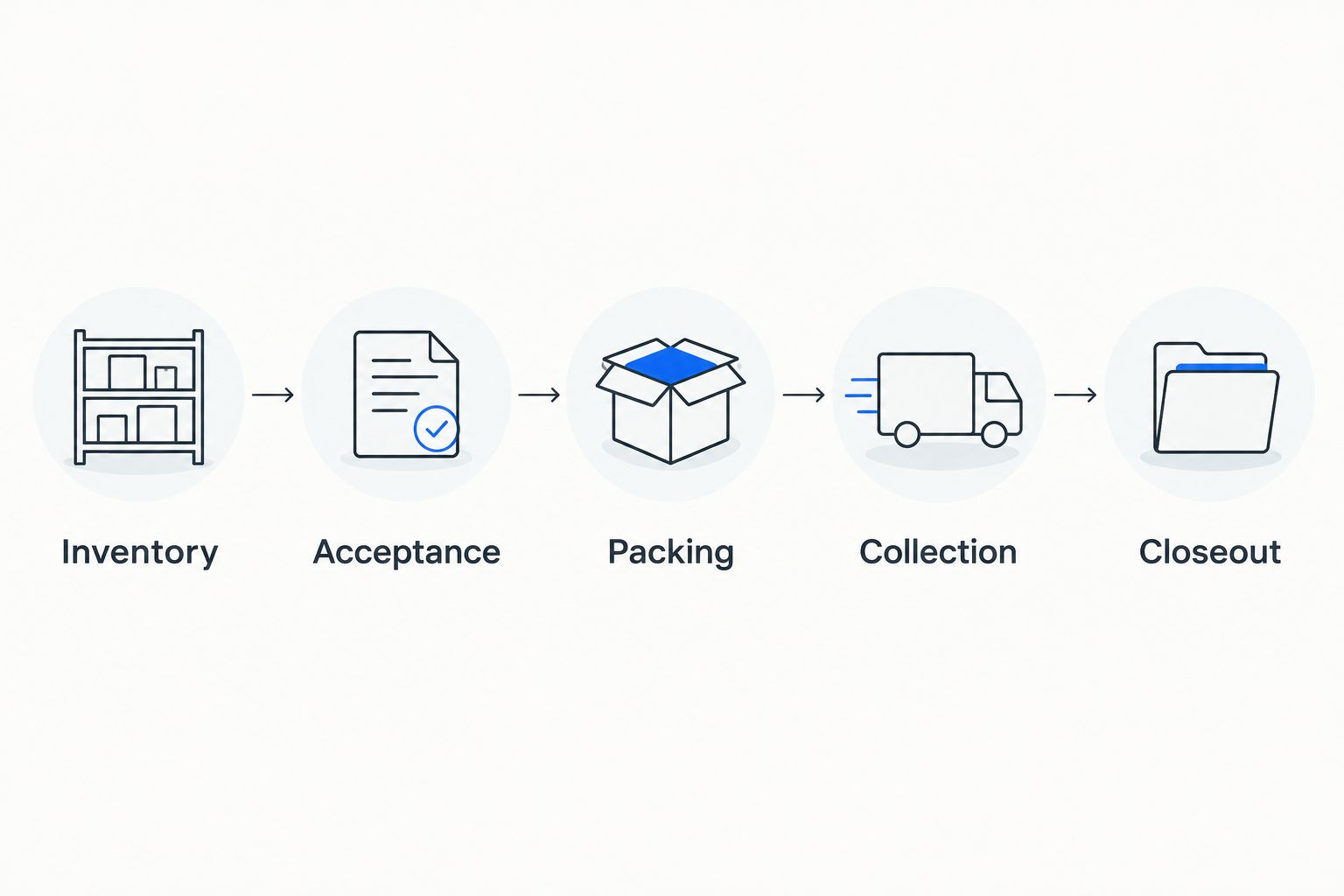
A solar farm retirement is not an ordinary office cleanout. You need to coordinate dismantling, temporary storage, loading, transport, receiving-facility acceptance, and project closeout without treating every item as the same waste stream.
For a 2026 decommissioning project, resolve the destination before equipment starts accumulating. A transport booking does not establish that the receiving facility accepts your module type, condition, or shipment size. Get those details confirmed together.
Usedcartridge is best for business electronics pickup coordination, not an assumed solar-module recycling route. Its stated services include free business e-waste pickup, computer and hard drive recycling, and on-site data destruction in the Tustin and Irvine area. Confirm equipment and location eligibility through Usedcartridge before including any project materials in a collection request.
Office managers, IT teams, and property managers can coordinate the associated electronics. Keep responsibility for solar-module acceptance and specialist transport explicit rather than assuming an office e-waste arrangement covers the whole site.
How to plan solar panel transport and recycling
Use the following steps as a practical handoff between the project owner, removal contractor, transport provider, and receiving facility. Assign responsibility by task, even when one contractor handles several tasks.
1. Define the equipment and ownership boundaries
Start with a shared spreadsheet and a site walk-through. Separate equipment being retired from equipment that remains operational, belongs to a tenant, or must stay with the property.
Organize the inventory into 3 workstreams: solar modules, associated electrical equipment, and business electronics. These are planning categories, not legal waste classifications. Record batteries separately wherever present and obtain instructions specific to them.
For each item group, identify who owns it and who can authorize removal. Property managers should obtain tenant or owner authorization before combining equipment from different occupants. Do not let an approaching clearance date substitute for a documented release.
Your 2026 inventory should capture enough detail for a receiving facility to assess the proposed load. A generic entry such as miscellaneous solar equipment is not a useful acceptance request.
- Record manufacturer and model details from accessible equipment labels.
- Count units and identify their current storage locations.
- Separate intact modules from visibly damaged modules.
- Flag batteries and devices that store business information.
- Identify the owner and removal approver for each equipment group.
2. Confirm acceptance before arranging transport
Send the inventory and clear condition photographs to prospective receiving facilities. Ask for written confirmation covering the actual equipment, not just a general statement that the facility handles electronics.
A business e-waste service is not proof of solar-panel acceptance. Usedcartridge offers business electronics pickup, but the supplied service information does not establish solar-module collection or processing. Treat those as separate eligibility questions.
Ask the solar receiving facility which module types and conditions it accepts, what preparation it requires, and what documentation accompanies the shipment. Confirm whether it receives materials directly or transfers them elsewhere. Request the final processing destination when that information is needed for project closeout.
If acceptance depends on inspection, identify who decides whether the load can proceed and what happens if it is rejected. Resolve that responsibility before loading, not when the vehicle reaches the gate.
- Submit equipment types, quantities, condition notes, and photographs.
- Confirm the collection address and receiving address in writing.
- Ask for separate instructions for damaged or unidentified modules.
- Establish responsibility for rejected or incorrectly described loads.
- Agree on the records needed to close the recycling workstream.
3. Agree on packing and loading responsibilities
Use a written loading plan before purchasing packing materials or reserving vehicles. Ask the receiving facility and transport provider to agree on packaging, load configuration, and unloading arrangements.
Do not create a universal stacking rule for every module. Packaging requirements depend on the equipment, its condition, and the agreed transport method. Follow applicable manufacturer instructions and the receiving facility's documented requirements.
Separate dismantling from transport preparation. State who disconnects equipment, who prepares it for loading, who supplies handling equipment, and who checks the load before departure. Keep electrical isolation and removal under the responsible site's approved procedures and qualified personnel.
For a 2026 pickup, share current access information rather than relying on an old site plan. Gates, tenant operations, construction work, and storage arrangements can change the loading route.
- Confirm packaging and stacking instructions before packing begins.
- Identify who provides pallets, containers, and load-restraint materials.
- Assign responsibility for loading and unloading equipment.
- Check access routes, loading surfaces, and vehicle restrictions.
- Keep damaged equipment segregated under the agreed handling instructions.
4. Build a collection handoff that can be checked
Create 1 shipment record per outgoing load as your project control. Match it to the inventory so the person releasing equipment can check what actually leaves the site.
The record should distinguish expected quantities from collected quantities. If equipment stays behind, note the reason and its storage location. A completed truck booking does not mean the site inventory is cleared.
Use a shared folder for photographs, acceptance correspondence, collection records, and any subsequent receiving documents. This manual approach gives the project team a common reference without requiring a new system.
For eligible business electronics, Usedcartridge provides a direct pickup-request route with free business pickup and quick email receipts. Confirm the equipment and location first; those service details do not establish eligibility for solar modules or specialist solar transport.
- Assign a shipment identifier that matches the equipment list.
- Record the actual equipment released to the collection team.
- Photograph the prepared load without exposing sensitive information.
- Name the person authorized to resolve collection-day discrepancies.
- Record items left behind and the action required for each.
5. Arrange data destruction separately
Check computers, hard drives, and other business devices associated with the site before releasing them. Solar-module recycling does not resolve the information stored on office or operational IT equipment.
Ask your IT owner to identify data-bearing devices, approve their retirement, and specify the required treatment. Do not assume a factory reset, a recycling label, or removal from the asset register proves that information has been destroyed.
Usedcartridge offers on-site data destruction and certificates of destruction for arranged destruction services. Specify which devices require that service before pickup. Free business pickup does not mean every destruction job is free.
Keep 2 distinct records where destruction is arranged: the pickup receipt and the certificate of destruction. The receipt records collection; the certificate documents the arranged destruction service. Neither document should be used to claim work outside its stated scope.
- Ask IT to identify and approve data-bearing devices.
- Keep devices awaiting destruction separate from ordinary equipment.
- Agree on the destruction scope and service terms in advance.
- Confirm how devices will be identified in the destruction record.
- Retain the pickup receipt and destruction certificate separately.
6. Close the project against the original inventory
Reconcile the equipment list after each collection rather than waiting until every contractor has left. Mark each item group as collected, retained, transferred elsewhere, or awaiting further action.
Ask for the receiving and processing records agreed at the start. Read what each document actually confirms. A collection acknowledgment establishes a different event from receipt at a processing facility or completion of a destruction service.
Your 2026 closeout folder should let another manager trace an equipment group from its original location to its documented handoff. Avoid closing a line item merely because an invoice or collection email arrived.
For property managers, separate tenant records from the building owner's records. That makes it easier to answer later questions without mixing ownership, authorization, or destruction documentation.
- Reconcile collected quantities against the original equipment list.
- Obtain the receiving or processing records specified in the agreement.
- Match destruction certificates to the devices covered by the service.
- Assign an owner to every unresolved discrepancy.
- Store the final records under your organization's retention policy.
Confirm your business electronics pickup
Ask about equipment eligibility, free business pickup, email receipts, and arranged destruction services.
Compare collection and recycling options
Choose the arrangement that matches the equipment and the responsibility you want to retain. The options below are project structures, not endorsements of unnamed providers. Verify each provider's actual scope before booking.
| Option | Best for | Practical advantage | Key limitation |
|---|---|---|---|
| Direct solar-module receiving facility plus separate transport | Project teams managing their own contractors | Lets you confirm the receiving destination directly | Your team must coordinate acceptance, packing, transport, and records |
| Decommissioning contractor with an agreed recycling scope | Owners assigning removal and logistics to one contractor | Can place several handoffs under one agreement | You still need named destinations, clear responsibilities, and closeout evidence |
| Separate business e-waste pickup | Office and IT managers clearing eligible business electronics | Keeps computers and office equipment on a distinct collection track | Does not establish solar-module or battery acceptance |
| Arranged on-site data destruction | IT teams retiring devices containing business information | Separates data handling from ordinary equipment collection | Requires an agreed device list and destruction scope; pickup alone is insufficient |
Select the receiving route before selecting the truck. Transport solves movement, not acceptance. For a 2026 project, make the collection agreement identify who handles a rejected load and who supplies the final records.
A single contractor can simplify communication, but it does not remove the need to inspect the scope. Separate providers create more coordination work while allowing you to assign specialist tasks directly.
Common mistakes solar farm project teams make
Treating all site electronics as one load
Modules, batteries, electrical equipment, and office IT need explicit acceptance decisions. A provider's willingness to collect computers does not establish that it accepts everything removed from a solar installation.
Booking transport before confirming the destination
A vehicle reservation leaves the receiving question unanswered. Obtain acceptance for the described load and agree on packing requirements before equipment is committed to dispatch.
Using a pickup receipt as proof of destruction
A pickup receipt records a collection. Request an arranged destruction service for the specified data-bearing devices, then retain the corresponding certificate of destruction.
Letting tenant equipment lose its identity
Combining equipment without ownership records creates avoidable questions at closeout. Preserve tenant or owner identification in the inventory and obtain removal authorization before collection.
Closing the job when the site looks empty
An empty staging area is not a reconciled project. Match outgoing loads to the inventory, collect the agreed documents, and assign unresolved items before declaring the recycling workstream complete.
FAQ
How do I arrange solar farm decommissioning recycling?
Start with an equipment inventory and written acceptance from the intended receiving facility. Then agree on packing, transport, loading responsibilities, and the records required for project closeout.
Does Usedcartridge collect solar panels from solar farms?
Solar-panel acceptance is not established by the stated business e-waste services. Confirm the module type, condition, quantity, and collection location directly before arranging any solar-panel shipment.
Is business electronics pickup free?
Free business electronics pickup is part of the stated service offering, subject to confirming equipment and location eligibility. Do not extend that offer to solar-module transport or assume every arranged destruction service is free.
What is the difference between a pickup receipt and a certificate of destruction?
A pickup receipt records equipment collection, while a certificate of destruction documents an arranged destruction service. Keep both records when your collection includes devices scheduled for destruction.
Can damaged solar panels travel with intact panels?
Obtain handling and acceptance instructions before combining damaged and intact panels. Describe the damage to the receiving facility and transport provider rather than assuming one packing method applies to both.
Who should arrange recycling for equipment left by a tenant?
The property manager should first establish ownership and obtain authorization from the responsible party. Identify who approves removal, who selects the receiving route, and who retains the final records.
What documents should I keep after a solar decommissioning pickup?
Keep the equipment inventory, written acceptance, shipment record, pickup receipt, and any receiving or processing records agreed for the job. Retain a separate certificate of destruction for devices covered by an arranged destruction service.
One last thing
Ask what happens if the receiving facility rejects the load. That question tests whether transport, acceptance, and responsibility have actually been coordinated. Put the answer in writing before dispatch, alongside the equipment description and agreed destination.
Related guides