
Discarded solar panels are classified as solid waste under federal law, and they become hazardous waste only if they fail a specific test, most often the toxicity characteristic measured by the Toxicity Characteristic Leaching Procedure. The EPA and DOE confirm that no federal universal waste category exists yet, so the generator, not the installer or the recycler, carries the legal duty to make that call.
TL;DR:
- Use manufacturer specifications or prior test results to document a panel model’s hazardous status; if neither is available, test a representative sample with TCLP.
- Check every state where panels are generated, stored, or shipped: California and Hawaii already include them in universal waste programs, but federal rulemaking remains proposed.
- Hazardous panels can use the transfer based exclusion only when the receiving recycler qualifies under the destination state’s rules; verify its status before shipping.
- Nonhazardous landfill disposal typically costs $30 to $70 per ton, while recycling costs more and domestic capacity may not handle large projects promptly.
Table of Contents
- How RCRA treats discarded solar panels and when they become hazardous waste
- Toxicity testing and generator knowledge: how to determine hazardous status
- State-level differences and the EPA universal waste rulemaking status
- Recycling, transfer-based exclusion, reuse pathways, and landfill disposal rules
- Costs, capacity constraints, and practical steps U.S. organizations should take now
- How Recycle for Life helps U.S. organizations classify and manage EOL solar panels
- Handling and classification of solar panel components separately
- Best practices for solar panel waste storage and transportation to recycling facilities
- Impact of international regulations on solar panel waste classification relevant to cross-border recycling
- Emerging technologies and methods for solar panel recycling and waste recovery
- The compliance-first case for planning end-of-life now
- How Recycle for Life can help: compliant collection, documented destruction, and audit-ready documentation
- FAQ
- Sources
How RCRA treats discarded solar panels and when they become hazardous waste
Under the Resource Conservation and Recovery Act, a solar panel becomes solid waste the moment its owner discards it, whether that means pulling it off a roof after storm damage or retiring an array at the end of its service life. Solid waste only crosses into hazardous waste territory if it exhibits one of four characteristics defined by RCRA: ignitability, corrosivity, reactivity or toxicity.
Toxicity is the characteristic that matters most for panels, because many contain lead or cadmium compounds in small quantities that can leach under acidic conditions. That leaching potential, not the mere presence of the metals, determines hazardous status.
The generator, the party who decides the panel is waste, carries the legal responsibility for that determination. This can be:
- A utility retiring a commercial solar farm
- A school district replacing rooftop panels after a renovation
- A commercial property owner clearing damaged units after a storm
A panel pulled for legitimate reuse, resale or refurbishment generally stays outside the discarded category altogether, since it has not yet been abandoned or disposed of.
Toxicity testing and generator knowledge: how to determine hazardous status
The TCLP simulates how a material behaves in a landfill by exposing a sample to a mild acid and measuring how much of each regulated metal leaches out. For panels, lead and cadmium are the elements most commonly checked against the federal thresholds.
Generators do not always need a lab test. EPA guidance allows the determination to rest on documented generator knowledge, such as manufacturer specification sheets or prior test results for the same panel model, instead of running TCLP on every batch. The risk sits in skipping both steps: an organization that assumes panels are nonhazardous without any supporting record can face penalties if an inspector disagrees with that assumption later.
A simple sequence keeps a generator defensible:
- Pull the manufacturer’s data sheet or any existing TCLP results for the panel model.
- If no usable record exists, send a representative sample for TCLP testing.
- Log the determination, the date and the evidence used to reach it.
- Keep that file with other hazardous waste records for the retention period your state requires.
Pro Tip: Request TCLP data from the panel manufacturer before decommissioning begins, since many manufacturers already hold results for their own product lines.
State-level differences and the EPA universal waste rulemaking status
Federal rules set the floor, but several states have already moved further. EPA notes that states including California and Hawaii run their own universal waste programs that already cover solar panels, ahead of any federal action. States that have adopted the transfer-based exclusion found in 40 CFR 261.4(a)(24) into their own regulations let recyclers handle hazardous panels without full RCRA Subtitle C permitting, but that adoption is not uniform nationwide.
At the federal level, EPA has proposed rulemaking to add solar panels to the universal waste program under 40 CFR Part 273, which would streamline storage time and paperwork for generators once finalized. That proposal is not yet law.
Organizations operating across multiple states should treat this patchwork as a floor-raising exercise:
- Identify every state where panels will be generated, stored or shipped
- Check whether that state has a universal waste designation or adopted exclusion
- Apply the strictest applicable standard as the internal baseline for every site
Recycling, transfer-based exclusion, reuse pathways, and landfill disposal rules
Three lawful pathways exist for end-of-life panels: legitimate reuse, recycling under an exclusion, or landfill disposal when the panel is nonhazardous. The transfer-based exclusion under 40 CFR 261.4(a)(24) lets a generator send hazardous panels to a qualified recycler without triggering full hazardous waste permitting, provided the recycler actually operates under that exclusion in the state receiving the shipment.
Legitimate recycling requires the material to be put to genuine productive use, not stockpiled indefinitely or diluted to mask contamination. Landfill disposal remains lawful when the panel either passes TCLP or when generator knowledge documents it as nonhazardous.
Before shipping anything, a generator should:
- Confirm in writing that the receiving facility accepts solar panels under the specific exclusion claimed
- Request the recycler’s permit or exclusion documentation for the destination state
- Preserve shipping records and any certificates of recycling or destruction
- Avoid any broker that cannot name the final processing facility
Our solar panel disposal laws guide walks through these generator obligations in more detail for organizations building an internal policy.
Costs, capacity constraints, and practical steps U.S. organizations should take now
Landfill disposal of nonhazardous panels typically costs between $30 and $70 per ton, while recycling costs more because specialized separation of glass, metal and semiconductor material is still a maturing process. DOE projects cumulative U.S. PV waste is expected to increase significantly by 2030, a volume that current domestic recycling capacity is not yet built to absorb at scale.
Organizations planning a large decommissioning event should build in lead time to locate a recycler with available capacity rather than assuming same-week pickup.
A short action checklist keeps a project compliant from start to finish:
- Inventory every panel by model, quantity and physical condition.
- Test or document hazardous status before scheduling removal.
- Confirm the receiving recycler’s exclusion or permit covers your state.
Our electronics disposal planning resource covers the broader scheduling and documentation workflow for organizations managing a large retirement event.
How Recycle for Life helps U.S. organizations classify and manage EOL solar panels
Our solar panel collection service is designed to address key decision points generators face: whether a panel is hazardous, where it can legally go, and what paperwork proves the choice was sound. We coordinate pickup and compliant transport to EPA-registered, DTSC-regulated downstream facilities.
When working with clients, we request information on panel count, model and condition at each site, any existing manufacturer or TCLP data available, and the site locations and states involved, since requirements vary. We then provide a Certificate of Recycling. Our step-by-step disposal guide outlines the full process we follow on every job.
Handling and classification of solar panel components separately
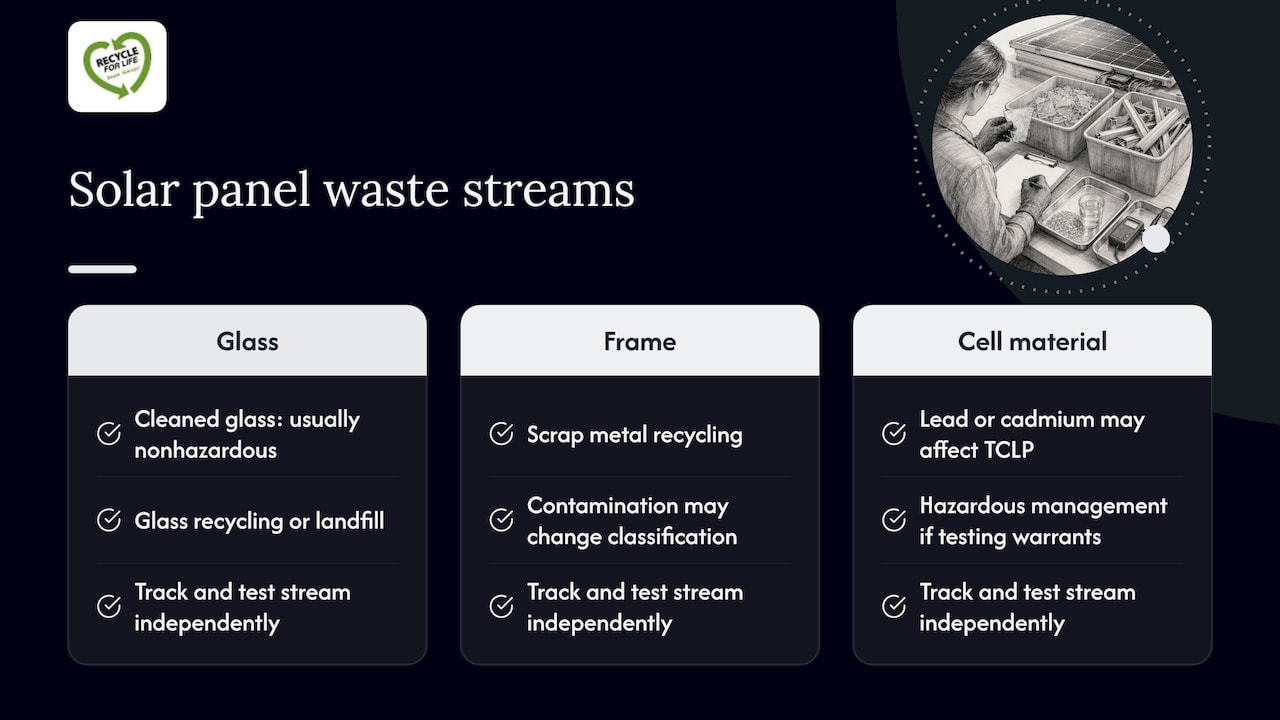
A solar panel is not one material, it is a laminate of several layers that each carry different waste classification implications once separated. Glass typically makes up the majority of a panel’s mass and, once cleaned of other materials, usually qualifies as ordinary nonhazardous waste suitable for standard glass recycling or landfill disposal.
The metal frame and junction box wiring are generally recyclable as scrap metal, following ordinary scrap channels rather than hazardous waste rules, unless visible contamination suggests otherwise.
The layer that drives most hazardous determinations is the semiconductor and encapsulant material sandwiched between the glass sheets. Crystalline silicon cells themselves are not typically a toxicity concern, but older cadmium telluride modules and the solder connections in many panel types can contain lead or cadmium in quantities relevant to TCLP thresholds. This is why a generator cannot classify an entire pallet of mixed panel models with one blanket assumption: panel chemistry varies by manufacturer and manufacturing era, and a thin-film cadmium telluride module carries a different risk profile than a standard crystalline silicon module.
Recyclers that separate these streams mechanically, destruction glass and frame from the cell layer, can often divert the bulk of a panel’s mass to nonhazardous recycling streams while routing only the concentrated cell material through hazardous waste management when testing confirms it is warranted. Generators working with a recycler should ask how the facility separates these streams and whether each resulting stream is tracked and tested independently rather than treated as a single undifferentiated waste.
Best practices for solar panel waste storage and transportation to recycling facilities
Panels awaiting removal or shipment should be stored intact wherever possible, since breakage increases the chance of leaching and complicates testing. Stack panels vertically on edge using padded racks or the original shipping crates rather than laying them flat and stacked, which risks cracking the glass under weight.
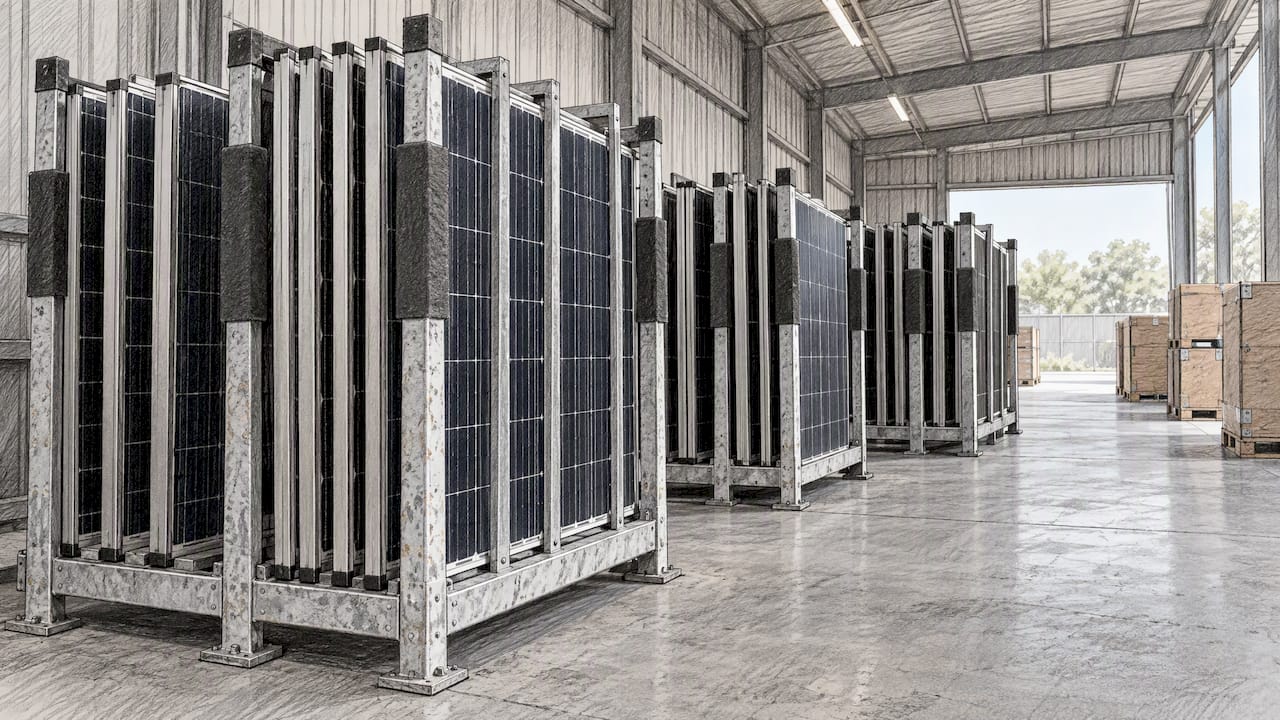
Cover outdoor storage to keep rainwater from pooling against broken units, and separate any known-damaged panels from the intact inventory so they can be tested or managed independently. Label storage areas and containers with the generator’s hazardous waste determination status so staff and inspectors can see at a glance whether a batch has been cleared as nonhazardous or is awaiting disposition.
Accumulation time limits apply to hazardous waste under RCRA, so organizations storing panels pending a determination should track how long material has been on-site and avoid drifting past the applicable limit for their generator category.
Pack panels for transport the way they were shipped new when possible, using edge protection and secured pallets to prevent the cracking that turns an easily recyclable panel into a damaged one requiring closer scrutiny.
Impact of international regulations on solar panel waste classification relevant to cross-border recycling
U.S. generators occasionally encounter international rules when panels or recovered materials cross borders, whether through an export-oriented recycler or a multinational organization decommissioning sites in more than one country. The European Union’s approach, which folds solar panels into its broader electronic waste producer-responsibility framework, is considerably more prescriptive than the U.S. federal approach and requires manufacturers to fund collection and recycling directly.
That divergence matters practically because a recycler or broker that also handles international volume may apply different sorting or documentation standards depending on destination, and a U.S. generator shipping panels to a facility with export operations should confirm which standard actually governs their material. The Basel Convention’s rules on transboundary shipment of hazardous waste can also apply if panels classified as hazardous are exported for recycling, adding another layer of documentation beyond domestic RCRA manifesting.
For most U.S. organizations managing domestic decommissioning, international rules remain a background consideration rather than a daily compliance concern, but any organization working with a recycler that ships materials overseas should ask directly whether that export triggers additional notice or consent requirements.
Emerging technologies and methods for solar panel recycling and waste recovery
Recycling technology for panels is still maturing, and the methods available today fall into three broad categories. Mechanical recycling, the most widely deployed method, destroys and separates glass, metal and plastic components, recovering the bulk of a panel’s mass but typically losing most of the silicon and silver content to lower-value byproducts.
Thermal and chemical delamination processes aim to separate the encapsulant layer from the glass and cells more cleanly, allowing recovery of higher-purity silicon and metals, though these methods remain more expensive and less widely available at commercial scale than mechanical destruction. DOE’s end-of-life research notes that recovering silicon and silver economically remains technically difficult, which is part of why recycling costs still exceed landfill fees for most generators today.
A newer area of development involves automated sorting systems that use optical or chemical sensing to identify panel chemistry before processing begins, letting a facility route cadmium telluride modules differently from crystalline silicon modules without manual inspection of every unit. As this sorting technology matures and recovery processes improve, the economics of panel recycling are expected to shift, though for now most domestic facilities rely primarily on mechanical separation supplemented by selective testing.
The compliance-first case for planning end-of-life now
Organizations that wait until a panel array fails to think about disposal end up making rushed, poorly documented decisions under time pressure. Planning the classification and disposal pathway months ahead, before any panel is physically removed, gives an organization time to gather manufacturer data, vet a recycler’s exclusion status and avoid storage violations. Conservative, well-documented classification is the cheapest insurance against a difficult inspection.
How Recycle for Life can help: compliant collection, documented destruction, and audit-ready documentation
We handle the parts of this process that create the most risk for busy facility teams: collection logistics, compliant transport and the certificates an auditor will eventually ask for. Our solar panel collection service pairs with our broader IT asset recovery and data destruction work, so organizations managing a mixed decommissioning project can consolidate everything under one documented process.

To request a quote, provide your panel count, locations, and any existing test data you have on hand. Get started with a compliance quote whenever you are ready to move forward.
FAQ
What happens to solar panels at the end of their life?
A retired panel becomes solid waste under federal law, and the generator must determine whether it also qualifies as hazardous waste, typically through TCLP testing or documented generator knowledge, as EPA guidance explains. From there, the panel moves to reuse, a recycler operating under the correct exclusion, or a landfill if it is nonhazardous.
What waste categories are considered universal waste?
Federal universal waste currently covers five established categories, and solar panels are not yet one of them, though EPA has proposed rulemaking to add them. Some states, including California and Hawaii, already treat solar panels as universal waste under their own programs ahead of any federal change.
How are solar systems rated?
This question falls outside solar panel waste classification, which concerns how retired panels are tested and categorized under RCRA rather than how system performance or output is rated. For disposal purposes, what matters is the panel’s hazardous waste determination, not its power rating.
Are solar panels recycled?
Yes, panels can be recycled through facilities that separate glass, metal and cell material, though DOE notes that recycling currently costs more than landfill disposal and domestic processing capacity is still limited. Many generators rely on the transfer-based exclusion to route hazardous panels to a qualified recycler without full hazardous waste permitting.
Sources
- End of life solar panels: regulations and management | US EPA
- End-of-life management for solar photovoltaics | U.S. Department of Energy