
Under SEC Rule 2-06, audit workpapers and related records must be retained for seven years from the conclusion of the audit or review. The rule covers memos, emails, spreadsheets, and any electronic record containing conclusions, opinions, or analyses tied to the engagement. Records must be stored securely to prevent tampering, remain untouched during any legal hold, and destruction should only occur after the required retention period has expired and no legal hold is in effect. Willful destruction invites criminal exposure under federal obstruction statutes.
TL;DR:
- Records created or received during an audit, including drafts, emails, spreadsheets, and logs, must be retained for a strict seven years from audit conclusion.
- Storage must be immutable, leveraging WORM technology, hashing, access controls, and encryption to maintain record integrity and prevent tampering.
- Legal holds must be issued promptly at the moment litigation or investigation is foreseeable, suspending destruction and requiring thorough documentation.
- Physical media containing audit records must follow a documented chain-of-custody and be destroyed only after the retention period expires and no legal hold is in effect.
- An effective enterprise SOX retention program involves comprehensive mapping, automation, regular testing, and documented destruction processes to ensure compliance and avoid criminal penalties.
Table of Contents
- What SOX Data Retention Actually Requires Under the Law
- What Records Actually Fall Under SOX Retention Rules?
- How Long Do You Actually Have to Keep SOX Records?
- Storage That Survives an Audit: WORM, Hashing, and Access Controls
- Legal Holds, Destruction Workflows, and Certificates of Destruction
- Turning SOX Retention Rules Into an Enterprise Program
- Where SOX Retention Programs Actually Break Down
- Chain-of-Custody: Closing the Retention-to-Destruction Gap
- 90-Day Action Plan for SOX Data Retention
- Where Secure Destruction Fits Into Your SOX Retention Program
- Sources
What SOX Data Retention Actually Requires Under the Law
Sarbanes-Oxley itself does not spell out a retention period in granular detail. Congress passed the statute in 2002 in response to Enron and WorldCom, and it directed the SEC to write specific rules governing how long audit-related records had to survive. That rulemaking produced Rule 2-06 under Regulation S-X, the regulation that actually carries the operational weight compliance teams cite today.
Rule 2-06 sets a seven-year retention floor for records created, sent, or received in connection with an audit or review of an issuer’s financial statements, running from the date the auditor concludes that engagement. That seven-year window is not a suggestion with wiggle room. It’s the statutory backbone every retention schedule in this space gets built around.
The rule targets accountants and audit firms directly, not the companies they audit. That distinction trips people up constantly. Public companies (issuers) face their own recordkeeping obligations under separate SEC rules and general corporate law, but Rule 2-06’s seven-year mandate is aimed squarely at the accounting firm performing the audit. In practice, though, issuers end up retaining the same universe of records anyway, because auditors request supporting documentation from the client throughout the engagement and because internal audit and legal teams need that same evidence trail for their own defense in litigation or regulatory inquiry.
The Federal Register final rule that implemented Rule 2-06 lays out exactly why the SEC picked seven years and which document categories fall inside the net. It’s worth reading directly if your legal team is drafting policy language, because paraphrased summaries (including this one) lose nuance the primary text preserves.
Layered on top of the SEC rule is PCAOB oversight. The Public Company Accounting Oversight Board sets the auditing standards that govern how documentation gets assembled and finalized in the first place, which matters because you cannot retain a record properly if it was never assembled and locked down correctly to begin with.
A few things every compliance officer should carry into policy drafting:
- Rule 2-06’s retention period starts at audit conclusion, not at fiscal year-end or filing date.
- The rule binds the accounting firm, but issuers inherit the same practical retention burden through contractual and evidentiary necessity.
- PCAOB standards govern documentation completion, while SEC Rule 2-06 governs retention after completion. They’re two different clocks solving two different problems.
- State-level records laws, tax retention rules, and litigation holds can extend retention well past seven years for the same document, so SOX is a floor, not a ceiling.
That last point deserves its own emphasis. Treating SOX retention in isolation is how organizations end up destroying evidence that a different statute of limitations still required them to keep. A unified retention schedule that reconciles SOX with tax law, industry-specific rules, and discovery obligations avoids that trap entirely, according to the reasoning behind the SEC’s own final rule.
What Records Actually Fall Under SOX Retention Rules?
The test the SEC uses is deceptively simple: was the record created, sent, or received in connection with the audit or review, and does it contain conclusions, opinions, analyses, or financial data material to that engagement? If yes, it’s in scope. That test catches far more than most first-pass inventories assume.
The concrete categories that show up again and again in audit documentation requests include:
- Audit workpapers, including planning memos and risk assessments
- Internal memoranda discussing accounting judgments or estimates
- Emails between the audit team and client personnel about any material issue
- Spreadsheets containing supporting calculations, reconciliations, or models
- Signed management representation letters and authorizations
- System-generated logs and reports pulled as audit evidence
- Correspondence with outside counsel or specialists retained for the audit
Drafts count, not just final versions. A memo that got revised three times because the audit team disagreed with the client’s initial accounting position has to survive in every iteration, because the SEC’s guidance explicitly folds in materials that reflect disagreements or contradict the final conclusion. Deleting the messy middle draft because the “clean” final version exists is exactly the kind of selective retention that draws regulatory scrutiny.
Electronic records get the same treatment as paper. That includes anything living in a general ledger system, a consolidation tool, or a shared drive, provided it meets the connection-to-audit test above.
Pro Tip: Chat messages, Slack threads, and Microsoft Teams conversations between the audit team and finance staff routinely get missed in retention inventories, and that gap is one of the most common findings auditors flag. If your collaboration platform isn’t mapped to a retention class with active archiving turned on, treat that as an open finding today, not a future project.
Ephemeral channels are where most retention programs actually fail, not the formal document repositories everyone remembers to lock down.
How Long Do You Actually Have to Keep SOX Records?
The key retention period is set at seven years from the date the auditor concludes the audit or review engagement, according to SEC Rule 2-06. This period typically anchors retention schedules for audit-related materials. But the seven-year window isn’t the only clock running, and getting the sequence wrong causes real compliance gaps.
- Documentation completion comes first. PCAOB auditing standards require the audit firm to assemble a complete and final set of documentation no later than 45 days after the report release date. Nothing gets added to the file casually after that point, and any post-completion changes must themselves be documented, including what changed, who changed it, and why.
- Retention begins at engagement conclusion, not fiscal year-end. Teams sometimes anchor the seven-year clock to the client’s fiscal year close, which is wrong. It starts when the auditor concludes the audit or review, a date usually tied to the report release.
- Accessibility expectations tighten early in the retention window. Related SEC recordkeeping rules for financial records generally expect that records stay quickly retrievable during the first two years, with a practical retrieval service level agreement of 48 to 72 hours being a reasonable internal target even where the rule doesn’t specify an exact number.
- Indexing has to happen at intake, not at audit time. If your record management system can’t tell you in minutes which engagement a document belongs to, you’ve built a retention program that technically complies but functionally fails the moment someone actually needs a file.
Set your internal retrieval SLA tighter than you think you need. Regulators and auditors don’t wait politely while IT hunts through unindexed backup tapes.
Storage That Survives an Audit: WORM, Hashing, and Access Controls
Auditors want proof that a record hasn’t been altered since the day it was created, and the storage architecture is how you deliver that proof. Write Once, Read Many (WORM) storage, or an equivalent non-rewritable format, is the accepted baseline for meeting that expectation, and it’s the approach industry guidance on SOX retention points to consistently.
WORM storage locks a file the moment it’s written. Nobody, including system administrators, can edit or delete it before its retention period expires, short of destroying the underlying media entirely. That immutability is what separates a defensible retention program from a folder structure that merely looks organized.
WORM alone isn’t the whole picture. A resilient setup layers several controls together:
- Role-based access control limiting who can even view, let alone modify, retained records
- Immutable audit logging that records every access attempt, successful or not
- File hashing (SHA-256 or similar) generated at intake and re-verified periodically to prove a file hasn’t been silently altered
- Encryption at rest and in transit protecting records from exposure during the entire retention window
- Separate primary and backup retention policies, since a backup copy that gets overwritten on a 90-day cycle is not a valid substitute for primary retained records
Cloud storage and on-premises infrastructure both work for SOX purposes, and the choice usually comes down to existing IT investment rather than compliance superiority. Cloud platforms with WORM-compliant object storage tiers simplify the immutability piece considerably, while on-prem setups demand more deliberate configuration but give some organizations tighter control over jurisdiction and access. What matters to an auditor isn’t which you picked. It’s whether you can produce a hash-verified, access-logged, unaltered record on request.
One distinction trips up more IT teams than any other: backup retention and compliance retention solve different problems. A nightly backup exists for disaster recovery and typically cycles out on a rolling schedule measured in weeks or months. SOX retention exists for regulatory evidence and has to survive on its own dedicated retention track, independent of whatever your backup rotation policy says.
Legal Holds, Destruction Workflows, and Certificates of Destruction
A legal hold has to go out the moment litigation, a government inquiry, or an internal investigation becomes reasonably foreseeable, not once a subpoena actually lands. Waiting for formal notice before suspending destruction is one of the fastest ways to convert an accidental deletion into a spoliation claim.
Building a defensible hold and destruction process means treating both ends of the record lifecycle with equal rigor:
- Identify the trigger. Legal counsel, not IT and not compliance alone, should own the decision on when a matter becomes reasonably foreseeable.
- Issue the hold notice broadly. Send it to every system owner whose platform might contain relevant records, including collaboration tools and shared drives, not just the obvious document repositories.
- Suspend automated deletion rules immediately for any record class covered by the hold, and confirm the suspension actually took effect rather than assuming it did.
- Route destruction requests through a named approval authority once a record’s retention period expires and no hold applies.
- Log the review that confirmed no active hold covers the record before destruction proceeds.
- Generate and retain a certificate of destruction documenting what was destroyed, when, by whom, and under what authority, an approach TechTarget’s compliance guidance treats as a core step in any defensible retention program.
- Keep the destruction certificate indefinitely, even though the underlying record is gone. The certificate itself is the evidence that disposal happened correctly.
Pro Tip: Test your automated deletion rules in a sandbox environment before they touch production data, and specifically test whether a rule respects an active legal hold flag. A surprising number of retention tools will run scheduled deletion jobs on a hold-tagged record class if the hold status wasn’t wired into the deletion logic correctly. Find that gap in testing, not in a deposition.
For hard drives, backup tapes, or any physical media that once held audit-relevant data, the destruction step needs its own documented chain of custody, a topic worth its own dedicated process rather than an afterthought bolted onto digital retention policy.
Turning SOX Retention Rules Into an Enterprise Program
Regulatory text tells you what to keep and for how long. It says nothing about how to actually build a system that does that reliably across dozens of applications, thousands of employees, and years of accumulated data. That translation work is where most retention programs either succeed quietly or fail publicly during an audit.
Start with a systems inventory that maps every application generating financial or audit-relevant records to a specific record type, and then map each record type to its governing retention period and citation. A general ledger system, an expense management platform, and an internal collaboration tool all need to land in the same master schedule, cross-referenced to the rule that governs each.
Automating classification and lifecycle enforcement is where mature programs pull ahead of manual ones. Auditors increasingly flag manual retention processes as an IT general controls (ITGC) weakness, because manual tagging is inconsistent, undocumented, and impossible to test at scale. An automated policy engine that applies retention classes at the point of creation, logs every lifecycle event, and flags exceptions gives auditors something they can actually test against a control objective.
A simple way to see how the pieces fit together:
| Program element | What it covers | Who typically owns it |
|---|---|---|
| Systems and record inventory | Mapping every application to the record types it generates | IT and compliance jointly |
| Master retention schedule | Consolidated periods with citations (SOX, tax, litigation) | Legal and compliance |
| Automated classification | Tagging records at creation with the correct retention class | IT / records management platform |
| Lifecycle logging | Capturing every access, modification attempt, and deletion event | IT security |
| Legal hold management | Issuing, tracking, and lifting holds across systems | Legal, with IT execution |
| Periodic control testing | Verifying automated rules behave as designed | Internal audit |
| Board and external auditor reporting | Summarizing retention program health and exceptions | Compliance leadership |
Define ownership explicitly for each row. A program where “IT handles retention” as a blanket statement, with no named individual accountable for the legal hold list or the destruction approval chain, is a program that collapses the first time someone asks a specific question during fieldwork.
Periodic testing matters as much as initial setup. Run quarterly spot checks pulling a sample of records nearing their retention expiration and confirming the system correctly identified them as eligible for destruction, correctly checked for active holds, and correctly logged the outcome either way. Report results to the board and to external auditors on a regular cadence rather than waiting for them to ask, because a compliance function that surfaces its own gaps proactively reads very differently to an auditor than one that gets caught by them.
A resource like Usedcartridge’s compliance planning guide for IT disposal can help teams building out the physical-media side of this program, particularly around the point where retained data on aging hardware needs to transition into a documented destruction process.
Where SOX Retention Programs Actually Break Down
Audit findings on retention rarely stem from a single catastrophic failure. They accumulate from small gaps that nobody flagged as urgent until an examiner asked to see a specific email thread from four years ago and nobody could produce it.
The recurring patterns show up across nearly every organization that gets cited:
- Missing evidence for judgment calls. The final accounting position survived, but the memo explaining why the team rejected an alternative treatment didn’t.
- No immutability proof. Records exist, but there’s no hash log or access trail showing they haven’t been altered since creation, so the auditor has no way to verify integrity.
- Uncontrolled deletion rules. A retention policy exists on paper, but the automated deletion job that enforces it wasn’t tested against active legal holds.
- Unmapped ephemeral channels. Chat and messaging platforms used for real audit conversations were never brought under any retention policy at all.
- Backup confused with retention. Records “exist” only on a backup tape that’s scheduled to cycle out in 90 days, which isn’t retention in any defensible sense.
The legal exposure behind these gaps is not abstract. Under 18 U.S.C. § 1519, willfully destroying or altering records to obstruct a federal investigation can carry criminal penalties, including substantial prison time. Section 1520 specifically targets auditors who fail to maintain records as required, with its own separate criminal exposure. These aren’t civil slap-on-the-wrist provisions. They’re federal criminal statutes written specifically because of what happened at Enron, and prosecutors have shown willingness to use them.
If you’ve found one of these gaps in your own environment, the remediation sequence is straightforward: freeze any deletion activity on the affected record class immediately, document the gap and its discovery date, notify legal and internal audit, and build the corrective control before you touch the backlog of at-risk records. Fixing the process before cleaning up the mess prevents the cleanup itself from becoming a second violation.
Chain-of-Custody: Closing the Retention-to-Destruction Gap
Every hard drive, backup tape, or storage array that held SOX-relevant data eventually reaches the end of its useful life, and what happens to that physical media at end of life is where a lot of otherwise solid retention programs quietly fall apart. A record can be perfectly retained digitally for seven years and still create exposure if the original hardware it once lived on gets disposed of without a documented, verifiable process.
Auditors expect a specific chain-of-custody trail for any media that held audit-relevant records. That trail should show who removed the device from service, where it was stored pending destruction, who transported or handled it, and what method destroyed it. A gap anywhere in that chain, a device that disappears from inventory for three weeks before showing up at a recycler, for instance, is exactly the kind of unexplained handoff that turns a routine disposal into a compliance question.
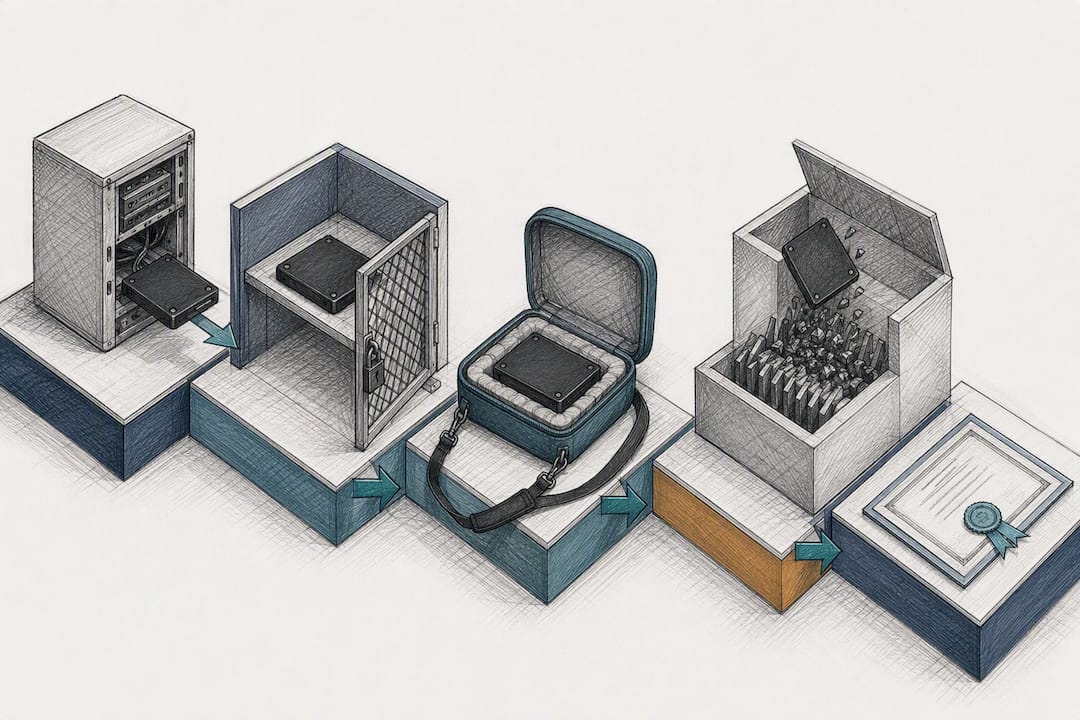
A certificate of destruction should document the specific serial numbers or asset tags destroyed, the destruction method used, the date and location, and the identity of the party performing the destruction. That certificate becomes part of your permanent audit evidence, filed alongside the retention schedule that governed the underlying data, not treated as a disposable receipt.
Timing matters as much as documentation. Physical media holding records still inside their seven-year retention window, or covered by an active legal hold, has to stay in service or in secure storage, full stop, regardless of whether the hardware itself is old or slow. Only after the retention period expires and legal confirms no hold applies should that media move into a destruction queue. Sequencing this wrong, destroying hardware because it’s outdated without checking retention status first, is how organizations accidentally destroy records they were legally required to keep.
A few practical markers worth building into any physical-media retention checklist:
- Confirm retention status and hold status before scheduling any device for destruction
- Maintain a documented chain-of-custody from removal through final destruction
- Require a certificate of destruction naming specific assets, not a generic batch reference
- File certificates alongside the retention schedule as permanent audit evidence
- Verify destruction method matches the sensitivity of the data the device held
Organizations handling this internally often lean on documented wiping verification methods for drives being repurposed rather than destroyed, since sanitization and destruction solve different problems and shouldn’t be treated interchangeably in policy language.
90-Day Action Plan for SOX Data Retention
Here’s the honest problem with most SOX retention programs: the regulation hasn’t changed much in over twenty years, but the volume and variety of data it applies to have exploded. Nobody in 2003 was thinking about Slack threads or cloud object storage tiers. That gap between old rule and new data reality is exactly where I’d focus limited time and budget first.
A 90-day plan that actually moves the needle looks like this:
- Week 1 to 2: Assign a single owner for the retention program overall. Diffuse ownership is the single biggest predictor of a failed audit finding.
- Week 2 to 4: Complete a systems inventory mapping every application to record types generated, including chat and collaboration platforms.
- Week 4 to 6: Consolidate findings into a single master retention schedule with legal citations for each record class.
- Week 5 to 7: Test whether existing automated deletion rules respect legal hold flags. Fix any that don’t before moving forward.
- Week 6 to 9: Deploy or verify WORM storage for core audit documentation repositories, prioritizing anything currently sitting in editable shared drives.
- Week 8 to 10: Implement hash-based integrity checks on a sample of critical records and confirm the verification process actually works end to end.
- Week 9 to 11: Set formal retrieval SLAs, targeting 48 to 72 hours for records inside their first two years.
- Week 10 to 12: Draft the legal hold playbook, naming the trigger authority and the notification distribution list explicitly.
- Week 12: Report status, gaps, and remediation timeline to the audit committee before the next external audit cycle begins.
The single highest-leverage task on that list is the automated deletion rule test in week five. Everything else is policy and infrastructure. That one is the difference between a program that works on paper and one that has actually been proven not to destroy evidence it was supposed to keep.
— Keith
Where Secure Destruction Fits Into Your SOX Retention Program
Retention only works if destruction, when it finally happens, is just as documented as the years of storage before it. Unlike a general records vendor, some specialized providers build processes specifically around the evidence auditors ask for: certificates naming exact assets destroyed, documented chain-of-custody from pickup through final destruction, and on-site destruction options for organizations that don’t want retired hardware leaving the building before it’s rendered unreadable.

That combination matters most in the exact scenario this article has walked through: hardware that held SOX-relevant records for years, is finally past its retention window, and now needs disposal that won’t create a new audit finding out of an old compliance win. Look for a vendor that hands you a certificate naming specific serial numbers, not a generic batch summary, and that can document custody at every handoff point.
If your organization has drives, servers, or backup media sitting past their retention date with no active legal hold attached, request a quote for equipment destruction and get a documented, audit-ready disposal process started before that hardware becomes the next finding on someone’s checklist.
Sources
- Retention of Records Relevant to Audits and Reviews — Federal Register (Final rule)
- Sarbanes-Oxley document management requirements and penalties (LegalClarity)
- 4 steps to remain compliant with SOX data retention policies (TechTarget)