
Compliance in data disposal is defined as the obligation to securely and verifiably destroy data according to legal, regulatory, and organizational requirements. The role of compliance in data disposal extends far beyond deleting files. It requires documented processes, auditable evidence, and accountability at every stage of the asset lifecycle. Frameworks like GDPR, HIPAA, and NIST Special Publication 800-88 set the technical and legal floor. Federal penalties can reach $53,088 per violation, and average breach liability exceeds $10.22 million. Those figures make a strong case for treating data disposal as a core governance function, not an IT afterthought. Certificates of Destruction and chain-of-custody documentation are the evidentiary standard regulators expect.
What are the main regulatory requirements governing data disposal?
Data disposal regulations span federal law, sector-specific mandates, and a growing patchwork of state statutes. Compliance officers must map their obligations across all three layers before designing any disposal program.
Federal and sector-specific frameworks

GDPR applies to any organization handling EU personal data, regardless of where the organization is based. Article 17 creates a continuous “right to be forgotten” obligation, meaning organizations remain liable if personal data is recoverable after a device is discarded. HIPAA requires covered entities to render protected health information unreadable and unrecoverable. The FTC Disposal Rule mandates proper disposal of consumer report information for any business that uses consumer reports. NIST SP 800-88 Rev 2, updated in september 2025, defines three escalating sanitization levels: Clear, Purge, and Destroy. That standard is the primary federal technical reference for agencies and contractors.
State-level complexity
State law adds significant pressure. 47 states impose explicit disposal duties on organizations handling personal information. That near-universal scope means no organization can treat state law as a regional concern. 12 states mandate physical destruction of data-bearing media regardless of data sensitivity, and 7 states, including Massachusetts and Texas, require disposal within 60 days. That 60-day window conflicts directly with typical IT asset disposition cycles, which run 90–120 days. CCPA adds a California-specific layer requiring businesses to honor deletion requests and dispose of data in a manner that prevents reconstruction.
| Regulation | Scope | Key requirement | Timeline |
|---|---|---|---|
| GDPR | EU personal data globally | Verifiable destruction; right to erasure | Ongoing obligation |
| HIPAA | Protected health information | Render data unreadable and unrecoverable | At end of retention period |
| FTC Disposal Rule | Consumer report data | Proper disposal preventing unauthorized access | At end of use |
| CCPA | California residents’ data | Honor deletion requests; prevent reconstruction | Upon verified request |
| NIST SP 800-88 Rev 2 | Federal agencies and contractors | Three-level sanitization: Clear, Purge, Destroy | Per asset decommission |
| State statutes (12 states) | All personal data on physical media | Physical destruction required | Within 60 days in 7 states |
Pro Tip: Build a retention matrix that maps each data category to its governing regulation and required disposal timeline. This single document becomes your compliance anchor for audits and vendor contracts.
Why is compliance governance more than a technical task?
Compliance in data disposal has shifted from a technical IT function to a governance and accountability core. That shift means the compliance officer, not just the IT team, owns the outcome. Regulators now expect verifiable, documented evidence, not internal assurances.
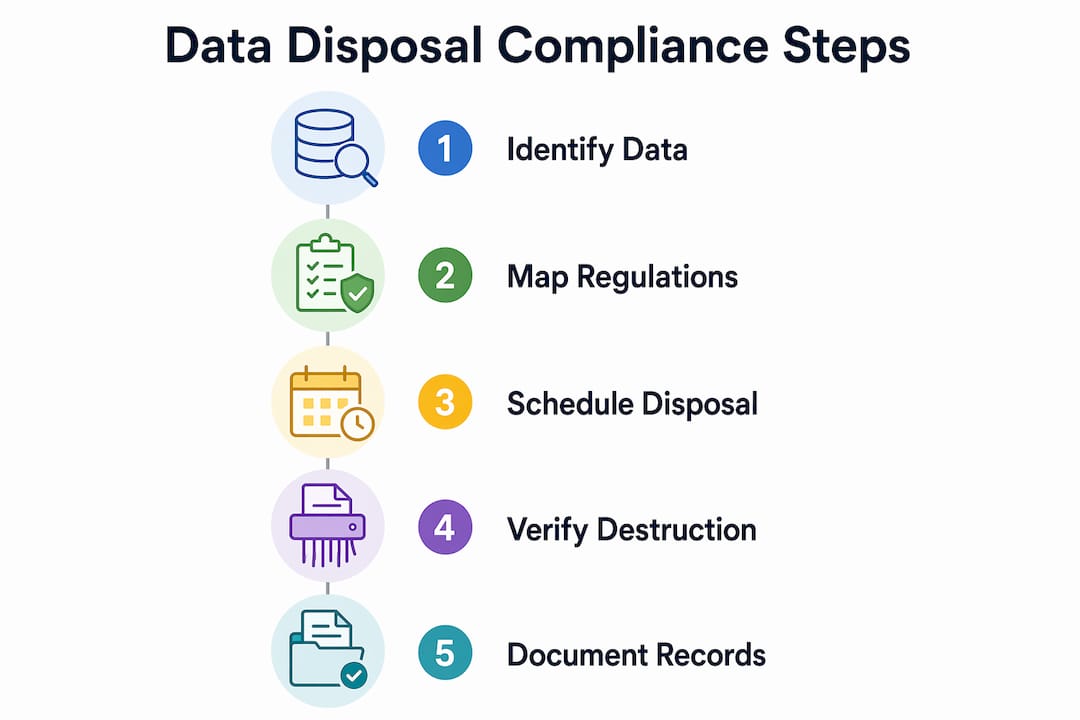
The most common misunderstanding is equating deletion with destruction. Deleting a file removes the pointer to data. It does not overwrite the underlying bits. A forensic examiner can recover deleted files from a drive that was “wiped” using standard OS tools. GDPR auditors and HIPAA investigators know this, and they will ask for proof of physical or cryptographic destruction, not a screenshot of an empty folder.
Governance requires formal policies that define who holds responsibility at each stage. Data stewards classify and flag assets for disposal. IT operations execute the physical or software-based sanitization. Compliance officers verify the process and retain the evidence. Without clear role definitions, accountability gaps appear exactly where regulators look first.
The essential elements of a compliant disposal governance program include:
- A written IT asset disposal policy approved at the executive level
- A defined chain of custody from asset decommission to final destruction
- Certificates of Destruction with dual-signature and custody logs for every asset
- Vendor contracts that specify destruction methods, timelines, and audit rights
- A documented escalation path when assets go missing or timelines slip
- Periodic internal audits and spot checks of vendor performance
Pro Tip: Never accept a vendor’s verbal confirmation of destruction. Require serialized, item-level destruction reports tied to asset tags. That specificity is what makes a Certificate of Destruction legally defensible.
What are best practices for a compliant data disposal program?
Building a defensible disposal program requires structure, not just good intentions. The steps below reflect what regulators actually examine during audits and investigations.
-
Assign disposal roles formally. Designate data stewards for classification, IT operations for physical handling, and a compliance officer for oversight and evidence retention. Document these assignments in writing and update them when personnel change.
-
Build a retention matrix. Link every data category your organization holds to its governing regulation, required retention period, and disposal trigger. Retention matrices tied to regulatory requirements are the foundation of timely, auditable disposal actions.
-
Select destruction methods by data sensitivity. Use NIST SP 800-88 Rev 2 as your technical guide. Clear-level sanitization suits low-sensitivity reuse scenarios. Purge-level covers most enterprise hard drives. Destroy-level, meaning physical shredding or disintegration, applies to classified or highly sensitive media. Review the certified hard drive destruction process to understand what each level looks like in practice.
-
Vet and contract vendors rigorously. Vendor assurances are insufficient without independent audits. Periodic unannounced audits combined with serialized, item-level destruction reporting are the minimum standard for vendor oversight. Embed audit rights directly into vendor contracts.
-
Document every disposal action. Each asset should generate a record that includes the asset tag, serial number, destruction method, date, location, and dual signatures. Timestamps matter. A Certificate of Destruction without a timestamp cannot establish that destruction occurred within a mandated window.
-
Automate classification and deletion triggers where possible. Metadata-driven workflows that flag records for disposal when retention periods expire reduce human error and create a consistent, auditable trail. Manual processes fail under volume.
-
Train staff and run spot audits. Annual training is the floor, not the ceiling. Quarterly spot audits of disposal records catch gaps before regulators do. The electronics disposal planning lifecycle requires ongoing attention, not a one-time setup.
Pro Tip: Schedule at least one unannounced vendor audit per year. Announced audits reveal what vendors want you to see. Unannounced audits reveal what is actually happening on the floor.
How does compliance in data disposal mitigate organizational risk?
Non-compliance with data disposal regulations produces three categories of harm: financial penalties, legal liability, and reputational damage. Each is serious on its own. Together, they can threaten an organization’s viability.
“C-suite leaders must incorporate data destruction into enterprise risk management, understanding that deletion is insufficient without proof and chain of custody.” — Data Center Dynamics
Federal penalties for FTC violations can exceed $53,088 per violation. That figure compounds quickly when a disposal failure affects thousands of records. Average breach liability exceeds $10.22 million when litigation, notification costs, regulatory fines, and remediation are combined. The most frequent compliance failure is a broken chain of custody during asset decommissioning. That single gap is enough to fail an audit or lose a regulatory investigation.
Reputational damage is harder to quantify but equally real. A publicized disposal failure signals to customers, partners, and regulators that the organization cannot be trusted with sensitive data. Recovery from that perception takes years, not months.
Effective compliance controls reduce exposure across multiple risk categories:
- Penalty avoidance: Documented disposal processes demonstrate good-faith compliance, which regulators weigh in enforcement decisions.
- Breach containment: Proper destruction prevents data from being recovered from discarded devices, eliminating a common breach vector.
- Audit readiness: Chain-of-custody logs and Certificates of Destruction give auditors the evidence they need without requiring emergency reconstruction of records.
- Vendor liability management: Contractual audit rights and serialized reporting shift accountability to vendors when destruction failures occur on their end.
- Litigation defense: Timestamped, dual-signed destruction records are admissible evidence that disposal occurred before a breach or complaint was filed.
The importance of data disposal compliance is clearest when you examine what happens without it. Organizations that treat disposal as a low-priority IT task consistently appear in enforcement actions and breach disclosures.
Key Takeaways
Compliance in data disposal requires documented governance, verifiable destruction evidence, and continuous lifecycle management across every jurisdiction where your organization holds personal data.
| Point | Details |
|---|---|
| Penalties are severe | Federal violations can exceed $53,088 per incident, with average breach liability above $10.22 million. |
| State law moves faster than ITAD cycles | 7 states require disposal within 60 days, shorter than the typical 90–120 day asset disposition cycle. |
| Deletion is not destruction | Regulators require proof of physical or cryptographic sanitization, not file deletion records. |
| Chain of custody is the audit standard | Dual-signed, timestamped Certificates of Destruction are the minimum defensible evidence. |
| Vendor oversight requires independent audits | Serialized item-level reporting and unannounced audits are necessary to confirm vendor compliance. |
What I’ve learned from watching compliance programs fail at the disposal stage
Compliance officers spend enormous energy on data collection controls and access management. Disposal gets a fraction of that attention, and that imbalance is where organizations get hurt. I have seen programs with excellent intake procedures and almost no documentation on the back end. When an auditor asks for proof that a decommissioned server’s data was destroyed, “we sent it to a vendor” is not an answer.
The multistate legal patchwork is genuinely difficult to manage. A 60-day destruction deadline in Massachusetts and Texas means your ITAD cycle has to be redesigned, not just acknowledged. Most organizations I have observed are still running 90-day cycles and assuming their vendor handles the compliance gap. That assumption does not hold up under scrutiny.
The shift I find most significant is the move toward continuous lifecycle management of data disposal. Regulators no longer accept the idea that disposal is a one-time event. They expect evidence that your program runs continuously, catches every asset, and produces auditable records without exception. That standard requires automation, trained staff, and executive sponsorship. It is not achievable through manual spreadsheets and good intentions.
My practical advice: treat your Certificate of Destruction program the same way you treat your financial audit trail. Every asset gets a record. Every record gets a signature. Every signature gets a timestamp. If you cannot produce that chain for any asset in your inventory, you have a gap that a regulator will find before you do.
— Keith
Certified data destruction services that meet compliance standards
Organizations that need to close the gap between policy and practice benefit from working with certified providers who deliver verifiable destruction evidence as a standard deliverable.

Usedcartridge offers certified data destruction services designed to meet the evidentiary standards that GDPR, HIPAA, and state disposal laws require. Services include on-site hard drive destruction, IT asset recovery, and e-waste recycling, each supported by Certificates of Destruction with full chain-of-custody documentation. For organizations managing large-scale decommissioning, Usedcartridge provides IT asset recovery quotes with pickup options and serialized reporting. Every service is built to produce the audit-ready records your compliance program depends on.
FAQ
What is the role of compliance in data disposal?
Compliance in data disposal means meeting legal, regulatory, and organizational requirements to securely and verifiably destroy data. It requires documented processes, chain-of-custody records, and Certificates of Destruction that can withstand regulatory audits.
When is compliance needed for data disposal?
Compliance obligations apply whenever an organization disposes of data-bearing assets, including hard drives, servers, and mobile devices. GDPR, HIPAA, the FTC Disposal Rule, and 47 state statutes all impose disposal duties that trigger at the end of a data’s retention period.
Is deleting files sufficient for compliance?
Deleting files does not meet compliance requirements. Regulators require proof of physical or cryptographic sanitization, such as shredding or degaussing, because deleted files remain recoverable through forensic tools.
What documents are required for a defensible disposal record?
A legally defensible disposal record includes a Certificate of Destruction with dual signatures, a timestamped chain-of-custody log, the asset serial number, the destruction method used, and the date and location of destruction.
How do state data disposal laws affect compliance timelines?
Seven states, including Massachusetts and Texas, require data disposal within 60 days of a disposal trigger. That deadline is shorter than the 90–120 day cycles most IT asset disposition vendors operate on, requiring organizations to renegotiate vendor contracts or select providers with faster turnaround.