
Chain-of-custody in electronics is the documented record of who held a device, when they held it, and what happened to it, from the moment it’s pulled from service to the moment it’s destroyed or resold. A credible chain-of-custody (CoC) proves continuous control: no unexplained gaps, no unaccounted handoffs, and a final disposition that ties back to a specific serial number. For an auditor, that means one Lot ID and Asset ID entry in a custody log connects directly to a matching Certificate of Destruction, method and all. If that link breaks anywhere in the chain, you don’t have proof. You have a guess.
Key Takeaways
A defensible chain-of-custody in electronics works only when every Asset ID, seal number, and signature reconciles cleanly to a final Certificate of Destruction.
| Point | Details |
|---|---|
| Define custody clearly | A chain-of-custody record proves continuous control from decommission through final destruction, tied to specific serial numbers. |
| Capture the core fields | Lot ID, Asset ID, seal numbers, timestamps, handler signatures, and verification results must all appear in the log. |
| Match destruction location to risk | Require on-site destruction for high-risk data; off-site is acceptable for lower-risk media with strong vendor documentation. |
| Verify vendor certifications | Confirm NAID AAA, e-Stewards, or R2 certification actually covers the facility and services handling your devices. |
| Choose a vendor built for reconciliation | Usedcartridge ties lot and asset tracking directly to Certificates of Destruction for both on-site and off-site jobs. |
Table of Contents
- Why chain-of-custody matters for compliance and risk
- Core elements of an effective electronics chain-of-custody
- The step-by-step custody workflow, from intake to disposition
- On-site vs. off-site destruction: which one protects custody better?
- What documentation auditors actually check
- Certifications and standards worth requiring from a vendor
- Your implementation checklist for this quarter
- How Usedcartridge builds custody into every pickup
- Sources
Why chain-of-custody matters for compliance and risk
Regulations like HIPAA, GDPR, and GLBA don’t just require you to destroy sensitive data. They require you to prove it happened, on demand, years later. That’s the part organizations underestimate.
Three failure patterns show up again and again: a hard drive goes missing between pickup and processing, a vendor can’t produce a destruction certificate for a specific asset tag, or an internal inventory count doesn’t match what the recycler reports as destroyed. Any one of these turns a routine disposal into an audit finding.
A working chain-of-custody protects against:
- Regulatory fines for unverifiable data destruction
- Contractual penalties from clients or partners who require proof of compliance
- Reputational damage from a breach traced to discarded hardware
- Lost resale value when asset tracking can’t confirm condition or ownership at handoff
Auditors reportedly spend roughly 60% of their review time reconciling certificates of destruction against asset registers. Sloppy IDs or inconsistent method labels are the most common reason that reconciliation stalls.
Core elements of an effective electronics chain-of-custody
A defensible CoC record isn’t complicated, but it does need to be complete. Every entry should include:
- Lot ID and Asset ID/serial number for each device, never reused across shipments
- Intake form with photo documentation at the point of collection
- Tamper-evident seal numbers, logged and photographed at intake and again at dispatch
- Signed transfer records every time custody changes hands
- Sanitization or destruction method and verification result, tied to the specific asset
- Certificate of Destruction reconciled against the asset register
- Retention rules specifying how long records stay on file
Barcode or QR-based ID tracking, paired with time-synced timestamps, removes most of the manual error that creeps into spreadsheet logs. When a seal is broken early or a count doesn’t match, that’s not a reason to skip the paperwork. It’s an exception, and it needs its own record: a CAPA entry with root cause noted, not a shrug.
The step-by-step custody workflow, from intake to disposition
A chain-of-custody SOP that auditors trust follows a consistent sequence, regardless of vendor:
- Decommission and authorization. Someone with the authority to retire the asset signs off before it moves anywhere.
- Intake and loting. Devices get scanned, assigned to a Lot ID, and photographed.
- Secure storage. Assets sit in a locked, access-logged area pending processing.
- Transfer forms for internal moves. Every internal handoff gets a signature, not a verbal confirmation.
- Sanitization or destruction, with verification. The method is recorded, along with tool version and pass/fail result.
- Outbound packaging and transport. Tamper-evident seals go on before the truck leaves.
- Proof-of-delivery and lot closure. The final signature closes the loop and reconciles the count.
At minimum, each asset’s CoC entry needs: Asset and Lot IDs, timestamps, handler names, seal numbers, destruction method, and verification result.
A few operational details separate a workflow that survives an audit from one that doesn’t:
- Keep all logging devices on time-synced clocks so timestamps can’t be disputed
- Photograph seals with the number visible in frame at every handoff
- Require two-person witness sign-off for on-site destruction of high-risk media
On-site vs. off-site destruction: which one protects custody better?
The honest answer is that both work, but they carry different risk profiles. On-site destruction gives you the highest level of control: you watch the shredder run, you sign the certificate before the truck leaves, and there’s no transport gap where custody could break. It costs more, but for classified data, contractual obligations, or anything with serious breach exposure, that cost buys certainty.
Off-site destruction is acceptable for lower-risk media, provided the vendor’s verification controls are strong. The tradeoffs:
- On-site: Highest control, visible verification, higher cost, best for high-risk or contractually restricted data
- Off-site: Requires transport controls, tamper-evident packaging, and stronger reliance on vendor documentation
Pro Tip: If you choose off-site destruction, require a signed transfer record with a photo and the visible seal number at every single handoff, not just the first and last. A gap in the middle of the chain is where most disputes originate.
What documentation auditors actually check
A Certificate of Destruction is only useful if it reconciles cleanly to your inventory. Expect it to include the destruction method, date and time, the specific asset IDs covered, and an authorized signature. Supporting evidence should include intake forms, transfer receipts, photos or video of intact seals, sanitization logs listing tool name and version, a QA reviewer’s sign-off, and proof-of-delivery for outbound shipments.
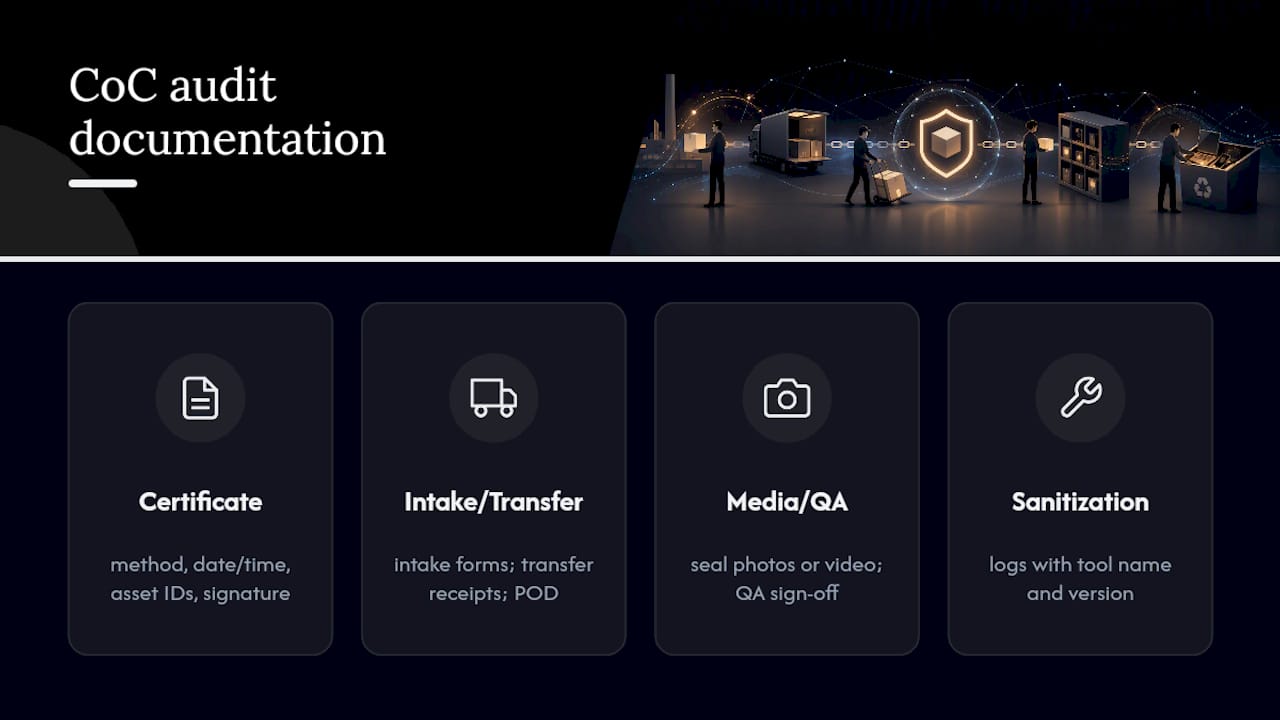
Keeping these as exportable digital logs, indexed by year, client, and Lot ID, beats a filing cabinet of paper every time an audit request lands with a short deadline.
Retention matters too. Common guidance points to keeping CoC logs and Certificates of Destruction for a multi-year retention period, depending on contractual or certification requirements, since auditors organize documentation by control purpose, governance, inventory, sanitization, and vendor management, rather than by date. Matching that structure internally saves real time when a review request arrives.
Certifications and standards worth requiring from a vendor
Not every certification means the same thing, and vendors sometimes lean on the name without the scope actually covering your devices. Ask for:
- NAID AAA certification, which verifies chain-of-custody and destruction process controls
- e-Stewards, which verifies responsible recycling and environmental handling
- R2 (Responsible Recyclers), which verifies ITAD processing controls
Check the certificate’s validity dates, confirm the scope covers the specific facility handling your devices, and request proof of insurance that covers data breach liability, plus SLA language specifying destruction timelines and audit rights.
Your implementation checklist for this quarter
Closing custody gaps doesn’t require a system overhaul. It requires discipline around a short list:
- Classify assets by data sensitivity and set retention or destruction trigger dates
- Assign Lot ID and Asset ID rules that are never reused
- Decide your on-site versus off-site policy by risk tier
- Require tamper-evident seals with photo evidence at every handoff
- Build Certificate of Destruction reconciliation into your process, not as an afterthought
- Schedule periodic vendor audits rather than a one-time onboarding check
When drafting an RFP or vendor contract, require proof of certification such as NAID AAA, stated insurance amounts, right-to-audit clauses, a defined SLA for destruction timing, and a sample Certificate of Destruction format you can test against your own inventory fields before signing anything.
Common pitfalls worth fixing now:
- Missing serial numbers on intake forms
- Reused Lot or Asset IDs across shipments
- Inconsistent method labels between the log and the certificate
Barcode scanning and automated reconciliation fix most of these without adding headcount.
An IT asset disposal provider’s field notes
Auditors don’t ask for a story. They ask for a serial number and want it matched to a signed certificate in under a minute. Reconciliation moves fast when the IDs were never reused and the seal photos exist. Three habits pay off every time: enforce unique IDs at intake, require photo evidence at every handoff, and automate the reconciliation between your asset register and destruction certificates instead of doing it by hand each quarter. The quick win for a busy IT team: start with barcode scanning on intake. It fixes the single most common audit gap.

How Usedcartridge builds custody into every pickup
Usedcartridge is built for the exact gap most organizations hit during an audit: a custody record that doesn’t connect cleanly to a certificate. Every pickup runs on lot and asset-level tracking, tamper-evident sealing, and Certificates of Destruction that reconcile directly to the asset IDs you handed over, whether the job runs on-site or off-site.

That means your team spends less time chasing paperwork after the fact and more time actually running IT operations. Facilities can request on-site destruction for high-risk data or route lower-risk media through certified off-site processing, with the same documentation standard either way. If you’re preparing for a compliance review or just tired of vendors who can’t produce a serial-number-matched certificate, get a quote and schedule a pickup through Usedcartridge’s e-waste logistics services and see what an audit-ready file actually looks like.
Sources
- Decideagree
- ITAD Audit Preparation: Document Your Destruction Program for Compliance Reviews – Disposition Compliance | IT Asset Disposition Guide
Keep a saved copy of each source in your procurement file rather than relying on a live link, and use them during vendor due diligence to confirm a proposed CoC template actually reconciles the way your auditors expect.