
Toner cartridge recycling is the process of collecting used laser printer cartridges and routing them through certified disassembly, cleaning, remanufacture, or material recovery rather than landfill disposal. For U.S. businesses, the EPA recommends manufacturer take-back programs or certified third-party recyclers over curbside disposal. The right partner will carry R2 or e-Stewards certification, provide chain-of-custody manifests, and issue a certificate of recycling or destruction. Usedcartridge offers exactly that kind of audited, documented service for organizations managing bulk volumes.
What to do right now:
- Stop placing used toner cartridges in curbside or office recycling bins.
- Designate a centralized collection point and store cartridges in original packaging or sealed plastic bags.
- Contact a certified recycler that provides manifests, weight-based receipts, and a certificate of recycling.
- Confirm R2 or e-Stewards certification before signing any service agreement.
Table of Contents
- Why toner cartridges don’t belong in your curbside bin
- How professional toner cartridge recycling actually works
- What certifications and documentation to require from a recycler
- Manufacturer take-back vs. third-party recyclers: which fits your organization?
- How to set up a toner cartridge recycling program for your organization
- What drives cost and how long the process takes
- U.S. regulatory and workplace safety considerations
- Key Takeaways
- Why the documentation gap is the real risk in toner recycling
- Usedcartridge handles the compliance work so your team doesn’t have to
- Authoritative sources and resources for U.S. teams
Why toner cartridges don’t belong in your curbside bin
Toner cartridges are composite products built from engineering-grade plastics, metal components, and residual toner powder. That combination is exactly what municipal sorting lines cannot handle. The fine particulate left inside a used cartridge is a respiratory irritant that can contaminate an entire sorting batch and pose real health risks to workers at materials recovery facilities.
The landfill math is also worth knowing. A single toner cartridge can take 450–1,000 years to break down and contributes roughly 3.5 pounds of solid waste. Multiply that across a mid-size office fleet and the numbers add up fast.
Safety callout: Never shake, disassemble, or drop a used toner cartridge into a bin without sealing it first. Residual toner powder is a fine plastic-based particulate classified as a respirable irritant by NIOSH. Handlers should wear gloves and, in high-volume settings, an N95 respirator.
Key materials that make curbside recycling unsuitable:
- High-density polyethylene and ABS plastic housing
- Metal drums, springs, and shafts
- Residual toner powder (carbon black, polymer resin, iron oxide)
- Foam seals and rubber components
How professional toner cartridge recycling actually works
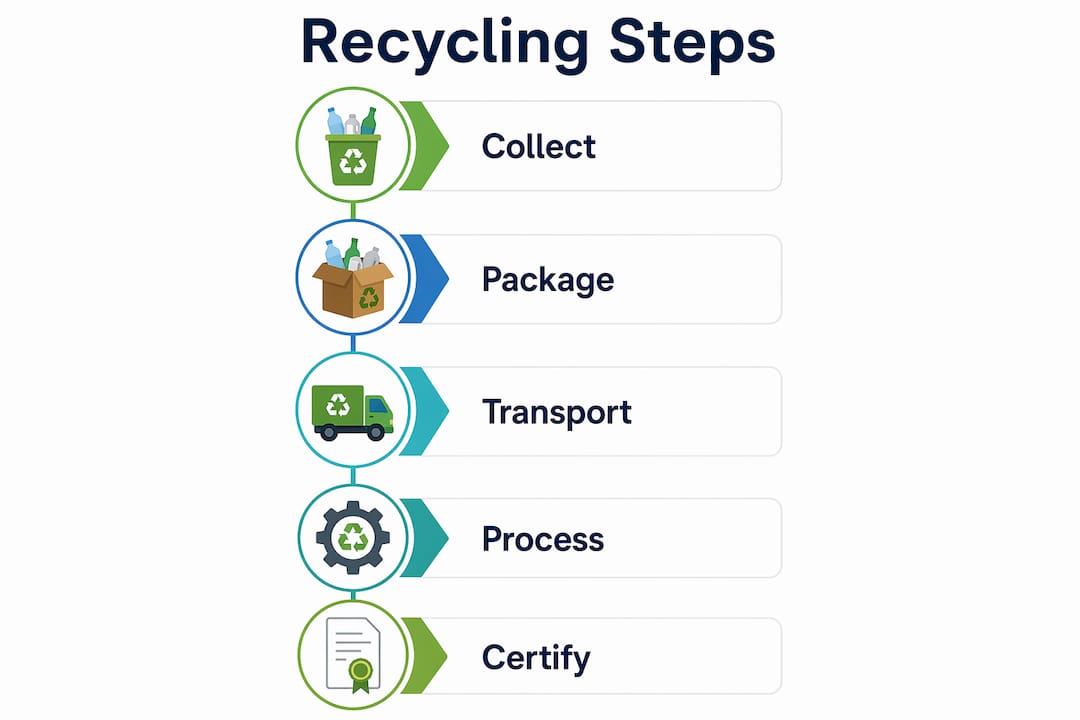
Professional recycling follows a defined chain of custody from the moment a cartridge leaves your facility. Here is the typical flow:
- Centralized collection at the client site, using original boxes or sealed poly bags
- Scheduled pickup or mail-back with a signed manifest documenting quantity, weight, and cartridge type
- Sorting and disassembly at the recycling facility, separating plastics, metals, and toner residue
- Cleaning and toner containment under controlled conditions to prevent airborne particulate
- Remanufacture or material recovery, depending on cartridge condition and program type
The end route matters. Closed-loop remanufacturing disassembles, cleans, and rebuilds cartridges for reuse, reducing raw material demand and keeping components out of the waste stream entirely. Material recovery, by contrast, shreds cartridges and recovers plastics and metals as feedstock. Both are legitimate, but remanufacture carries a lower environmental footprint when quality controls are in place.
| End Route | Best For | Environmental Benefit | Limitation |
|---|---|---|---|
| Closed-loop remanufacture | High-volume, consistent cartridge models | Highest: parts reused, no shredding | Requires strict contamination controls |
| Material recovery (shred/recycle) | Mixed brands, damaged cartridges | Good: plastics and metals recovered | Parts not reused; higher energy use |
| Energy recovery | Severely contaminated or degraded units | Moderate: avoids landfill | Lowest resource conservation |
Pro Tip: Ask your recycler which end route applies to your specific cartridge models before signing a contract. “Recycled” can mean shredded for material recovery, not remanufactured. If remanufacture is your sustainability goal, confirm it in writing.
What certifications and documentation to require from a recycler
Certification is not a nice-to-have for businesses with audit obligations. It is the difference between a defensible compliance record and a liability gap. Centralized procurement and return strategies paired with certified partners produce the audit-ready records regulators and internal auditors expect.
Require all of the following before engaging a recycler:
- R2 (Responsible Recycling) or e-Stewards certification from an accredited third-party auditor
- Chain-of-custody manifest for every pickup, signed and dated
- Certificate of recycling or destruction issued per shipment
- On-site destruction capability for any cartridges containing sensitive print data
- Weight-based or SKU-based receipts for inventory reconciliation
- Final disposition report stating whether cartridges were remanufactured, shredded, or sent to energy recovery
For OSHA compliance, handlers at your facility should follow NIOSH guidance on respirable particulate: sealed storage, no open-air disassembly, and PPE (gloves, dust mask or N95) when handling damaged or leaking units. Your electronics disposal planning process should include a written handling procedure for toner cartridges specifically.
Manufacturer take-back vs. third-party recyclers: which fits your organization?
Three main program types exist, and the right one depends on your volume, brand mix, and reporting requirements.
Manufacturer take-back programs (HP Planet Partners, Canon Laser Return Program) accept only their own brand’s cartridges, typically via prepaid mail-back labels or pallet pickup for large accounts. Canon’s program, for example, emphasizes disassembly and parts reuse with a zero-landfill goal. HP Planet Partners has recycled more than one billion Original HP cartridges through its program. These work well for single-brand fleets with low-to-moderate volume.
Third-party commercial recyclers accept mixed brands, handle bulk logistics, and provide the manifesting and disposition reports that enterprise compliance programs require. For high-volume organizational fleets, scheduled pallet pickup through a dedicated third-party program yields better traceability and lower total operational cost than retail drop-off. This is the right lane for multi-brand environments, large print fleets, or any organization that needs audit-ready documentation.
Retail drop-off (Office Depot, Staples) is practical for small volumes. Office Depot has kept more than 65 million cartridges out of landfills since 2003 through its in-store program. Policies and quantity limits vary by location, so confirm acceptance rules before sending a driver across town with a pallet.
A sustainable corporate print policy should specify which program type applies to each cartridge brand in your fleet, so procurement and facilities teams are not making ad hoc decisions at the bin.
How to set up a toner cartridge recycling program for your organization
- Audit your cartridge inventory. List every printer model, cartridge brand, and approximate monthly volume. This determines whether a manufacturer program, third-party recycler, or hybrid approach makes sense.
- Select a program type. Match your brand mix and volume to the right channel (see the comparison above). For mixed-brand, high-volume fleets, a certified third-party recycler is almost always the better fit.
- Negotiate logistics and documentation. Confirm pickup frequency, manifest format, certificate issuance timeline, and final disposition reporting before signing.
- Train staff. Post handling instructions at every printer station: seal cartridges in original boxes or poly bags, do not shake or disassemble, and bring to the designated collection point.
- Schedule pickups and maintain records. Keep manifests, weight receipts, and certificates of recycling in a dedicated compliance folder. Retain for at least three years, or longer if your state e-waste rules require it.
For packaging specifics: use original boxes when available. When they are not, seal cartridges in plastic bags and box them before transport. Never stack loose cartridges in an open bin.
Pro Tip: Build cartridge return into your procurement cycle. When a new cartridge ships in, the empty goes into a labeled return box. That one habit eliminates the “pile of old cartridges in the supply closet” problem that delays most programs.

What drives cost and how long the process takes
Cost and timeline vary by several factors:
- Cartridge type and size: Large-format laser toner cartridges cost more to process than standard desktop units.
- Brand mix: Single-brand programs are simpler to sort; mixed-brand loads require additional handling.
- Transport and logistics: Local pallet pickup is typically faster and cheaper than national mail-back for high volumes.
- Certification level: R2/e-Stewards-certified recyclers carry audit overhead that is reflected in pricing, but that cost buys defensible documentation.
- Disposition route: Remanufacture programs may offer rebates or cost offsets; material recovery is generally lower cost but provides no reuse credit.
For small mail-back programs, expect a turnaround of days to a few weeks from drop-off to certificate issuance. Bulk pallet pickups with remanufacture typically run two to four weeks. Manufacturer programs like HP Planet Partners and retail drop-offs at Office Depot offer free or low-cost options for modest volumes, which can offset program costs for smaller organizations.
U.S. regulatory and workplace safety considerations
The regulatory picture for toner cartridge disposal involves several overlapping frameworks:
- EPA guidance directs businesses to manufacturer take-back or certified electronics recyclers rather than curbside disposal for printer consumables.
- State e-waste laws vary significantly. Some states mandate electronics recycling programs; others leave it to voluntary channels. Check your state environmental agency’s current rules before assuming curbside or landfill disposal is permitted.
- RCRA: Toner cartridges are generally not classified as hazardous waste under federal RCRA, but residual toner powder can trigger state-level review in certain jurisdictions. When in doubt, treat them as specialty waste and document accordingly.
- OSHA/NIOSH: Respirable particulate from toner powder falls under general industry standards for airborne particulates. Handlers should use gloves and appropriate respiratory protection when dealing with damaged or leaking cartridges.
Businesses should confirm current state-specific e-waste disposal rules with their state environmental agency before finalizing a disposal program. This article is general guidance, not legal or regulatory advice, and rules change.
For compliance recordkeeping, the IT asset disposal audit trail principles that apply to hardware apply equally here: retain manifests, certificates, and disposition reports as evidence of due diligence.
Key Takeaways
Toner cartridge recycling requires certified partners, chain-of-custody documentation, and a centralized collection process to meet U.S. compliance standards and avoid landfill and health risks.
| Point | Details |
|---|---|
| Never use curbside bins | Residual toner powder contaminates sorting lines and poses respiratory risks to workers. |
| Cartridges are long-lived waste | A single toner cartridge can take 450–1,000 years to break down and adds roughly 3.5 pounds to landfill. |
| Require R2 or e-Stewards certification | Demand chain-of-custody manifests, certificates of recycling, and final disposition reports from every recycler. |
| Match program to volume | Manufacturer take-back suits single-brand, low-volume fleets; certified third-party recyclers fit mixed-brand, high-volume programs. |
| Usedcartridge for B2B compliance | Usedcartridge provides bulk pickups, certificates of recycling, and audit-ready manifests for organizations that need documented, compliant service. |
Why the documentation gap is the real risk in toner recycling
Most organizations that get this wrong are not cutting corners on purpose. They drop cartridges in the office recycling bin because it looks like the responsible thing to do, or they use a retail drop-off for a 200-unit fleet because it is familiar. Neither produces the manifest trail a compliance audit actually needs.
The remanufacture-versus-shred distinction is also underappreciated. Calling something “recycled” when it was shredded for material recovery is technically accurate but environmentally weaker than closed-loop remanufacture. Organizations with sustainability reporting obligations should ask specifically which end route applies to their cartridges, and get it in writing.
The other overlooked risk is the health side. Toner powder is not dramatically dangerous in normal handling, but in a high-volume collection point where cartridges are tossed loosely into bins and powder escapes, it accumulates. A written handling procedure costs nothing and protects both staff and the organization from OSHA exposure claims.
Usedcartridge handles the compliance work so your team doesn’t have to
For organizations managing dozens or hundreds of cartridges per month, the documentation burden alone is a reason to use a dedicated B2B recycling partner rather than piecing together retail drop-offs and manufacturer mail-backs. Usedcartridge provides scheduled bulk pickups, chain-of-custody manifests, certificates of recycling and destruction, and on-site destruction options for sensitive materials, all in one audited service.

The compliance records come with the service. Every pickup generates a manifest and a certificate, so your procurement and facilities teams have the documentation they need for internal audits, sustainability reporting, or regulatory review without chasing paperwork after the fact.
Request a quote or schedule a bulk pickup through Usedcartridge’s e-waste recycling services page, or get a fast assessment through the IT asset recovery quote form if you are bundling cartridge recycling with broader hardware disposal.
Authoritative sources and resources for U.S. teams
Use these to verify rules, locate drop-off points, and vet recycler credentials:
- U.S. EPA: Federal guidance on electronics and specialty product recycling; starting point for regulatory questions.
- R2 Certification (SERI): Search for R2-certified recyclers by location; the standard most enterprise compliance programs require.
- e-Stewards Certification: Alternative certification with strong downstream accountability requirements; searchable recycler directory.
- Earth911 Recycling Locator: Find local drop-off options for cartridges by ZIP code.
- HP Planet Partners: HP’s official take-back program for Original HP and Samsung toner cartridges.
- Canon Laser Return Program: Canon’s take-back and remanufacture program with free return labels.
- Office Depot Ink & Toner Recycling: In-store drop-off with rewards for any brand; confirm quantity limits at your local store.
- NH Recycles: Toner Cartridge Guidance: Practical state-level guidance on centralized collection and program setup.
- Your state environmental agency: Search “[your state] e-waste recycling law” to confirm current disposal requirements and any mandatory take-back obligations.
Save these links in your compliance folder alongside your manifests and certificates. When an auditor asks how you disposed of 500 toner cartridges last quarter, the answer should be a folder, not a memory.