
Recycling partnerships are defined as formal collaborations between asset managers and certified recycling operators that provide verifiable material recovery, data destruction, and circularity metrics required for ESG compliance. Understanding why asset managers need recycling partners has become a front-line concern in 2026, as circular economy regulations, data security mandates, and portfolio resilience demands converge. The World Economic Forum reports that 94% of executives recognize strategic partnerships as critical for unlocking circular economy value. That consensus reflects a structural shift, not a trend. Asset managers who lack qualified recycling partners face audit failures, greenwashing exposure, and growing liability under frameworks like the EU Digital Product Passport and Extended Producer Responsibility regulations.
Why do asset managers need recycling partners for ESG compliance?
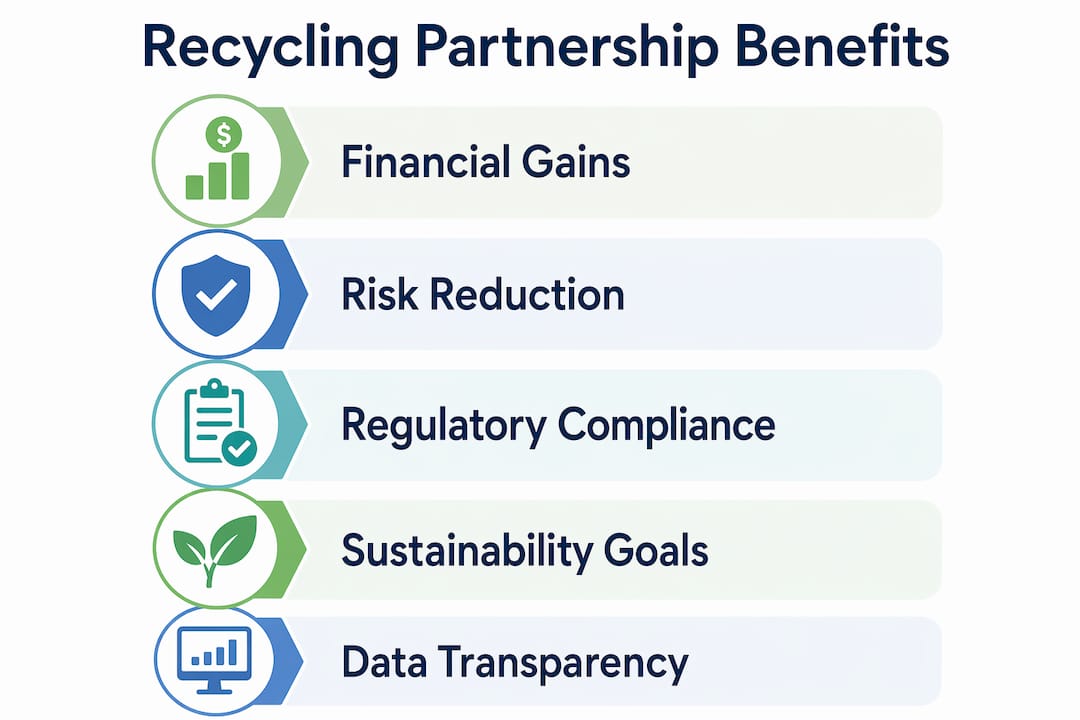
Recycling partnerships give asset managers access to the circularity metrics that ESG reporting now legally requires. Research published in Frontiers in Sustainability confirms that circular economy metrics like material recirculation ratios and product longevity are needed for compliance under EU Digital Product Passport regulations starting in 2026. Carbon intensity scores alone no longer satisfy regulators or institutional investors. Asset managers increasingly require traceability and lifecycle transparency to meet portfolio management standards.
The EU Digital Product Passport and Extended Producer Responsibility frameworks require that companies document where materials go after use. A recycling partner provides that documentation chain. Without a verified partner, asset managers cannot produce the audit-ready data these frameworks demand. That gap creates direct regulatory exposure.

Greenwashing risk is the other side of this equation. Asset managers who report sustainability commitments without verifiable recycling data face reputational and legal consequences. A certified recycling partner generates the paper trail that separates genuine circularity claims from marketing language. The role of recycling in ESG reporting is now a compliance function, not a communications function.
Partnerships also enable control over what the World Economic Forum calls value creation archetypes, including feedstock recovery and product lifespan extension. These are measurable outputs that feed directly into ESG dashboards.
- Material recirculation ratios: Quantify what percentage of recovered materials re-enter the supply chain.
- Product longevity data: Document how long assets remain in service before disposal, a key metric under EPR rules.
- Audit-ready reporting: Partners generate certified records that satisfy third-party ESG auditors.
- Greenwashing defense: Verified data from partners protects asset managers from regulatory scrutiny.
Pro Tip: Request sample audit reports from any recycling partner before signing a contract. If a partner cannot produce a sample compliance certificate within 48 hours, treat that as a disqualifying signal.
What financial and risk benefits do recycling partners bring?
Recycling infrastructure assets generate defensive cash flows that behave differently from traditional equity or fixed income. Goldman Sachs Asset Management identifies circular economy investments as offering portfolio diversification, inflation protection, and resilience to supply chain disruptions. That combination is rare in a single asset class. For asset managers building portfolios that must perform across economic cycles, recycling partnerships provide exposure to that resilience.
Global waste production is projected to nearly double by 2050. That trajectory makes recycling a structural growth market, not a niche allocation. Asset managers who establish recycling partnerships now position their portfolios ahead of that demand curve.
“Circular economy strategies reduce dependence on volatile commodity markets and provide inflation-linked revenue streams that support long-term asset manager goals.” — Goldman Sachs Asset Management, 2025
The inflation protection argument is concrete. Localized resource recovery models reduce exposure to imported raw material prices. When commodity markets spike, portfolios with recycling infrastructure exposure offset losses through recovered material value. That is a real hedge, not a theoretical one.
- Defensive cash flows: Recycling facilities generate revenue regardless of equity market conditions.
- Commodity hedge: Recovered materials offset raw material price volatility in portfolio holdings.
- Supply chain stability: Local recycling reduces dependence on geopolitically sensitive supply chains.
- Growth exposure: The waste management sector grows as global consumption and regulation both increase.
- Inflation linkage: Material recovery revenues tend to rise with input costs, providing natural inflation protection.
Circular economy investments also represent a new frontier in infrastructure. The risk-adjusted returns from recycling assets compare favorably to traditional infrastructure like toll roads or utilities, with the added benefit of regulatory tailwinds rather than headwinds.
How should asset managers evaluate and select recycling partners?
Partner selection is where most asset managers make costly mistakes. The most common error is treating recycling brokers and recycling operators as equivalent. They are not. A broker arranges disposal but does not control the end process. An operator owns and manages the actual recycling facility.
Broker-only partners create hidden liability risks for asset managers. If the broker’s downstream processor fails an audit or violates environmental regulations, the asset manager may bear reputational and legal consequences without direct recourse. Selecting an operator, or at minimum a broker with contractually verified downstream processors, eliminates that exposure.
AI-driven research published in MDPI shows that recycling efficiency and R&D expenditure are the dominant predictors of investment efficiency in circular economy sectors. That finding has a direct implication for due diligence. Partners who cannot disclose their recycling efficiency rates or R&D investment levels are signaling data opacity. Data opacity is a liability in an audit-driven compliance environment.
Evaluation criteria ranked by risk impact:
- Operator vs. broker status: Confirm whether the partner directly controls end processing or subcontracts it.
- Recycling efficiency disclosure: Request documented efficiency rates for material recovery across asset categories.
- Certification and compliance history: Verify certifications like R2 (Responsible Recycling) or e-Stewards, and check for past regulatory violations.
- Audit-ready data delivery: Confirm the partner can deliver structured, machine-readable compliance reports.
- R&D investment transparency: Partners investing in process improvement are less likely to cut corners under cost pressure.
- Partnership agreement structure: Contracts should include data delivery timelines, compliance warranties, and liability clauses tied to downstream processor performance.
| Criterion | Broker risk | Operator advantage |
|---|---|---|
| Regulatory liability | High if downstream fails | Direct control reduces exposure |
| Data transparency | Limited to what broker receives | Full process visibility |
| Audit readiness | Dependent on third parties | In-house documentation |
| Compliance track record | Hard to verify end-to-end | Directly auditable |
Pro Tip: Ask every candidate partner for their last third-party audit report and their downstream processor list. A partner who refuses either request is not suitable for a regulated asset management environment.
Low-cost, unverified disposal providers are the highest-risk option. The short-term cost saving is real. The long-term liability from a failed audit or a data breach tied to improper IT asset disposal is not recoverable through cost savings. Certified recycling vendor compliance is a non-negotiable baseline for any asset manager subject to ESG reporting requirements.
How can asset managers integrate recycling partnerships into their workflows?
Integration starts with data architecture. Recycling partner outputs must feed directly into ESG reporting dashboards and portfolio management systems. That requires agreeing on data formats, delivery schedules, and verification protocols before the partnership begins. Most asset managers underspecify this step and spend months reconciling incompatible data formats after contracts are signed.
The practical workflow connects four teams: asset recovery, compliance, portfolio management, and external reporting. Each team needs different outputs from the recycling partner. Compliance needs certified destruction records. Portfolio management needs material recovery valuations. External reporting needs audit-ready circularity metrics. A single partner data feed structured correctly serves all four.
- Define data requirements first: Specify exactly which metrics each internal team needs before issuing a partner RFP.
- Align with investment mandates: Recycling partnership terms should reference the specific circular economy frameworks in your investment policy statement.
- Use technology for monitoring: AI-driven analytics tools can track recycling efficiency metrics in real time and flag deviations from contracted performance levels.
- Schedule quarterly reviews: Partner performance against contracted recycling efficiency rates should be reviewed on a fixed schedule, not only at annual contract renewal.
- Connect asset recovery to data destruction: IT asset recycling and secure data destruction must be coordinated. Disposing of hardware without certified data destruction creates a separate compliance failure.
| Workflow stage | Team responsible | Partner output required |
|---|---|---|
| Asset recovery | Operations | Pickup confirmation, chain-of-custody records |
| Data destruction | IT / Compliance | Certified destruction certificates |
| Material recovery | Portfolio management | Material recirculation ratios, recovery valuations |
| ESG reporting | External reporting | Audit-ready circularity metrics, third-party certifications |
Cross-department alignment is the factor most often missing. Recycling partnerships that are managed solely by procurement or facilities teams rarely generate the compliance-grade data that portfolio managers and ESG auditors need. Assign a named owner in the compliance or portfolio team to manage the partner relationship alongside procurement.
Key Takeaways
Asset managers need recycling partners because these partnerships provide the verified circularity data, regulatory compliance documentation, and portfolio resilience that 2026 ESG and circular economy frameworks require.
| Point | Details |
|---|---|
| ESG compliance requires verified data | Recycling partners generate audit-ready circularity metrics that satisfy EU Digital Product Passport and EPR requirements. |
| Operators outperform brokers | Broker-only partners create hidden liability; operators provide direct process control and verifiable compliance records. |
| Financial resilience is real | Circular economy investments offer inflation protection, commodity hedging, and defensive cash flows per Goldman Sachs. |
| Data integration is the critical step | Partner outputs must be structured to feed ESG dashboards and compliance systems before contracts are signed. |
| Partner selection criteria matter | Recycling efficiency disclosure, R2 or e-Stewards certification, and audit history are non-negotiable evaluation criteria. |
The gap most asset managers still haven’t closed
The recycling partnership conversation in asset management is still dominated by the wrong question. Most teams ask “which partner is cheapest?” when the correct question is “which partner can survive our next ESG audit?” I’ve watched organizations sign low-cost disposal contracts and then spend three times the savings on remediation when a downstream processor failed a regulatory inspection.
The circular economy frameworks arriving in 2026 are not aspirational. The EU Digital Product Passport is a legal requirement with audit teeth. Extended Producer Responsibility rules shift financial liability upstream. Asset managers who treat recycling as a facilities management issue rather than a compliance and portfolio function will face that reality the hard way.
The other gap I see consistently is the disconnect between IT asset disposal and data security. Asset managers handle sensitive client data on hardware that eventually reaches end of life. Recycling that hardware without certified data destruction is a dual failure: an ESG compliance gap and a data privacy violation. These two functions must be managed together, not by separate teams with separate vendor relationships.
The asset managers who get this right in 2026 will have a structural advantage. Their ESG reports will be audit-ready. Their portfolios will carry recycling infrastructure exposure that hedges commodity and inflation risk. Their data destruction records will satisfy regulators. That is not a sustainability story. That is a risk management story.
— Keith
Usedcartridge: certified recycling and data security for asset managers
Asset managers need recycling partners who can deliver certified compliance documentation, not just pickup and disposal. Usedcartridge provides e-waste recycling services built for organizations that operate under ESG reporting requirements and data security mandates.

Usedcartridge handles IT asset recovery, certified hard drive destruction, and electronic waste recycling with documented chain-of-custody records at every stage. Each service produces the compliance certificates that ESG auditors and data privacy regulators require. Asset managers working toward 2026 circular economy compliance can request a free quote and pickup through Usedcartridge, with on-site destruction options available for sensitive hardware. The process is direct, documented, and built for organizations where compliance is not optional.
FAQ
Why do asset managers need recycling partners specifically?
Asset managers need recycling partners to generate the verified circularity metrics and compliance documentation required under 2026 ESG frameworks like the EU Digital Product Passport. Without a certified partner, asset managers cannot produce audit-ready data for regulators or institutional investors.
What is the difference between a recycling broker and a recycling operator?
A broker arranges disposal but does not control the end process, creating hidden liability if downstream processors fail audits. An operator owns the recycling facility and provides direct, verifiable compliance records.
How do recycling partnerships protect against greenwashing claims?
Certified recycling partners generate documented material recovery records and third-party audit certificates. Those records provide the evidence base that separates verified sustainability claims from unsubstantiated marketing statements.
What certifications should asset managers require from recycling partners?
R2 (Responsible Recycling) and e-Stewards are the two primary certifications that confirm a recycling partner meets environmental and data security standards. Both require regular third-party audits and are recognized by ESG reporting frameworks.
How does IT asset recycling connect to data security compliance?
Disposing of IT hardware without certified data destruction creates a data privacy violation separate from any ESG compliance gap. Asset managers must coordinate hardware recycling and data destruction services through a single verified partner to satisfy both regulatory requirements simultaneously.