
Secure destruction of sensitive information is defined as the physical or verified elimination of data so that no recovery method, including laboratory-level forensic analysis, can retrieve it. Every organization handling financial records, employee data, or client files faces the same core risk: improperly discarded media can expose that data to identity theft, corporate espionage, and regulatory penalties. Standards like NIST SP 800-88 define exactly how organizations must sanitize data before disposal. Understanding why destroy sensitive information policies exist, and how to execute them correctly, is the difference between compliance and a costly breach.
Why destroying sensitive information is not optional
The industry term for this practice is “data sanitization,” and it covers everything from software-based erasure to physical shredding. Most organizations treat it as a low-priority task. That is a serious mistake. CIOs frequently underestimate high-security data destruction, treating it as routine housekeeping rather than a core security function. The result is that retired hard drives, printed reports, and decommissioned servers leave the building with recoverable data still on them.
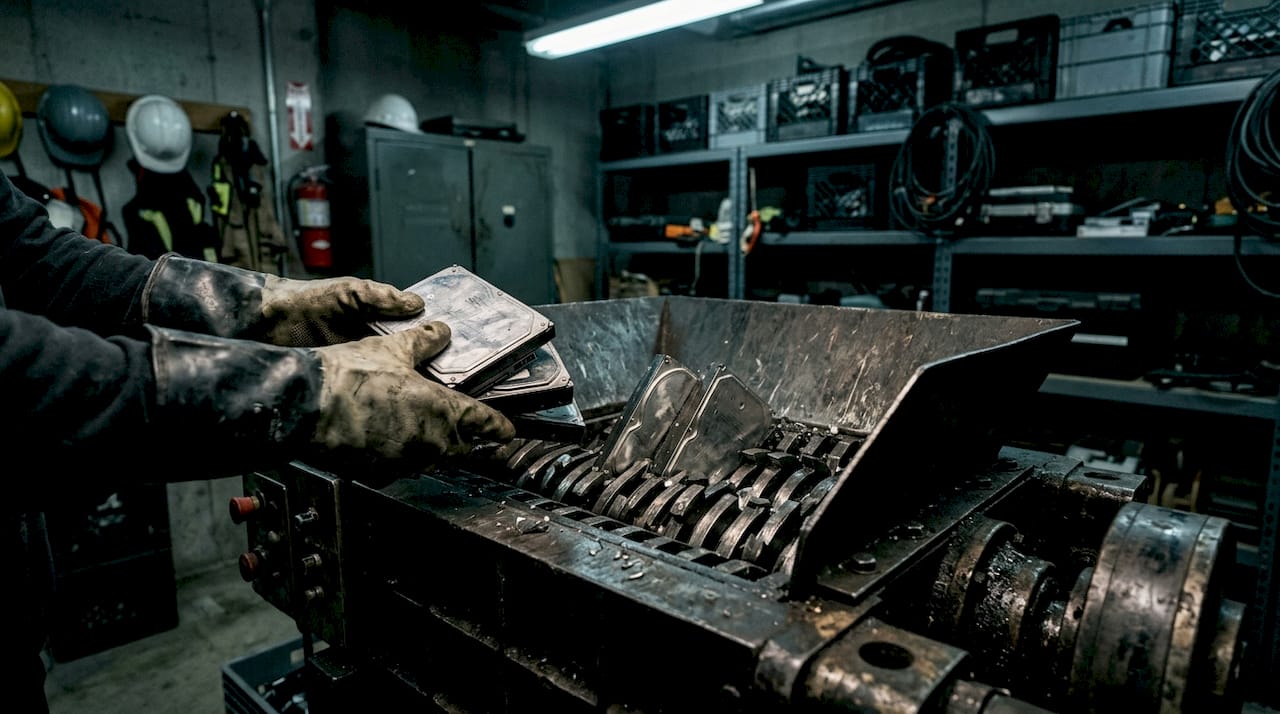
The risks are concrete. A discarded hard drive sold at auction, a recycled laptop passed to a refurbisher, or a shredded document with particles too large to prevent reconstruction can all become entry points for a breach. Physical destruction, when done correctly, eliminates that risk entirely. No other method provides the same absolute assurance.
Why deleting files or resetting devices is not enough
Standard file deletion and factory resets do not erase the underlying data. They only remove file pointers, leaving the actual data on the storage medium and fully recoverable with widely available forensic tools. This is the most common misconception organizations carry into their IT retirement processes.
The exposure risk is real and well-documented:
- A deleted file on a hard drive remains intact until the operating system overwrites that sector, which may never happen before the device leaves your control.
- A factory-reset smartphone often retains user data in unallocated storage space, accessible with consumer-grade recovery software.
- Solid-state drives (SSDs) use wear-leveling algorithms that scatter data across cells, making software-based overwriting unreliable without drive-level cryptographic support.
- Optical media like CDs and DVDs cannot be overwritten at all; physical destruction is the only viable method.
Certified physical destruction provides absolute certainty that data cannot be recovered by any forensic technique, including those used by nation-state adversaries. That certainty is what regulations and auditors require.
Pro Tip: Before retiring any device, check whether it uses an SSD or HDD. Software-based overwriting tools designed for HDDs are often ineffective on SSDs. Classify the device type first, then select the appropriate destruction method.
What are the industry-standard methods for data destruction?
NIST SP 800-88 defines three sanitization levels: Clear, Purge, and Destroy. Each level matches a different threat model and data sensitivity tier.
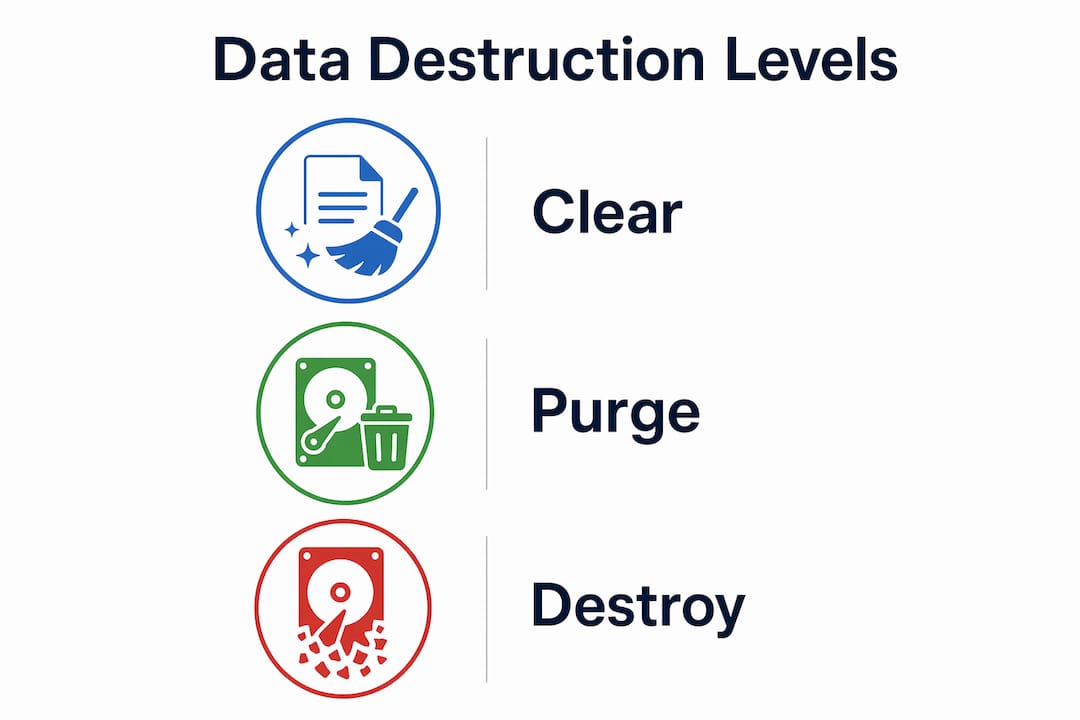
Clear uses software tools to overwrite data. It protects against casual recovery but not against forensic analysis. Purge applies more intensive techniques, including cryptographic erasure and degaussing, that defeat laboratory-level recovery. Destroy renders the media physically unusable, providing the highest assurance level available.
The Destroy level includes shredding, pulverizing, incineration, and disintegration. Particle size requirements are specific: Secret-level data requires shredding to 1mm particles, while Controlled Unclassified Information (CUI) requires particles no larger than 2mm. These limits exist because smaller particles prevent reconstruction even with advanced reassembly techniques.
| Sanitization level | Method examples | Assurance level | Approximate cost per device |
|---|---|---|---|
| Clear | Software overwrite | Protects against casual recovery | Pennies |
| Purge | Cryptographic erasure, degaussing | Defeats forensic analysis | $15–$50 |
| Destroy | Shredding, incineration, pulverizing | Absolute, no recovery possible | $25–$100+ |
Costs reflect complexity and the assurance level delivered. For high-sensitivity data, the cost of Destroy-level methods is negligible compared to the cost of a breach.
One important nuance: cryptographic erasure qualifies as Purge-level sanitization only when encryption has been active since provisioning and key destruction is fully verifiable. Many organizations assume their cloud or device encryption meets this standard. Most do not implement it correctly, which means physical destruction remains the only legally defensible option for high-risk scenarios.
Pro Tip: Do not assume that because a drive is encrypted, cryptographic erasure is sufficient. Verify that encryption was active from the moment the device was provisioned, not added later. If you cannot confirm that, default to physical destruction.
How does regulatory compliance drive the need for secure data disposal?
Regulations do not suggest secure destruction. They require it. The FTC and IRS Publication 1075 both mandate specific sanitization methods and prohibit disposal of sensitive data without verified destruction. These rules apply to tax records, financial data, personally identifiable information (PII), and protected health information (PHI).
The consequences of non-compliance are significant:
- Regulatory fines can reach millions of dollars depending on the breach scope and the regulation violated.
- Reputational damage from a publicized breach often outlasts the financial penalty, eroding client trust for years.
- Legal liability extends to executives and board members in sectors governed by HIPAA, SOX, or GLBA.
- Audit failures triggered by missing destruction documentation can result in loss of contracts, especially in federal and defense supply chains.
A risk-based sanitization strategy balances speed, cost, and assurance by applying the correct method to each scenario rather than using one approach for all data types. This matters because over-applying Destroy-level methods to low-sensitivity data wastes budget, while under-applying them to high-sensitivity data creates legal exposure. The role of compliance in data disposal has grown significantly as regulators increase enforcement activity.
How to implement an effective data destruction process
A structured process prevents the gaps that lead to breaches and audit failures. These steps reflect current best practices for business environments of any size.
-
Classify data sensitivity before anything else. Data classification drives method selection. Misclassifying data leads to either under-protection of sensitive records or unnecessary expense on low-risk media. Assign each data type a sensitivity tier (public, internal, confidential, restricted) before selecting a sanitization method.
-
Match the destruction method to both the data classification and the media type. HDDs, SSDs, optical media, and paper documents each respond differently to destruction methods. An SSD requires different treatment than a magnetic tape. Confirm the media type before selecting the method.
-
Use certified destruction vendors. Third-party destruction services provide a documented chain of custody and issue certificates of destruction that satisfy regulatory audit requirements. Verify that any vendor you use meets NIST SP 800-88 standards and carries relevant certifications.
-
Require forensic-grade verification for high-sensitivity media. For Secret-level or restricted data, verification sampling confirms that particle size limits were met. Firms specializing in damaged drive evidence recovery demonstrate exactly how much data survives inadequate destruction, which underscores why verification matters.
-
Document every destruction event. Maintain records that include the device serial number, data classification, destruction method used, date, vendor, and certificate reference. These records are the primary evidence in a compliance audit.
-
Integrate destruction into your data lifecycle management policy. Destruction should trigger automatically at the end of a device’s retention period, not when someone remembers to schedule it. Build destruction checkpoints into your IT asset retirement workflow so no device exits the organization without a verified sanitization record.
Key Takeaways
Physical destruction of sensitive information is the only method that provides absolute, legally defensible assurance against data recovery, regardless of media type or adversary capability.
| Point | Details |
|---|---|
| Deletion is not destruction | Standard deletion removes file pointers only; data remains recoverable with forensic tools. |
| NIST SP 800-88 sets the standard | Three levels, Clear, Purge, and Destroy, match method to data sensitivity and threat model. |
| Classify data before selecting a method | Misclassification leads to under-protection or wasted budget on low-risk media. |
| Regulations require documented proof | FTC and IRS rules mandate verified destruction records for audits and legal defensibility. |
| Certified vendors provide compliance coverage | Certificates of destruction from accredited vendors satisfy regulatory audit requirements. |
Why I think most businesses are one retired laptop away from a breach
The uncomfortable truth I’ve learned from working with organizations across industries is that data destruction is treated as an afterthought in most IT retirement cycles. Teams focus on procurement, deployment, and support. When a device reaches end of life, it gets stacked in a storage room or handed to a recycler with no verification of what happens to the data on it.
The mistake I see most often is confusing media type with data sensitivity. An IT manager will say, “It’s just an old SSD, we wiped it.” But the question is not what the media is. The question is what data was on it and whether the method used actually eliminates recovery risk for that data classification. Those are two completely different questions, and conflating them is how breaches happen.
Cryptographic erasure gets oversold as a catch-all solution. It works, but only under very specific conditions that most organizations do not fully implement. If encryption was not active from the moment the device was provisioned, cryptographic erasure is not Purge-level sanitization. It is just deletion with extra steps.
My advice is to build physical destruction into your default process for any device that held confidential or restricted data. The cost difference between software erasure and physical destruction is small. The liability difference is enormous. Stakeholder trust, once lost after a breach, takes years to rebuild. A strict destruction policy, documented and audited, is one of the cheapest forms of risk management available to any organization.
Usedcartridge: secure destruction and responsible recycling
Businesses that need verified, compliant data destruction do not have to manage it alone. Usedcartridge provides equipment destruction services that meet NIST SP 800-88 standards, with certificates of destruction issued for every job. Every destruction event is documented, giving your compliance team the audit trail regulators require.

Usedcartridge also integrates secure e-waste recycling into the destruction process, so retired IT assets are disposed of responsibly without creating environmental liability. From hard drives to full server racks, the process covers both data security and sustainability in a single, verified workflow. Request a free quote and see how straightforward compliant destruction can be.
FAQ
Why can’t I just delete files before recycling a device?
Standard deletion removes only the file pointer, not the data itself. Forensic tools can recover that data from a recycled or resold device in minutes.
What does NIST SP 800-88 require for data destruction?
NIST SP 800-88 defines three levels: Clear, Purge, and Destroy. The Destroy level requires physical destruction with specific particle size limits, such as 1mm for Secret-level data.
Is cryptographic erasure the same as physical destruction?
No. Cryptographic erasure qualifies as Purge-level sanitization only when encryption was active from provisioning and key destruction is verifiable. Physical destruction provides a higher and more defensible assurance level.
What regulations require businesses to destroy sensitive data?
The FTC and IRS both mandate verified sanitization for sensitive data. Regulations like HIPAA, SOX, and GLBA impose additional requirements depending on the industry and data type involved.
What is a certificate of destruction and why does it matter?
A certificate of destruction is a documented record issued by a certified vendor confirming that specific media was destroyed to a defined standard. It serves as primary evidence in regulatory audits and legal proceedings.