
An e-waste policy is a formalized organizational guideline that defines how electronic devices must be collected, sanitized, and disposed of to protect health, satisfy legal requirements, and support sustainability goals. Why organizations need e-waste policies has never been more pressing: global e-waste volumes are climbing, data privacy laws are tightening, and regulators are scrutinizing disposal practices with greater intensity. Without a documented policy, your organization faces environmental liability, data breach exposure, and audit failures simultaneously. This article covers the environmental, compliance, data security, and sustainability dimensions of e-waste policy, plus a practical implementation framework.
What environmental and health risks do e-waste policies help organizations mitigate?
Electronic devices contain lead, mercury, cadmium, and brominated flame retardants. When improperly discarded, these substances leach into soil and groundwater, contaminate food chains, and accumulate in human tissue. Improper e-waste disposal contaminates environmental and biological systems globally. That finding means your organization’s retired laptops and servers are not neutral objects once they leave the building.
A formal e-waste policy changes that outcome by specifying exactly how devices move from retirement to certified recycling. Without that structure, individual employees make ad hoc decisions, and ad hoc decisions produce inconsistent results. The risks your policy must address include:
- Soil and groundwater contamination from landfilled circuit boards containing heavy metals
- Air pollution from informal burning of cables and plastics to recover copper
- Human health exposure for workers and communities near unregulated disposal sites
- Reputational damage when your organization is linked to irresponsible disposal
“Coordinated policies reduce hazardous exposure and enhance resource reuse across the entire disposal chain.” — Frontiers Environmental Science, 2026
A policy that mandates certified recyclers and documented chain-of-custody eliminates the conditions that produce these outcomes. It also gives your environmental, health, and safety team a defensible record if regulators ever ask how a specific device was handled.
Pro Tip: Require recycling vendors to provide R2v3 or e-Stewards certification before approving them. Certified vendors operate under audited environmental controls, which transfers much of the compliance burden off your team.
How do e-waste policies ensure regulatory compliance and reduce organizational risks?
Regulatory frameworks governing electronic waste now span federal, state, and international jurisdictions. The Resource Conservation and Recovery Act (RCRA), state-level e-waste laws in California, New York, and over 25 other states, and international standards like the Basel Convention all impose specific disposal obligations. Formal IT asset disposal policies mitigate data exposure and environmental liabilities simultaneously. That dual function is what makes a written policy worth the effort to build.
Non-compliance carries concrete consequences. Fines under RCRA can reach $70,000 per day per violation. State penalties vary but are equally serious. Beyond financial penalties, a publicized disposal violation damages vendor relationships and customer trust in ways that are harder to quantify and much harder to repair.
A compliant e-waste policy addresses these risks through four documented steps:
- Classify all retiring assets by device type, data sensitivity, and applicable regulatory category before disposal begins.
- Select approved vendors who hold current R2v3 or e-Stewards certification and can provide downstream documentation.
- Maintain chain-of-custody records from device retirement through final recycling or destruction, including serial numbers and dates.
- Conduct annual vendor audits to verify that downstream partners meet your policy standards and have not changed their practices.
The EPA is also moving toward electronic hazardous waste manifests, estimated to save $26–28 million annually across the industry. That shift increases transparency and makes it easier for regulators to identify organizations that lack proper documentation. Organizations with existing digital tracking systems will adapt faster and face less disruption.
Downstream vendor documentation and oversight are critical to meeting standards and avoiding nonconformities. Vendor due diligence is not optional. It is the mechanism that extends your policy’s reach beyond your own facility.
Why is data security a critical reason to implement formal e-waste policies?
Every retired hard drive, SSD, smartphone, and network switch is a potential data breach waiting to happen. Storage media retains recoverable data even after standard deletion or formatting. A formal e-waste policy specifies the exact sanitization method required for each device class, removing the guesswork that creates exposure.

The NIST 800-88 standard defines three sanitization levels: Clear, Purge, and Destroy. Each level applies to different media types and threat models. Organizations subject to HIPAA, GDPR, or CCPA must document which method was applied to each device and retain that record as proof of compliance. A policy without this specificity is not a policy. It is a wish.
The data security requirements your e-waste policy must cover include:
- Device-level sanitization records showing method, technician, date, and verification result for each asset
- Chain-of-custody documentation from internal retirement through vendor receipt and final processing
- Vendor contractual obligations requiring certified destruction and issuance of a Certificate of Destruction
- Escalation procedures for devices that fail sanitization verification before leaving your facility
IT asset disposal policies establish secure sanitization, chain-of-custody, and vendor oversight practices to meet privacy laws like HIPAA and GDPR. Auditors expect device-level evidence, not generic claims. If your policy says “devices are wiped before disposal” without specifying the NIST 800-88 method and verification process, it will not satisfy an audit.
Pro Tip: Require a Certificate of Destruction for every data-bearing device. This single document is your primary defense in a breach investigation or regulatory audit. Without it, you cannot prove the data was destroyed.
How do e-waste policies support sustainability and circular economy goals?
E-waste policies are the organizational mechanism that connects device retirement to resource recovery. Without a policy mandating recycling, most retired electronics end up in landfills, where valuable materials are permanently lost and toxic substances are released. With a policy, those same devices become inputs to a circular economy.
The EPA quantifies this benefit precisely. Recycling one million laptops saves the equivalent electricity needed to power 3,500 homes for a year. That figure represents real energy avoided, not an abstract environmental credit. At organizational scale, a structured recycling policy produces measurable reductions in energy consumption and raw material extraction.
| Resource Recovered | Source Device | Circular Economy Benefit |
|---|---|---|
| Copper | Circuit boards, cables | Reduces mining demand and smelting emissions |
| Gold and silver | Cell phones, laptops | Recovers precious metals without new extraction |
| Aluminum | Laptop casings, servers | Saves up to 95% of the energy needed for primary production |
| Rare earth elements | Hard drives, displays | Reduces dependence on geopolitically sensitive supply chains |
“Sustainability messaging backed by quantifiable data enhances credibility and stakeholder engagement.” — U.S. EPA
Corporate social responsibility reporting increasingly requires organizations to document their waste diversion rates and material recovery figures. A policy that mandates certified recycling generates the data your sustainability team needs to make credible claims to investors, customers, and regulators. Organizations without that documentation cannot substantiate their environmental commitments, which is a growing liability as ESG scrutiny intensifies.
For a broader view of how e-waste recycling supports business sustainability, the connection between policy and measurable environmental outcomes is direct and well-documented.
What practical steps can organizations take to implement effective e-waste policies?
Building an e-waste policy from scratch is manageable when you follow a structured sequence. The most common failure mode is writing a policy that looks complete on paper but lacks the operational detail needed to execute it consistently. Avoid that by working through these steps in order:
- Conduct an asset inventory audit. Identify every device category your organization retires, including computers, monitors, mobile devices, network equipment, and peripherals. Assign each category a data sensitivity level and a regulatory classification.
- Define disposal pathways for each category. Specify whether each device type goes to certified recycling, certified destruction, or IT asset recovery. Document the approved vendors for each pathway.
- Establish chain-of-custody procedures. Create a tracking form that follows each device from retirement request through vendor receipt. Include serial numbers, asset tags, and responsible parties at each handoff.
- Draft vendor qualification criteria. Require R2v3 or e-Stewards certification, current insurance, and the ability to provide Certificates of Destruction. Review vendor credentials annually.
- Train all relevant staff. IT, facilities, procurement, and legal teams all touch the disposal process. Each group needs role-specific training on the policy’s requirements and their responsibilities.
- Schedule annual policy reviews. Regulations change, vendor landscapes shift, and your device mix evolves. A policy that is not reviewed annually becomes outdated and creates compliance gaps.
Reviewing your organization’s obligations under electronic disposal regulations before drafting the policy saves significant revision time later. Knowing which laws apply to your specific device types and jurisdictions shapes every decision in the policy.
Key takeaways
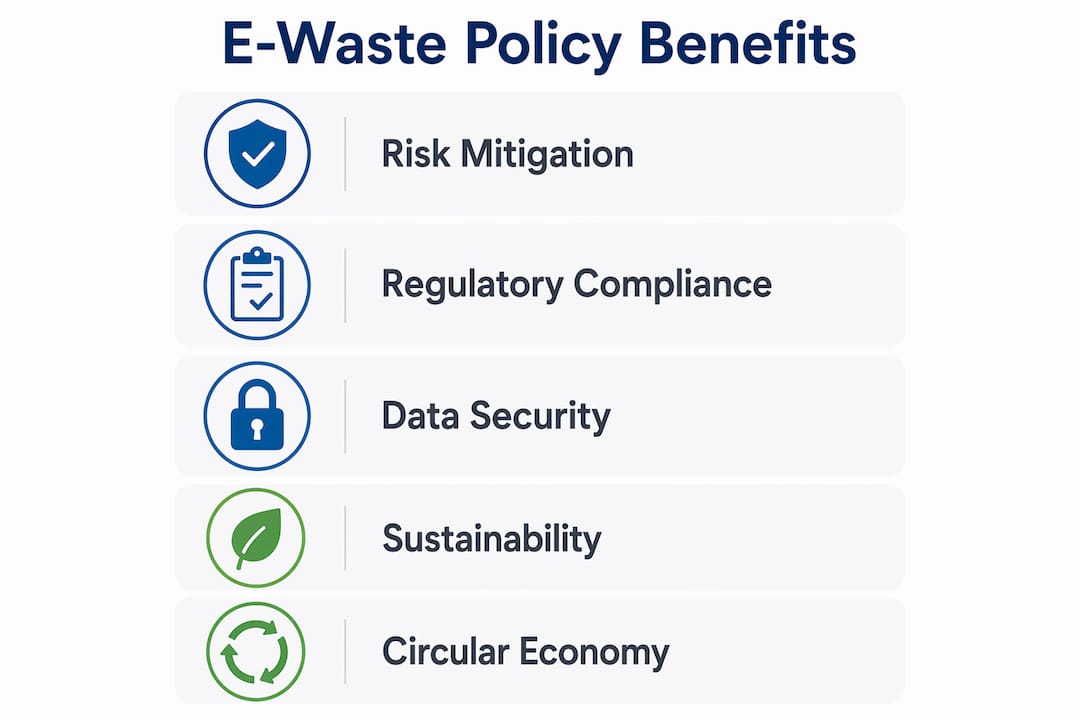
Organizations that formalize e-waste policies protect themselves from environmental liability, data breaches, regulatory penalties, and sustainability reporting failures simultaneously.
| Point | Details |
|---|---|
| Environmental risk mitigation | Policies mandate certified recyclers, preventing toxic contamination from heavy metals in retired devices. |
| Regulatory compliance | Documented disposal procedures and vendor audits satisfy RCRA, HIPAA, GDPR, and state e-waste laws. |
| Data security assurance | NIST 800-88 sanitization requirements and Certificates of Destruction provide defensible proof of data destruction. |
| Sustainability and resource recovery | Structured recycling policies generate measurable material recovery data for ESG and CSR reporting. |
| Implementation discipline | Asset classification, chain-of-custody tracking, and annual reviews keep policies current and enforceable. |
The policy gap most organizations don’t see until it’s too late
I’ve reviewed e-waste programs at organizations ranging from regional healthcare networks to mid-size financial services firms. The pattern I see most often is not malice or negligence. It is a policy that exists on paper but was never operationalized. Someone wrote a document, filed it in a compliance folder, and assumed the problem was solved.
The gap shows up during audits. Auditors ask for device-level sanitization records, and the IT team produces a spreadsheet with 40 entries covering 400 retired devices. They ask for vendor certifications, and procurement pulls a certificate that expired 18 months ago. Neither situation reflects bad intentions. Both reflect a policy that was never connected to daily operations.
The organizations that handle this well treat their e-waste policy the same way they treat their information security policy: as a living document with named owners, scheduled reviews, and measurable outcomes. They track devices from retirement to destruction the same way they track financial assets. That discipline is not expensive to build. It requires clarity about who is responsible for what, and a commitment to documenting the process rather than assuming it happened correctly.
The regulatory trajectory makes this more urgent, not less. Electronic manifest requirements, expanding state e-waste laws, and tightening ESG disclosure standards all point in the same direction. Organizations that build the policy infrastructure now will adapt to new requirements with minor updates. Those that wait will face the cost of building that infrastructure under deadline pressure, which is always more expensive and more disruptive.
— Keith
How Usedcartridge helps organizations build compliant e-waste programs
Usedcartridge provides the operational backbone that turns a written e-waste policy into a working program. From certified e-waste logistics and chain-of-custody documentation to on-site data destruction with Certificates of Destruction, every service is designed to satisfy the compliance requirements your policy demands.

Organizations managing device retirements at scale need a partner who understands both the environmental and data security dimensions of disposal. Usedcartridge delivers R2-aligned processes, vendor documentation, and pickup options that remove the operational burden from your IT and compliance teams. Request a free quote and see how Usedcartridge can close the gap between your policy and its execution.
FAQ
What is an e-waste policy?
An e-waste policy is a documented organizational procedure that defines how retired electronic devices are collected, sanitized, and disposed of in compliance with environmental and data security regulations. It assigns responsibilities, specifies approved vendors, and requires chain-of-custody documentation.
Why do organizations need e-waste policies for compliance?
Regulations including RCRA, HIPAA, GDPR, and more than 25 state e-waste laws require documented disposal procedures and vendor oversight. Without a formal policy, organizations cannot demonstrate compliance during audits and face fines that can reach $70,000 per day per violation.
How does an e-waste policy protect against data breaches?
A policy specifies NIST 800-88 sanitization methods for each device class and requires Certificates of Destruction from vendors. That documentation is the primary defense in a breach investigation or regulatory audit.
What are the sustainability benefits of e-waste policies?
Structured recycling policies recover copper, gold, silver, and rare earth elements from retired devices. The EPA reports that recycling one million laptops saves electricity equivalent to powering 3,500 homes annually.
How often should organizations review their e-waste policies?
Organizations should review e-waste policies annually at minimum. Regulatory changes, new device categories, and vendor certification renewals all require policy updates to maintain compliance and operational accuracy.