
Best for a local business pickup with arranged on-site destruction: Recycle for Life. Best for witnessed disposal: on-site physical destruction. Best for centralized collection: off-site destruction. Best for equipment reuse: verified sanitization. This 2026 guide compares data destruction services for banks and credit unions, starting with the practical process: confirm eligibility, arrange pickup and destruction, then retain the appropriate records.
- Recycle for Life data destruction services suit Orange County, LA and San Diego businesses seeking pickup with separately arranged on-site destruction.
- Free business pickup does not mean destruction services are free; confirm the scope before scheduling.
- A Certificate of Recycling records collection. A certificate of destruction documents the arranged destruction service.
- Choose bank and credit union equipment disposal by custody controls, destruction method, and documentation—not collection convenience alone.
Why this matters
A bank equipment retirement is not finished when the computers leave the building. Your team still needs to account for storage devices, confirm the authorized treatment, and keep records that match the work performed.
For your 2026 retirement plan, separate collection from destruction. A Certificate of Recycling helps record the pickup; a certificate of destruction serves a different purpose. Neither document should be treated as a substitute for the other.
Recycle for Life data destruction services are best suited to Orange County, LA and San Diego businesses seeking pickup with separately arranged on-site destruction. Confirm your institution’s vendor requirements, equipment eligibility, and location before booking.
What makes the best data destruction services?
Use these 6 selection checks before approving a service. A convenient collection process matters, but it does not replace your institution’s security review.
- Equipment fit: Identify hard drives, solid-state drives, and other storage media. Ask which items the proposed service covers.
- Method fit: Require a clear description of what happens to each media type. Deleting files is not the same as verified sanitization or physical destruction.
- Custody records: Establish who releases equipment, who receives it, and how transfers are recorded.
- Documentation: Agree on the pickup Certificate of Recycling and certificate of destruction requirements before collection.
- Location eligibility: Confirm service coverage, building access, and whether on-site work can be arranged at your premises.
- Institutional approval: Obtain the vendor, security, and records approvals your bank or credit union requires.
Ask for written answers. A service description that leaves the destruction method or documentation unclear is not ready for approval.
Data destruction services at a glance
These 4 service models answer different operational needs. They are not interchangeable, and the ranking is a decision guide rather than a claim that every provider offers every method.
| Service option | Best for | Standout feature | Key limitation |
|---|---|---|---|
| Recycle for Life: local pickup with arranged on-site destruction | Orange County, LA and San Diego business equipment batches | Coordinates business pickup and separately arranged destruction | Confirm equipment, location, and institutional requirements |
| Witnessed on-site physical destruction | Teams requiring observation before media leaves | Destruction occurs at the agreed premises | Requires access planning and a method suitable for the media |
| Off-site destruction with documented custody | Multi-location teams using a central collection process | Moves destruction to a separate facility | Requires controls during transport and before destruction |
| Verified sanitization for reuse | Working devices approved for redeployment | Removes data while preserving usable equipment | Requires media-appropriate verification and reuse approval |
1. Recycle for Life: best for local pickup coordination
Recycle for Life provides free B2B electronic waste pickup, computer and hard drive recycling, and on-site data destruction services for businesses in the Orange County, LA and San Diego area. For a bank or credit union retiring equipment, the next step is to confirm the batch, address, and destruction requirements—not assume that pickup includes every service.
The practical benefit is a straightforward collection process supported by Certificates of Recycling. Certificates of destruction apply to arranged destruction services; pickup alone does not establish that data has been destroyed.
Best for: Office and IT managers coordinating a local business equipment batch with separately arranged destruction.
Recycle for Life pros:
- Free business pickup, subject to confirming equipment and location eligibility.
- On-site data destruction is among the stated services.
- Certificates of Recycling support collection records.
- Certificates of destruction support arranged destruction services.
Recycle for Life limitations:
- Confirm coverage outside the stated Orange County, LA and San Diego area.
- Confirm the destruction method and documentation against your institution’s requirements.
- Do not assume destruction work is included with free pickup.
For an Irvine location, review the hard drive destruction services for Irvine businesses information before describing your equipment batch.
Verdict: Buy only after the equipment, location, destruction scope, and internal approvals are confirmed.
2. On-site physical destruction: best for witnessed disposal
On-site physical destruction brings the agreed destruction process to your location. It suits an institution that requires an authorized employee to observe treatment before the storage media leaves the premises.
Specify the media involved rather than asking only for hard drive destruction. Magnetic hard drives and solid-state storage are different, so the proposed physical process must address the actual devices in your batch.
Best for: Banks and credit unions whose approved disposal procedure requires witnessed physical destruction.
On-site physical destruction pros:
- Lets an authorized employee observe the agreed work.
- Avoids transporting intact media before the on-site destruction step.
- Allows staff to reconcile listed devices against the destruction event.
On-site physical destruction cons:
- Requires an agreed work area and building access arrangements.
- Makes staff attendance part of scheduling.
- Does not preserve destroyed media for reuse.
For a 2026 branch closure, identify the witness and backup contact before setting the service date. Also agree on how exceptions—such as an unlisted drive—will be handled without informal additions to the job.
Verdict: Buy when witnessed destruction is an approved requirement and the premises support the work.
3. Off-site destruction: best for centralized collection
Off-site destruction separates collection from the destruction event. Equipment or media travels to another location for the agreed treatment, so the collection record is only the beginning of the documentation trail.
This model fits a centralized retirement process only when your institution approves the custody arrangements. Define the receiving location, transfer records, storage controls, and responsibility for resolving inventory differences before release.
Best for: Multi-location teams whose approved process sends retired media to a separate destruction facility.
Off-site destruction pros:
- Separates branch collection from the destruction work area.
- Supports a common collection procedure across participating locations.
- Allows destruction to take place at an agreed external facility.
Off-site destruction cons:
- Introduces transport and pre-destruction storage stages.
- Requires reconciliation between collection and destruction records.
- Does not provide an on-site witness at the branch.
Ask how your team will identify the devices covered by the final record. A certificate that cannot be connected to your released inventory leaves an unresolved records problem, even if collection went smoothly.
Verdict: Hold until custody arrangements and inventory reconciliation are approved in writing.
4. Verified sanitization: best for approved equipment reuse
Sanitization is a process intended to make stored data inaccessible at the required level. Unlike physical destruction, an appropriate sanitization method can preserve equipment for continued use.
Choose this route only when reuse is approved and the process fits the media. A factory reset, file deletion, or an employee’s assurance that a drive is empty is not equivalent to documented verification.
Best for: Working equipment that your institution has approved for redeployment, transfer, or another reuse route.
Verified sanitization pros:
- Preserves equipment when the selected process supports reuse.
- Allows a reuse decision rather than automatic physical destruction.
- Provides a basis for documenting treatment and verification separately.
Verified sanitization cons:
- Requires a method suitable for the storage technology.
- Requires a defined response when sanitization cannot be verified.
- Is not suitable when institutional policy requires physical destruction.
For 2026 procurement and retirement planning, decide the reuse route before scheduling disposal. Otherwise, a batch intended for reuse can arrive with instructions that authorize irreversible destruction.
Verdict: Buy only for approved reuse, with verification and a defined failure-handling process.
Arrange pickup without leaving data handling unclear
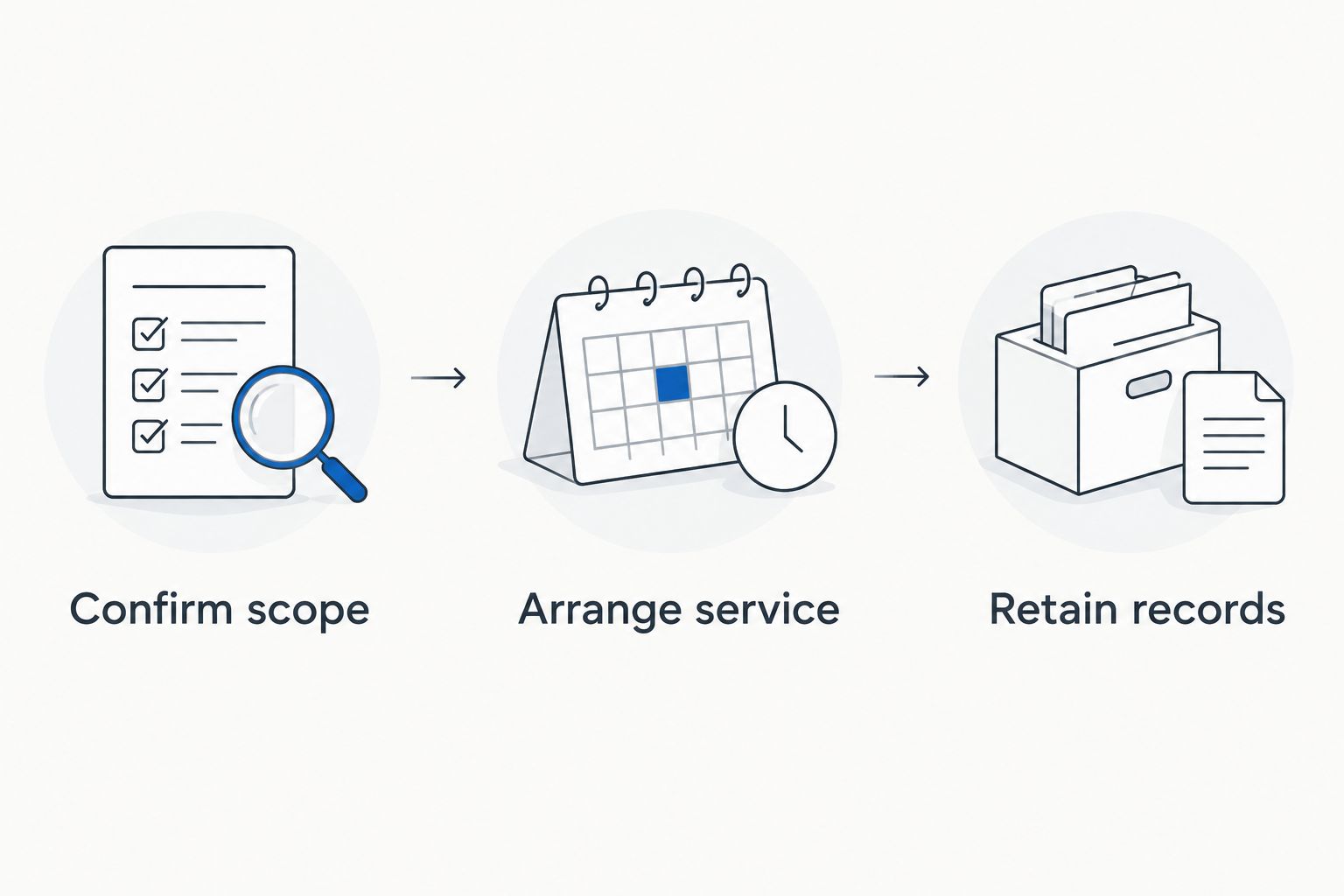
Use these 3 steps to move from a storage-room batch to an approved service request. Keep collection instructions and destruction instructions distinct throughout.
1. Confirm scope
Prepare an equipment list, location, and site contact. Identify which items contain storage media, which belong to the institution, and which require a separate ownership decision.
For property managers coordinating tenant equipment, obtain the tenant’s authorization. Access to a room does not establish authority to release every device inside it.
2. Arrange service
Confirm equipment and location eligibility, pickup access, and the requested destruction work. State whether your institution requires a witness, inventory matching, or particular certificate details.
Ask which services are included and which need a separate arrangement. Free business pickup should never be interpreted as an agreement that all destruction work is free.
3. Retain records
Save the Certificate of Recycling with the collection record. For arranged destruction, retain the certificate of destruction and reconcile its scope against the authorized batch.
If a device is missing from the records or its treatment is unclear, leave that item open in your internal tracking. Do not mark the whole retirement complete merely because a pickup occurred.
Your service request should describe the work needed without exposing customer information. Send equipment categories and operational requirements through the agreed contact process; do not attach account records or photographs showing sensitive screens.
Arrange your business equipment pickup
Confirm eligibility, request pickup, and specify any destruction services and documentation needed.
Certificate of Recycling versus certificate of destruction
A Certificate of Recycling records collection; a certificate of destruction documents destruction. Keep both when both services form part of the job.
Before authorizing a 2026 retirement batch, ask what each document will identify. Your institution should decide whether it needs asset references, media descriptions, treatment details, or other information to reconcile the work.
Do not assume those fields are included automatically. Agree on the required documentation before equipment changes hands, and confirm how any discrepancies will be resolved.
How the options are ranked
This ranking prioritizes local coordination, observation requirements, custody arrangements, and reuse needs. It does not claim comparative test results, banking credentials, or a universal compliance outcome.
The right service is the one that meets your approved disposal procedure and produces records your team can reconcile. Convenience determines how easily a job happens; scope and documentation determine whether you can close it properly.
Which data destruction service should you choose?
Start with local pickup and arranged on-site destruction if you manage an Orange County, LA or San Diego business location. Confirm that the proposed service meets your bank or credit union’s approval requirements before releasing equipment.
Choose witnessed physical destruction when observation is required. Choose off-site destruction only with approved custody controls, and choose verified sanitization only when equipment reuse is authorized.
FAQ
What are the best data destruction services for banks and credit unions?
The best fit is a service that meets your institution’s approved method, custody, and documentation requirements. Choose witnessed on-site destruction, controlled off-site destruction, or verified sanitization according to the equipment and its authorized destination.
Does free business pickup include hard drive destruction?
Free business pickup does not establish that hard drive destruction is included. Arrange destruction separately and confirm the service scope before collection.
Is a Certificate of Recycling the same as a certificate of destruction?
No. A Certificate of Recycling records collection, while a certificate of destruction documents the arranged destruction service. Retain the appropriate record for each activity.
Should a bank choose on-site or off-site destruction?
Choose on-site destruction when your approved process requires observation before media leaves the premises. Choose off-site destruction only when your institution approves the transfer, storage, and reconciliation arrangements.
Can a bank reuse computers instead of destroying them?
A bank can select reuse when its internal policy permits it and the storage media undergoes appropriate, verified sanitization. Physical destruction remains the required route when the institution’s approved procedure calls for it.
What should an IT manager prepare before requesting pickup?
Prepare the equipment categories, location, site contact, and requested destruction work. Confirm ownership, internal approvals, eligibility, and documentation requirements before scheduling.
Can a property manager arrange destruction for a departing tenant?
A property manager should obtain the tenant’s authorization before arranging release or destruction of tenant equipment. Keep ownership decisions separate from building access and collection arrangements.
One last thing
Keep a separate list of exceptions. An unidentified drive, a device without release approval, or a missing certificate entry should stay unresolved until someone documents the decision.
That small habit prevents a tidy equipment room from being mistaken for a completed data destruction project.
Related guides
- Business electronics recycling before an office lease ends
- Business electronics recycling in multi-tenant offices
- Hard drive destruction services for Tustin businesses