
It’s the primary record compliance teams use to satisfy audits and sustainability reporting. Standards like e-Stewards, R2, and the Recycled Claim Standard set the bar for what “audited” actually means, and providers like Usedcartridge issue these documents as standard practice.
TL;DR:
- Accept only audit certificates from accredited third parties for high-stakes audits, regulatory compliance, or customer claims, rather than simple receipts.
- Ensure certificates include critical details such as material type, weight, pickup and processing dates, chain-of-custody references, and responsible signer contact information.
- Recognize standards like e-Stewards, R2, and Recycled Claim Standard as key benchmarks for verifying responsible recycling practices and recycled-content claims.
- Verify certificates by cross-checking certification IDs, weights, and job numbers against original shipment records, storing documents linked to invoices for audit readiness.
- For routine disposal, a receipt confirming custody transfer may suffice, but for compliance and sustainability claims, always request and validate formal, third-party audited certificates.
Table of Contents
- Certificate of Recycling: Formats and What They Actually Prove
- What Information Should a Certificate of Recycling Include?
- Who Actually Needs a Recycling Compliance Certificate?
- How Are Recycling Certificates Issued?
- Recognized Third-Party Standards for Recycling Certification
- How to Request, Verify, and Store Recycling Certificates
- Building an Audit-Ready Certificate Template
- What Compliance Teams Get Wrong About Recycling Documentation
- Get Audit-Ready Certificates Without the Paperwork Chase
- Where to Verify Recycling Standards and Certification Rules
- Sources
Certificate of Recycling: Formats and What They Actually Prove
Not every document calling itself a “certificate of recycling” carries the same weight. Recyclers, brokers, and third-party certifiers issue different documents for different purposes, and confusing them is where compliance programs run into trouble.
An acceptance receipt is the simplest form: a recycler confirms they received your materials. It proves custody transferred, nothing more. A transaction certificate, used heavily under standards like the Recycled Claim Standard, documents recycled content moving through a verified chain of custody between certified parties. An audit certificate, the strongest form, means an accredited third party reviewed the recycler’s actual operations, not just paperwork.
Here’s how the formats break down by issuer and use case:
- Acceptance receipt — issued by the recycler at pickup; confirms materials changed hands
- Certificate of recycling — issued by the processor after material is sorted and routed; confirms destination and method
- Transaction certificate — issued under a certification scheme; tracks recycled-content claims through the supply chain
- Audit certificate — issued by an accredited body after on-site inspection of the recycler’s facility and practices
A simple receipt works fine for routine, low-stakes disposal. For anything tied to regulatory audits, investor sustainability disclosures, or customer-facing recycled-content claims, insist on audited certification instead.
What Information Should a Certificate of Recycling Include?
A certificate that’s missing key fields is barely more useful than a verbal promise. Before you file one away, check it against these essentials:
- Date of pickup and date of processing (they’re often different)
- Material type and weight, in specific units, not vague categories
- Job or tracking numbers linking the certificate to your original service request
- Chain-of-custody reference showing the material’s path from pickup to final disposition
- Signer name and contact information, tying the document to an accountable person
- Processing facility name and location
Two optional fields matter more each year for sustainability reporting: recycled-content percentage and pre-consumer versus post-consumer designation. Auditors and ESG reporting frameworks increasingly ask for these breakdowns, and a certificate that already includes them saves your team a follow-up email. Common certificate examples in the waste management industry show pickup date, bill of lading, job number, and material type as baseline fields.
Who Actually Needs a Recycling Compliance Certificate?
Not every disposal event requires formal certification, but three situations make it close to mandatory.
Compliance and internal audits top the list. If your organization operates under environmental regulations or maintains an internal audit trail, a recycling compliance certificate is the paper trail an auditor will ask for first. Sustainability and procurement teams need them too, since supplier scorecards and customer-facing environmental claims both depend on documented proof rather than a vendor’s word.
Asset disposition scenarios round out the picture:
- Electronics and IT hardware reaching end of life
- Batteries, which carry their own hazardous-material handling rules
- Toner and ink cartridges disposed of in volume
- Solar panels, an increasingly common asset class hitting decommissioning age
If your organization touches any of these categories, a certificate isn’t optional paperwork. It’s the chain of custody that protects you if a regulator or customer ever asks where your equipment actually went.
How Are Recycling Certificates Issued?
Certificate issuance follows a fairly predictable path from pickup to paperwork, though the timeline varies depending on whether you’re getting a basic receipt or an audit-backed document.
- Collection and manifesting. At pickup, the recycler should record a bill of lading, container numbers, and initial weight estimates. This is the moment to catch errors, since anything missed here is hard to reconstruct later.
- Processing and verification. The recycler separates material streams, weighs them on calibrated scales, and documents where each stream ultimately goes, whether that’s a smelter, a plastics reprocessor, or a landfill diversion program.
- Issuance. The recycler generates the certificate itself. Some providers offer on-demand portals with same-day access; others batch certificates after processing completes, which can take up to five business days for larger loads.
- Renewal. For ongoing service relationships, expect a new certificate per shipment or per billing cycle rather than a single annual document.
Pro Tip: Ask your recycler upfront whether their certificates are generated automatically at intake or only after full processing. If your audit deadline falls mid-cycle, you need the faster option.
Recognized Third-Party Standards for Recycling Certification
Third-party certification exists precisely because vendor self-reporting has an obvious blind spot: nobody checks the vendor’s own math. That’s the entire value proposition of external audits.
e-Stewards and R2 both require scheduled on-site audits examining environmental management systems, worker safety protocols, and export policies that govern where materials are legally allowed to go. Certification under either scheme typically runs on renewal cycles of about a year, with surveillance audits and corrective-action requirements if a facility falls short.
The Recycled Claim Standard operates differently but solves a related problem: it governs recycled-content claims specifically, requiring verifiable recycling records and independent certification at every stage a material passes through.
Why does this matter beyond paperwork? The Association of Plastic Recyclers puts it bluntly: proof, not promises. Independent certification is what separates a defensible sustainability claim from one that collapses the moment a journalist or regulator asks for backup.
- e-Stewards: environmental, worker safety, and export compliance audits
- R2: responsible recycling practices across the full processing chain
- RCS: recycled-content verification and transaction-level chain of custody
How to Request, Verify, and Store Recycling Certificates
Getting a document called a “certificate” isn’t the finish line. Verifying it actually holds up is the part most compliance teams skip.
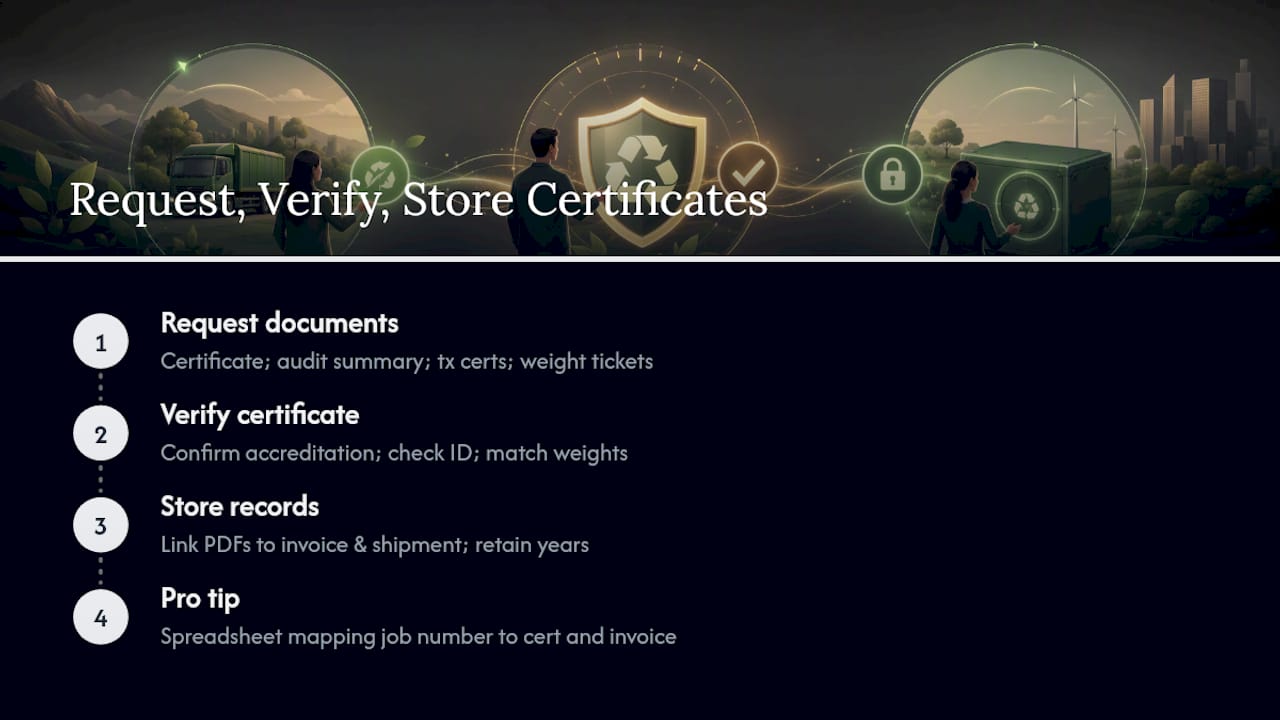
When you request paperwork from a recycler, ask for the certificate itself, an audit summary if they’re third-party certified, transaction certificates for any recycled-content claims, and the underlying weight tickets. Verification comes down to three checks worth memorizing: confirm the certifier’s accreditation, cross-check the certificate ID against the issuer’s records, and match reported weights and job numbers to your original shipment paperwork.
For recordkeeping, keep certificates as PDFs linked directly to the corresponding invoice and shipment record, not floating in a shared drive disconnected from context. Most audit frameworks expect retention for several years past the transaction.
Pro Tip: Build a simple spreadsheet mapping job number to certificate ID to invoice number. It takes ten minutes and saves hours when an auditor asks for backup on a specific shipment.
Building an Audit-Ready Certificate Template
A usable template needs specific fields, not vague categories. At minimum, structure yours around: certificate ID, issue date, material description, quantity in specific units, job number, processing facility name, certifying body (if applicable), and an authorized signature.
Pair the certificate with supporting documents auditors will actually ask to see:
- Bill of lading from the original pickup
- Weight tickets from the processing facility
- Manifests for hazardous or regulated material streams
- Transaction certificates for recycled-content claims
- Audit summary reports, if the recycler holds third-party certification
Adapt the template by material stream. Electronics need data destruction confirmation alongside recycling proof. Batteries need hazard classification codes. Plastics need resin type and post-consumer percentage if recycled-content claims are involved.
What Compliance Teams Get Wrong About Recycling Documentation
Usedcartridge issues certificates covering pickup weights, job numbers, and chain of custody for every service completed, because we’ve watched too many compliance programs accept a one-line receipt and assume it will hold up under scrutiny. The most common mistake we see: companies file the paperwork without ever matching reported weights to the invoice, then discover the mismatch during an actual audit, when it’s expensive to fix. The second most common: treating a signature as proof of certification, when a real audit trail requires an accreditation reference you can independently check.
— Keith
Get Audit-Ready Certificates Without the Paperwork Chase
Usedcartridge is the direct alternative to chasing down mismatched receipts after the fact. Instead of piecing together weight tickets, job numbers, and vague vendor confirmations across multiple emails, you get one documented chain of custody from pickup through final disposition, built into the service itself rather than requested as an afterthought.

Every job includes on-site destruction options for sensitive equipment, documented processing weights, and a certificate that ties directly back to your job number and invoice, the exact fields auditors ask for. Whether you’re clearing out end-of-life computers, decommissioning IT assets, or managing routine e-waste at scale, the documentation arrives as part of the job, not as a separate favor. If your compliance calendar has an audit coming up, request a quote now so the paperwork is already in hand before anyone asks for it.
Where to Verify Recycling Standards and Certification Rules
Before accepting any certificate at face value, check it against the standard it claims to follow. The e-Stewards certification page explains audit frequency and scope. The RCS implementation manual covers transaction certificates and chain-of-custody rules in detail. For understanding why third-party verification matters for recycled-content claims generally, the Association of Plastic Recyclers guidance lays out the case plainly, and it applies well beyond plastics.
Sources
- e-Stewards Electronic Recycling Certification – Amtivo
- Proof, Not Promises: Verify Recycled Plastic with Third-Party Certification – Association of Plastic Recyclers (APR)
- Recycled Claim Standard (RCS) implementation manual