
Most IT asset managers and business owners assume electronics recycling is straightforward: schedule a pickup, hand off the equipment, done. But that assumption has cost organizations thousands, and in some cases, far more. Businesses face real financial penalties when they fail to meet electronics recycling requirements, and the enforcement landscape is tightening every year. This article breaks down the actual risks, explains what compliance really requires, and gives you a practical framework to protect your organization while turning compliance into a genuine operational advantage.
Table of Contents
- The real risks of ignoring electronics recycling compliance
- What makes electronics recycling compliance so complex?
- How chain-of-custody and audit trails ensure compliance
- Certifications and standards: The pillars of compliant recycling
- Practical strategies for maintaining compliant electronics recycling
- The overlooked truth: Compliance is a business value driver, not just risk management
- Take the next step: Secure, compliant electronics recycling made easy
- Frequently asked questions
Key Takeaways
| Point | Details |
|---|---|
| Non-compliance is costly | Ignoring electronics recycling rules can result in major penalties and damage to your company’s reputation. |
| Regulation is complex | Jurisdictional patchwork and export controls demand careful, ongoing compliance processes. |
| Chain-of-custody is critical | End-to-end tracking and audit trails are central to proving compliance and preventing gaps. |
| Certifications matter | Working with certified recyclers ensures industry-standard best practices for data and environmental protection. |
| Compliance is strategic | Treating compliance as core business discipline gives lasting efficiency, trust, and risk reduction. |
The real risks of ignoring electronics recycling compliance
The financial exposure is the first thing to understand. Regulators in California, for example, can impose penalties up to $70,000 per day for violations of electronics recycling laws. That is not a number reserved for industrial polluters. Small and mid-sized businesses have faced enforcement actions for paperwork failures, using uncertified recyclers, or simply not knowing which regulations applied to them. Ignorance is not a recognized defense.
Beyond fines, the environmental stakes are significant. Electronics often contain hazardous components like lead-bearing CRT glass, mercury, and cadmium. When these materials are mismanaged, they contaminate soil and groundwater, and regulators have steadily tightened rules to ensure these materials are tracked and handled safely at every step of the process. The EPA continues to strengthen e-waste regulatory enforcement precisely because improper disposal creates lasting environmental harm.
The reputational risk is less obvious but often just as damaging. When a device leaves your building without proper documentation, you lose control of what happens to the data it contains and how the materials are processed. A data breach traced back to improperly disposed equipment is a trust crisis that no organization recovers from quickly. Customers, partners, and auditors all take notice.
Key financial and operational risks at a glance:
| Risk category | Example consequence | Triggering factor |
|---|---|---|
| Regulatory fines | Up to $70,000 per day (California) | Using uncertified recyclers |
| Data breach liability | Lawsuits, regulatory action | Undocumented device disposal |
| Environmental penalties | Cleanup costs, civil action | Improper hazardous material handling |
| Reputational damage | Customer loss, audit failure | Public enforcement action |
| Export violations | Federal prosecution | Unlicensed cross-border e-waste shipment |
Before you can manage these risks, you need to understand what makes compliance genuinely complex. That is where most organizations fall short.
What makes electronics recycling compliance so complex?
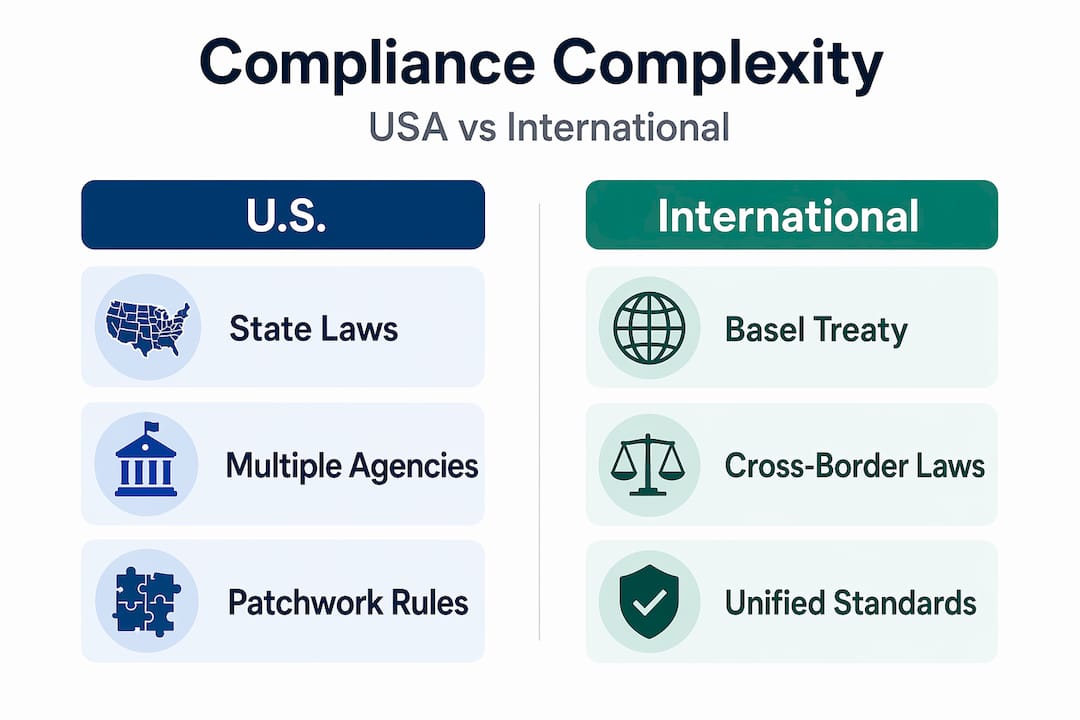
Most businesses expect a single, unified set of rules. What they find instead is a patchwork. Compliance in the U.S. is jurisdictional, meaning California, New York, Texas, and every other state may have different requirements for what qualifies as e-waste, how it must be handled, and who is certified to process it. A recycling program that is fully compliant in one state can fall short in another.
Internationally, the complexity multiplies. The Basel Convention’s e-waste amendments have expanded regulatory controls on cross-border shipments, requiring detailed notification and permitting processes for electronics exported to other countries. If your organization operates globally or uses vendors who export materials, you are now responsible for knowing whether those movements are properly authorized. This has become one of the most common compliance gaps in large enterprises.
The practical implications of this complexity are significant:
- Identify applicable rules by jurisdiction. Know which states and countries your assets move through, not just where they originate.
- Track regulatory updates actively. Rules change. A vendor or process that was compliant last year may not meet current standards.
- Document each handoff in the chain. Compliance is a series of documented steps, not a single signed receipt.
- Verify downstream processors. Your liability does not end when your recycler picks up the equipment. You are responsible for knowing what happens next.
- Integrate compliance into procurement. Vendor contracts should specify certification requirements and documentation expectations before equipment ever leaves your facility.
For organizations managing responsible IT disposal across multiple locations, this means building compliance into every stage of the IT asset lifecycle, not treating it as an afterthought at end of life.
Pro Tip: Build a jurisdiction matrix for your organization. List every state or country where your equipment originates, is processed, or is exported, and document the applicable regulations for each. Review it quarterly, because rules shift more often than most teams expect.
Comparison of U.S. vs. international compliance requirements:
| Compliance dimension | U.S. domestic | International (Basel Convention) |
|---|---|---|
| Regulatory framework | State-by-state patchwork | Multilateral treaty obligations |
| Documentation level | Varies by state | Notification and permit required |
| Hazardous material tracking | EPA and state rules | Stricter for transboundary movement |
| Data destruction standards | NIST 800-88 widely referenced | Varies by destination country |
| Enforcement authority | EPA, state agencies | Customs and national authorities |
How chain-of-custody and audit trails ensure compliance
Chain-of-custody is the backbone of any defensible compliance program. It means documented, verified control over every device from the moment it is flagged for retirement through pickup, processing, destruction, and final disposition. A gap anywhere in that chain is a compliance liability.

End-to-end chain-of-custody with serialized, audit-ready records is the core methodology that separates organizations that pass audits from those that scramble during them. Serialization means each device gets a unique identifier that follows it through every step. When an auditor asks what happened to asset number 4,872, you should be able to answer with timestamps, handler names, and final disposition documentation.
Where compliance programs typically break down:
- Undocumented downstream processing. Your recycler may subcontract to a third party. If that subcontractor lacks certification and documentation, the gap becomes your liability.
- Fragmented internal tracking. Different departments using different asset tags, spreadsheets, or systems create tracking inconsistencies that are impossible to reconcile at audit time.
- Unverified recyclers creating audit gaps. Selecting a vendor based solely on price, without verifying their certification and documentation practices, is one of the most common causes of compliance failure.
- Missing certificates of destruction. A signed certificate from a certified vendor is your primary proof of compliant disposal for data-bearing devices.
- Delayed documentation. Records created weeks after the fact are harder to defend and easier to challenge.
“A chain-of-custody record is only as strong as its weakest handoff. One undocumented transfer can invalidate an otherwise robust compliance program.”
When you review your device recycling preparation steps, build documentation requirements into each step rather than collecting paperwork at the end. That shift alone significantly improves audit readiness.
Pro Tip: Require your recycling vendor to provide serialized manifests at pickup, not just a generic receipt. The manifest should list individual asset serial numbers, device types, and the handler responsible for each stage of processing.
Certifications and standards: The pillars of compliant recycling
Certifications are not marketing labels. For IT asset managers, they are the most efficient way to verify that a recycling partner meets recognized standards for safety, data destruction, and environmental controls. Recognized third-party certifications serve as operational benchmarks across four critical dimensions: sanitization methods, chain-of-custody procedures, health and safety practices, and downstream controls.
The certifications that matter most:
- R2v3 (Responsible Recycling): The most widely recognized U.S. standard for electronics recyclers. Requires documented data sanitization, safe handling of hazardous materials, and verified downstream processing.
- e-Stewards: A stricter certification that prohibits export of hazardous e-waste to developing countries and requires robust environmental and worker safety standards.
- NAID AAA: The gold standard for data destruction services. Covers physical destruction, degaussing, and software-based sanitization methods with regular third-party audits.
- NIST 800-88 (Guidelines for Media Sanitization): A federal standard widely used as a benchmark for data destruction methods across sectors. Specifying NIST 800-88 compliance in your vendor contracts sets a clear, defensible bar.
Working with vendors certified to these standards gives you something critical: defensibility. When a regulator, auditor, or client asks how you handled end-of-life equipment, you can point to specific, recognized standards that governed every step.
The equipment destruction standards you require from vendors should appear explicitly in your service contracts. Do not assume a certification is current. Ask for the certificate date and verify through the certifying body’s public registry if one is available.
Pro Tip: When evaluating a new recycling vendor, ask for their last third-party audit report, not just proof of certification. Audit reports reveal how a vendor performed against standards in practice, which tells you far more than a certificate alone.
Visit our certified data destruction guide and IT asset recovery compliance tips for a deeper look at how to structure vendor requirements.
Practical strategies for maintaining compliant electronics recycling
Knowing the rules and actually embedding them into daily operations are two different challenges. The organizations that consistently pass audits treat compliance as a controlled IT asset lifecycle process, from procurement through verified end-of-life. They do not treat disposal as a separate event. Disposal is the final step in a documented journey that starts when the asset is purchased.
Practical strategies to build into your program:
- Add compliance language to vendor contracts. Specify required certifications, documentation formats, audit rights, and downstream processing restrictions before signing. Revisit these terms annually.
- Standardize your asset tracking system. Use a single platform across all departments and locations. Inconsistent asset numbering between departments is one of the most common audit vulnerabilities.
- Schedule regular internal compliance reviews. Do not wait for an external audit to find gaps. Quarterly internal reviews let you catch documentation failures and process drift before they become regulatory exposure.
- Train staff who handle equipment. The person wiping a drive or boxing up equipment for pickup should understand their role in the documentation chain, not just the physical task.
- Require certificates of destruction for every device. For data-bearing devices, documentation supports both audit readiness and legal risk management simultaneously.
For organizations running secure equipment recycling programs, the goal is a process that generates clean documentation automatically, not one that requires a scramble every time an auditor asks a question.
Pro Tip: Create a single-page compliance checklist for every device retirement event. It should cover asset tag confirmation, data sanitization method, handler verification, chain-of-custody documentation, and certificate of destruction receipt. Keep completed checklists in a centralized, searchable archive.
The overlooked truth: Compliance is a business value driver, not just risk management
Here is the perspective most compliance conversations miss entirely. The organizations that treat electronics recycling compliance as a pure cost center are thinking about it wrong. They see audits as interruptions, certifications as overhead, and documentation as busywork. That mindset is both expensive and strategically backwards.
The IT asset managers who have seen the most value from compliance programs are the ones who reframed it early. They recognized that a clean, documented disposal process is also a selling point. Clients in regulated industries, such as healthcare, finance, and government contracting, increasingly require proof of compliant disposal practices from their technology vendors and service partners. If you can hand a prospective client a sample certificate of destruction and explain your chain-of-custody process, you have just differentiated yourself from a competitor who cannot.
There is also a process efficiency angle that rarely gets discussed. Organizations that build compliance into their IT lifecycle workflows discover that the documentation infrastructure they create for regulatory purposes also helps them manage assets better in general. Serialized tracking, scheduled reviews, and standardized handoff procedures reduce equipment loss, catch unauthorized disposal, and surface assets that could be recovered for reuse rather than retired at full cost.
Our compliance and ROI tips explore this further, but the core idea is simple: a compliance program that runs smoothly also runs efficiently. And an efficient IT disposal process creates measurable bottom-line value, not just regulatory protection.
The uncomfortable truth is that organizations that wait for an enforcement action to get serious about compliance almost always spend more than those who built it right the first time. The investment in certifications, documentation systems, and trained vendors pays back through avoided fines, cleaner audits, and the competitive advantage of being the organization that can actually prove what happened to every device.
Take the next step: Secure, compliant electronics recycling made easy
Moving from awareness to action does not have to be complicated. The right partner handles the documentation, certifications, and chain-of-custody requirements so your team focuses on core operations rather than compliance logistics.

UsedCartridge.com provides certified, audit-ready business e-waste recycling services that cover everything from secure pickup through verified destruction and final processing. If data destruction best practices are a priority for your organization, we can provide on-site destruction with serialized documentation and certificates that satisfy even the most demanding auditors. Ready to see what a compliant program looks like for your specific situation? Request an IT asset compliance quote and get a clear picture of exactly what your organization needs.
Frequently asked questions
What are the consequences of non-compliant electronics recycling?
Businesses face substantial fines and reputational damage for electronics recycling violations, with penalties up to $70,000 per day reported in California alone. Liability can also extend to data breach lawsuits if improperly disposed devices expose sensitive information.
How can I prove my organization is compliant with e-waste rules?
Maintain serialized asset records, chain-of-custody documentation, and certificates of destruction from certified vendors. End-to-end audit-ready records from pickup through final disposition are the core of a defensible compliance program.
What certifications should I require from my electronics recycling partners?
R2v3, e-Stewards, and NAID AAA certifications demonstrate adherence to recognized recycling and data-destruction standards. Recognized third-party certifications serve as operational benchmarks across sanitization, chain-of-custody, safety, and downstream controls.
Does compliance only matter for hazardous e-waste?
No. Data-bearing and non-hazardous devices still require documentation and may be subject to regulatory controls, especially for exports. Compliance is jurisdictional and can vary by material and process, so all device types need to be managed within a formal program.
Are compliance requirements different in other countries?
Yes. International rules differ significantly, and Basel Convention amendments now require rigorous documentation, notifications, and approvals for cross-border e-waste movements. Organizations with global operations must account for destination-country requirements, not just rules at the point of origin.