
The IT disposal documentation process is the systematic recording of every action taken on a retiring IT asset, from initial inventory through data destruction to final disposition. Compliance officers and IT managers who treat this process as a checkbox exercise routinely fail audits and expose their organizations to regulatory penalties. The three documents that define this process are the Certificate of Data Destruction, the Chain of Custody Record, and the Asset Disposition Summary. Together, they create the audit trail that regulators, insurers, and courts demand. Understanding safe IT asset disposal starts with understanding what these documents must contain and why each one matters.
What are the essential documents in the IT disposal documentation process?
The Certificate of Data Destruction is the most scrutinized document in any IT disposal audit. It must identify each device by its unique serial number, specify the destruction method used (such as NIST 800-88 overwriting, degaussing, or physical shredding), and carry the name and signature of the verifying technician. Batch certificates without device-specific details are insufficient for rigorous audits and can cause direct compliance failures. Every asset must be linked to its destruction method, verification technician, and date.
The Chain of Custody Record captures every transfer of physical possession from the moment an asset leaves your facility. Each entry requires a timestamp, the names of the releasing and receiving parties, and a signature. Chain of custody documentation provides a legal liability shield by proving each asset’s movement, custody holders, condition, and timestamps, protecting against vendor disputes claiming asset loss. This document is your primary legal defense if a vendor later claims an asset was never received.

The Asset Disposition Summary is an aggregate report covering all assets disposed of in a given cycle. It records disposal outcomes, the vendor used, environmental compliance status, and whether assets were resold, recycled, or destroyed. Certificates of Recycling belong in this package as well, particularly for organizations subject to environmental reporting under regulations like the Resource Conservation and Recovery Act (RCRA).
Retention is non-negotiable. Organizations must retain chain of custody and destruction documentation for a minimum of 7 years under most 2026 regulations, with some defense contracts requiring permanent retention. Seven years covers most statute of limitations windows for data breach litigation.
Core document requirements at a glance:
- Certificate of Data Destruction: unique serial number, destruction method, technician name, date, and signature
- Chain of Custody Record: timestamps, party names, signatures at every transfer point, and asset condition notes
- Asset Disposition Summary: aggregate outcomes, vendor identification, and environmental compliance status
- Certificate of Recycling: downstream processor identity, material weights, and regulatory compliance confirmation
- All records: stored in tamper-evident systems with access logging enabled
Pro Tip: Request digital certificates with blockchain verification from your ITAD vendor. These offer a stronger audit trail than paper certificates and are far harder to dispute in a breach investigation.
| Document | Key Required Fields | Retention Standard |
|---|---|---|
| Certificate of Data Destruction | Serial number, method, technician, date | 7 years minimum |
| Chain of Custody Record | Timestamps, party names, signatures | 7 years minimum |
| Asset Disposition Summary | Outcomes, vendor, environmental status | 7 years minimum |
| Certificate of Recycling | Processor identity, material weights | 7 years minimum |
How should organizations organize IT disposal documentation for audit readiness?
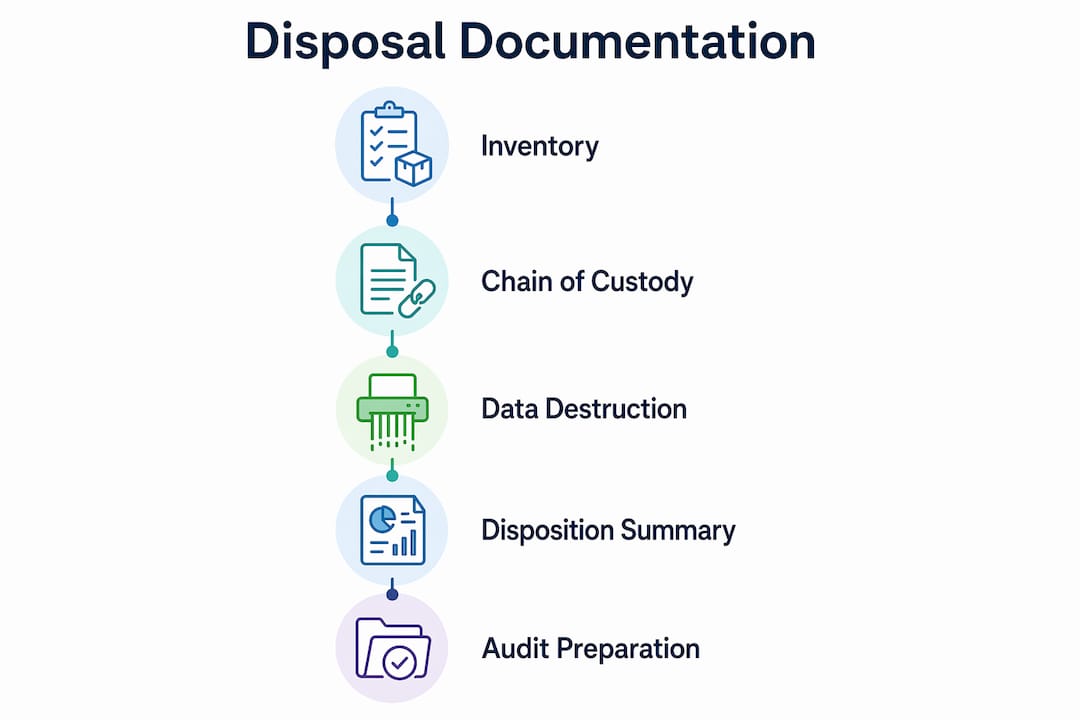
Most organizations file disposal records by date. Auditors do not work that way. Organizing disposal documentation by control function rather than chronologically aligns files with auditor expectations and dramatically reduces the time needed to respond to audit requests. The four control categories are governance (policy documents and vendor contracts), inventory (asset registers and pre-disposal reports), sanitization proof (Certificates of Destruction), and chain of custody (transfer records and transport logs).
Digital documentation systems outperform paper filing in every measurable way, but they introduce their own risks. Access control failures, inadequate backup schedules, and poor data residency decisions can all compromise a digital record set. Your system must enforce role-based access, generate access logs automatically, and store backups in a geographically separate location. Automated asset retirement approvals coupled with validation of ownership, data classification, and hold status before disposal proceeds reduce human error and keep the workflow compliant.
Common audit traps that organizations fall into include:
- Generic batch certificates that cover multiple devices without individual serial numbers
- Inventory discrepancies where the number of assets sent to a vendor does not match the number of certificates returned
- Chain of custody gaps caused by undocumented internal transfers before the vendor pickup
- Documents filed chronologically rather than by control category, forcing auditors to search manually
- Missing litigation hold flags on assets that should not have been disposed of
Pro Tip: Run a quarterly spot check by pulling 10 random Certificates of Destruction and verifying each serial number against your master asset inventory. This single practice catches reconciliation errors before an auditor does.
The role of documentation in e-waste management extends beyond internal compliance. Regulators, insurers, and clients increasingly request proof of responsible disposal as a condition of doing business. Organizations that treat documentation as a living system rather than a post-disposal formality consistently outperform peers in audit outcomes.
What are the step-by-step procedures for secure IT disposal documentation?
A complete IT asset disposal procedures workflow runs through five distinct phases. Each phase generates specific documents, and gaps in any phase create audit vulnerabilities.
-
Initial asset inventory. Before any asset moves, record its make, model, serial number, asset tag, physical condition, and data classification level. Photograph each device. This inventory becomes the baseline against which all downstream documents are reconciled.
-
Custody transfer at pickup. When a vendor collects assets, both parties sign a pickup manifest listing every device by serial number. Verify the vendor’s credentials and certifications at this stage. Signed custody transfer forms are a required element of a defensible chain of custody, not an optional formality.
-
Transportation tracking. Require GPS tracking confirmation or a signed delivery receipt from the processing facility. This step closes the gap between your facility and the vendor’s facility. Without it, you cannot prove where the asset was between those two points.
-
Data sanitization documentation. Each device must generate its own sanitization record, specifying the method used, the technician who performed it, and a before-and-after verification result. NIST 800-88 provides the standard framework for acceptable sanitization methods. Per-device Certificates of Destruction including unique serial numbers and destruction methods are critical to successful audits.
-
Final disposition certificate. The vendor issues a final summary document confirming the destruction method, date, witnessing personnel, and environmental disposition of materials. This document closes the loop on the entire process.
| Disposal phase | Document generated | Key verification point |
|---|---|---|
| Initial inventory | Asset register with photos | Serial number and data classification confirmed |
| Pickup | Signed pickup manifest | Vendor credentials verified |
| Transportation | GPS log or delivery receipt | Continuous custody confirmed |
| Sanitization | Per-device Certificate of Destruction | Method and technician recorded |
| Final disposition | Disposition summary certificate | Environmental compliance confirmed |
Pro Tip: Assign a single internal owner to each disposal batch. That person signs off at every phase transition. Distributed responsibility is the fastest path to documentation gaps.
How do compliance audits evaluate IT disposal documentation?
Auditors spend about 60% of their compliance audit time reconciling the master asset inventory database against individual Certificates of Destruction. Discrepancies between these two records are the leading cause of audit failure. A single unresolved mismatch signals to an auditor that your process lacks controls, which typically triggers a deeper review of the entire disposal program.
The most frequent mistakes that compliance officers and IT managers make include filing generic batch certificates, accepting partial serial number matches from vendors, and failing to flag assets under litigation hold before disposal proceeds. Each of these errors is avoidable with a checklist-driven approval workflow.
“Chain of custody documents are not just operational records. They serve as primary legal evidence to protect organizations from vendor claims and loss liabilities.” — IT Asset Disposal Policy Best Practices
Tabletop exercises are the most underused tool in IT waste management compliance programs. Run a simulated audit twice a year using your actual documentation. Assign one team member to play the auditor role and attempt to reconcile 20 random assets from the master inventory to their Certificates of Destruction. Every gap found internally is a gap that will not surprise you during a real audit. For guidance on electronics disposal planning, building these drills into your annual calendar is a concrete step toward sustained compliance.
Exception reporting matters as much as the primary documentation. When an asset cannot be reconciled, the exception must be documented with an explanation, a corrective action, and a resolution date. Leaving exceptions unresolved is treated by auditors as evidence of systemic failure, not isolated error.
Key Takeaways
The IT disposal documentation process succeeds only when per-device records, control-category filing, and continuous chain of custody combine into a single auditable system.
| Point | Details |
|---|---|
| Per-device certificates are mandatory | Batch certificates without serial numbers fail audits and expose organizations to compliance penalties. |
| Retain records for 7 years minimum | Most 2026 regulations require this retention period; defense contracts may require permanent storage. |
| File by control category, not date | Organizing by governance, inventory, sanitization, and custody aligns directly with auditor workflows. |
| Chain of custody is a legal document | Timestamped transfer records protect your organization from vendor disputes and loss liability claims. |
| Run internal audit drills twice yearly | Tabletop reconciliation exercises catch documentation gaps before regulators do. |
Why I think most organizations are solving this problem backwards
Most compliance teams I have seen treat disposal documentation as a post-event task. The devices leave the building, the vendor sends a certificate weeks later, and someone files it. That sequence is the root cause of most audit failures I have observed.
The documentation process must start before the first asset moves. The moment a device is flagged for retirement, its serial number, data classification, and hold status should be locked in a record. Every subsequent action, pickup, transport, sanitization, and final disposition, adds to that record rather than creating a new one. When you build documentation forward from retirement rather than backward from destruction, reconciliation becomes trivial.
I have also seen organizations accept batch certificates from vendors without pushing back. Vendors issue batch certificates because they are faster to produce. That efficiency benefit belongs entirely to the vendor. The compliance risk belongs entirely to you. Demand per-device destruction certificates as a contractual requirement, not a request. If a vendor cannot provide them, that vendor is not the right partner for regulated data environments.
The final point I would make is about training. Documentation quality degrades when the people executing the process do not understand why each field matters. A technician who does not know that a missing serial number can invalidate an entire certificate will not treat that field as critical. Brief, quarterly training sessions tied to real audit findings from your own records change that behavior faster than any policy document.
— Keith
How Usedcartridge supports compliant IT asset disposal

Usedcartridge provides certified data destruction, chain of custody support, and environmental recycling services built for organizations that cannot afford documentation gaps. Every disposal engagement generates per-device Certificates of Destruction, signed pickup manifests, and a final disposition summary, giving compliance officers and IT managers the audit-ready records they need from day one. Usedcartridge’s secure data destruction services cover hard drives, servers, and full IT asset loads, with on-site destruction available for the highest-sensitivity environments. For organizations ready to move from documentation risk to documentation confidence, an IT asset recovery quote is the fastest way to get started.
FAQ
What documents are required in an IT disposal documentation process?
The core documents are the Certificate of Data Destruction, the Chain of Custody Record, and the Asset Disposition Summary. Each must include device-specific serial numbers, destruction methods, technician verification, and timestamps.
How long must IT disposal records be retained?
Most 2026 regulations require a minimum retention period of 7 years for chain of custody and destruction documentation. Some defense and government contracts require permanent retention.
Why do batch certificates of destruction fail compliance audits?
Batch certificates lack the device-specific serial numbers and destruction details that auditors require to reconcile individual assets. Each asset must be linked to its own certificate to satisfy rigorous audit standards.
What is the most common cause of IT disposal audit failure?
Discrepancies between the master asset inventory and individual Certificates of Destruction are the leading cause of audit failure. Auditors spend the majority of their review time on this reconciliation.
How does chain of custody documentation protect organizations legally?
Chain of custody records provide timestamped proof of every asset transfer, custody holder, and condition change. This documentation serves as primary legal evidence in vendor disputes and breach investigations.