
Secure server recycling typically runs $50 to $200 per unit for standard processing and data destruction, though full data-center decommissioning projects often price out per pound ($0.25 to $1.50) or as flat project bids starting around $10,000. Vendors quote in four main ways: per-unit, per-pound, revenue-share (where resale value offsets your bill), or project-based for large refreshes. Newer enterprise servers frequently cost nothing net, or even generate a payment back to you, once resale value is applied against destruction and logistics fees.
TL;DR:
- Resalable enterprise servers in recent three to five years can often generate enough resale value to offset or even cover the entire recycling cost through revenue-share models.
- Cost per server typically ranges from $50 to $200, with higher expenses for servers requiring certified destruction or complex handling, especially for SSDs.
- Large decommissioning projects priced as flat bids usually start around $10,000 and can go well above $100,000, including transport, destruction, and reporting.
- The actual bill fluctuates based on factors like server age, drive count, media type, handling complexity, and batching efficiency; sorting inventory beforehand saves money.
- Vendors must provide detailed documentation, including certificates of destruction and chain-of-custody, especially when data privacy compliance is involved.
Table of Contents
- How Much Does Server Recycling Cost Per Unit?
- What Actually Drives Your Server Recycling Bill Up or Down?
- Can Server Resale Value Actually Offset Recycling Costs?
- What Data Destruction Methods and Certifications Should You Require?
- What Pickup Fees and Timelines Should You Expect?
- How Do You Request and Compare Server Recycling Quotes?
- How UsedCartridge Handles Server Recycling From Pickup to Certificate
- When Server Recycling Is a Cost vs. When It Pays You Back
- Get a Straight Answer on What Your Server Fleet Is Actually Worth
- Sources
- FAQ
How Much Does Server Recycling Cost Per Unit?
The number on a vendor’s invoice depends almost entirely on what happens to the drives inside the machine. A basic server with no special data-sanitization requirement, minimal drives, and easy loading-dock access lands at the low end of the range. A rack-mounted unit loaded with a dozen SSDs that all need certified destruction, pulled from a data hall with no freight elevator, sits at the high end, sometimes well past it once you add labor and special handling.
Industry benchmarking puts flat per-server fees at $50 to $200, depending on complexity and the sanitization method required. A separate cost estimator frames a more conservative baseline of $15 to $50 per server for basic processing, before data destruction and logistics get added as line items. Both figures are directionally consistent: expect $50 to $150 to be your realistic planning range for a mid-size fleet with standard drive counts, and budget toward the top of that band if every drive needs certified physical destruction rather than a software wipe.
| Pricing Model | How It Works | Typical Range | Best Fit |
|---|---|---|---|
| Per-unit (flat fee) | Fixed price per server regardless of weight | $50–$200 per server | Small to mid-size fleets with mixed models |
| Per-pound | Priced by total weight of equipment | $0.25–$1.50 per pound | Bulk decommissions, mixed hardware types |
| Revenue-share/buyback | Vendor sells recovered assets, splits proceeds with you | 60/40 to 80/20 splits | Newer, working, resalable servers |
| Project-based | Single fixed bid for the entire job | $10,000–$100,000+ | Full data-center decommissioning |
Per-pound pricing shows up most often when a facility is clearing out a mixed pallet of servers, switches, and cabling with no interest in itemizing each device. It simplifies invoicing but can work against you if your fleet includes several higher-value units that would have sold for real money individually.
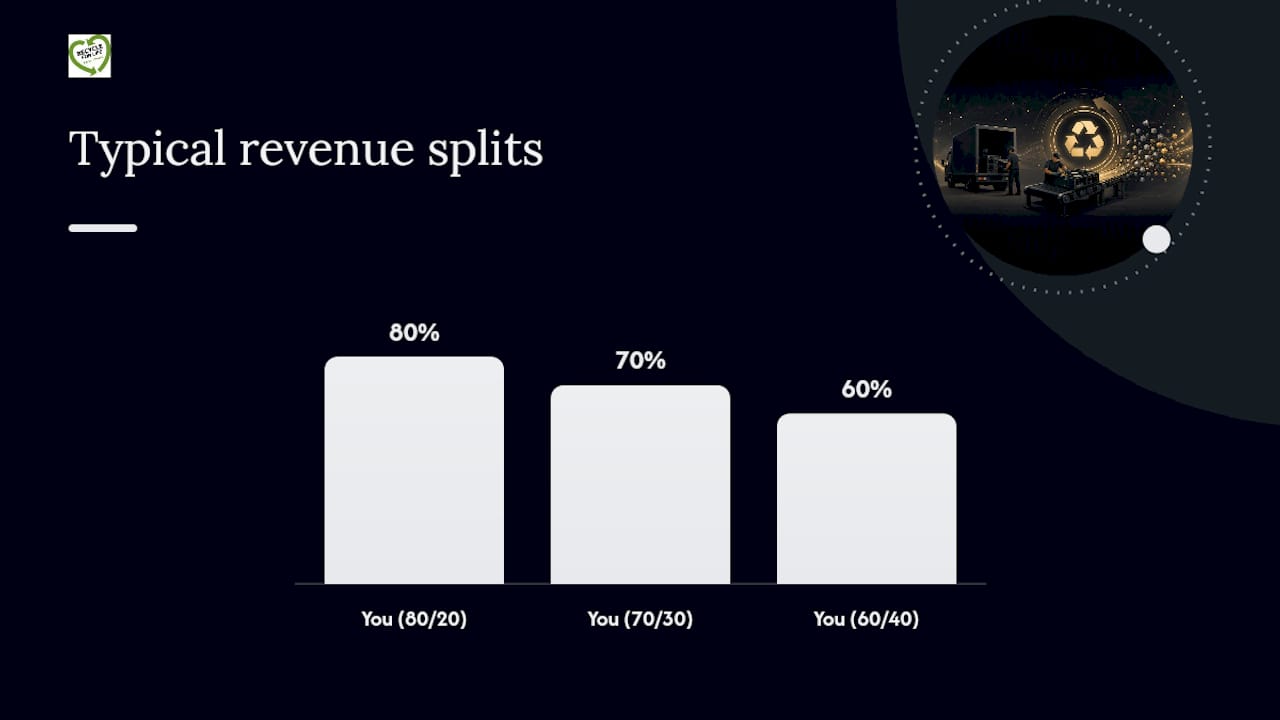
Revenue-share and buyback arrangements calculate a split of resale proceeds after the vendor covers processing costs. A 70/30 vendor-to-customer split is common for older equipment, while newer hardware in working condition sometimes commands 80/20 in the customer’s favor. The math only works in your favor if you know what your gear is worth before you sign anything.
Project-based pricing takes over once you’re retiring dozens or hundreds of units at once, typically for a full rack-and-stack teardown or a colocation exit. These bids run $10,000 to $100,000 or more for large-scale jobs, according to ITAD cost benchmarking data, and usually bundle transport, destruction, and reporting into one number. A few things determine which model makes sense for your situation:
- Fleets under 20 servers usually do better with per-unit pricing, since it’s easier to compare quotes line by line.
- Mixed-condition inventory (some working, some dead) often benefits from revenue-share, so you’re not overpaying flat fees on units worth reselling.
- Full-facility decommissions almost always land better as project-based bids, since vendors can price the labor and logistics as one job instead of piecing it out.
- Ask every vendor to show their math regardless of model. A revenue-share quote with no stated split percentage is not a real quote.
What Actually Drives Your Server Recycling Bill Up or Down?
Two identical-looking racks of servers can generate wildly different invoices. The difference almost never comes down to the vendor being greedy. It comes down to a handful of variables that most IT managers don’t think to ask about until the quote arrives.
Age and configuration set the ceiling on resale value, which is the single biggest swing factor in your net cost. A three-year-old dual-socket server with recent-generation processors and a full memory bank might be worth reselling for parts or refurbishment. A ten-year-old unit with obsolete processors is scrap weight, period, and you’ll pay to have it hauled away rather than get paid for it.
Drive count and media type change the sanitization bill more than almost anything else. A server with eight SSDs costs more to sanitize than one with two spinning HDDs, since certified destruction or shredding fees run higher for solid-state drives due to the extra handling required to physically destroy flash memory versus a mechanical platter. If your fleet is SSD-heavy, expect your per-drive destruction line item to be noticeably higher than a legacy HDD-based environment.
Physical handling adds fees that catch a lot of facility managers off guard. Rack removal from a raised floor, multi-floor moves with no freight elevator, and heavy cabinets that need a lift gate on the truck all show up as separate charges. UPS units and server batteries carry their own hazardous-material handling requirements, which typically means an added fee per unit rather than a bundled rate.
Volume works in your favor, but only if you plan for it. Batching your retirements into a single scheduled pickup, rather than calling a vendor every time one server dies, cuts your per-unit transport cost substantially. Batching retirements on a quarterly or semi-annual cycle can lower per-device transport costs by 40 to 60 percent compared to one-off pickups.
Pro Tip: Before you request a quote, sort your inventory into three buckets: resalable working units, units needing certified destruction only, and units needing both. Vendors price these completely differently, and a mixed quote request almost always produces a worse rate than a segmented one.
Can Server Resale Value Actually Offset Recycling Costs?
Yes, and for newer equipment it often does more than offset costs. It can turn what looks like an expense line into a net credit. The catch is that most businesses never find out, because they accept a “free” recycling offer without asking what the vendor recovers on the back end.
Enterprise servers built in the last three to five years, especially those with usable processors and enough RAM to be worth refurbishing, can resell anywhere from roughly $500 to $5,000 or more depending on the model and configuration. A single rack of a dozen such units, sold through a revenue-share arrangement, can generate enough proceeds to cover destruction fees for an entire fleet refresh with money left over.
Revenue splits are the mechanism that determines whether that value reaches you or stays with the vendor. A 70/30 split (vendor takes 30 percent, you get 70) is standard for mixed-age equipment. Newer, higher-demand hardware sometimes commands an 80/20 split in your favor, while older or partially functional units might only justify 60/40. Run the numbers before you agree to any split:
- A small fleet of 15 recent-model servers, mostly working, split 80/20: if resale nets $18,000 total, you keep $14,400 after destruction and logistics fees are deducted from the vendor’s cut.
- A large data-center refresh of 300 mixed-age units at 70/30: older units contribute little, but the working subset can still fund most of the project’s destruction and transport costs.
- A fleet of end-of-life units with no resale value: you’re paying flat per-unit or per-pound fees with no offset, and that’s the scenario where cost-center thinking applies.
A public ITAD calculator shows that projects involving modern, working assets frequently net a refund back to the seller once minimal certified-destruction costs are subtracted, while projects dominated by broken or obsolete gear tend to run cost-positive for the vendor instead.
Watch for vendors advertising completely free pickup and recycling with no mention of what happens to resale proceeds. Free offers often mean the vendor keeps 100 percent of whatever recovery value exists, which might be a fine trade for a pile of dead laptops but a bad one for a rack of recent enterprise servers worth real money. Ask directly: if my equipment resells, where does that money go?
What Data Destruction Methods and Certifications Should You Require?
The sanitization method you choose changes both your cost and your legal exposure, and the two don’t always move in the same direction. A cheaper method that leaves you without documentation can cost far more later in breach liability or failed compliance audits than the money you saved upfront.
Three main options exist. A logical wipe overwrites data on a drive that will be reused or resold, and it’s the cheapest option when the drive is healthy enough to be repurposed. A certified purge, following the NIST Special Publication 800-88 media sanitization guidelines, uses cryptographic erasure or multiple-pass overwriting to render data unrecoverable while keeping the drive intact for resale. Physical destruction, whether shredding or crushing, is the most expensive per-drive but the only option that satisfies some regulatory frameworks outright, since there’s no drive left to audit or fail.
Certified media destruction and shredding typically carry per-drive fees that run higher for SSDs than HDDs, reflecting the extra mechanical work required to fully destroy flash memory chips rather than a single spinning platter.
Requiring documentation isn’t optional if you’re subject to any data-privacy regulation. At minimum, ask for:
- A certificate of destruction listing serial numbers, destruction method, and date, issued per batch or per device.
- A chain-of-custody record tracking every asset from pickup to final disposition, so nothing goes missing between your loading dock and the shredder.
- Audited reporting showing sanitization method matched against NIST 800-88 standards or an equivalent framework your compliance team recognizes.
- Confirmation of on-site witnessed destruction if your data classification requires it, understanding that watching a mobile shredder truck do the work on your property typically costs more than off-site processing.
Vendors that refuse to provide itemized documentation are a red flag worth taking seriously, regardless of how competitive their price looks. A guide to certified hard drive destruction walks through what a compliant process should include if you want to compare your vendor’s documentation against a baseline before you sign.
What Pickup Fees and Timelines Should You Expect?
Getting the equipment out of your building costs money separate from what it costs to destroy it, and this is the line item most first-time buyers underestimate. Transportation fees commonly run $200 to $1,500 per pickup, driven mainly by distance, vehicle size, and whether the crew needs a lift gate to load heavy server cabinets without a loading dock.
Special handling adds its own charges on top of base transport. Racks bolted to a raised floor need disassembly time. Batteries and UPS units require hazmat-compliant handling and sometimes a separate manifest, since they can’t legally travel with general e-waste. Bulky infrastructure like PDUs and cable trays takes up truck space without adding resale value, so some vendors price it by volume rather than weight.
Failure fees are worth asking about upfront rather than discovering them on an invoice. If a drive fails sanitization verification, meaning the wipe doesn’t complete or the drive is unreadable for certified erasure, some vendors charge a per-device fee to move that unit to physical destruction instead. Get this fee quoted in writing before the pickup, not after.
Timeline also affects price. A rush pickup scheduled within 48 hours typically carries a premium over a standard two-to-three-week scheduling window, since the vendor has to reroute a truck and crew. Batching your retirements onto a quarterly or semi-annual schedule avoids rush fees entirely and, as covered earlier, cuts per-unit transport costs by 40 to 60 percent compared to reactive one-off calls.
How Do You Request and Compare Server Recycling Quotes?
An apples-to-apples comparison between vendors is impossible if you send them different information. Before you request a single quote, build an inventory sheet with these fields for every unit:
- Manufacturer and model number for each server.
- Serial numbers, which vendors need for both chain-of-custody tracking and resale valuation.
- Drive count and type (HDD, SSD, or mixed) per unit.
- Physical condition: working, partially functional, or dead on arrival.
- Rack unit (U) size and mounting type, since this affects removal labor.
- Battery or UPS presence, flagged separately for hazmat handling.
- Total estimated weight if you’re comparing against per-pound pricing.
- Pickup location details: floor number, dock access, elevator availability.
- Desired timeline and whether any units need rush processing.
- Data sensitivity classification, so vendors know which sanitization tier applies.
With that inventory in hand, ask every vendor these questions and insist on itemized answers rather than a single bundled number:
- What’s the line-item breakdown for transport, destruction, and logistics separately?
- What percentage split do you offer on resale value, and how is that value determined?
- What’s your turnaround time from pickup to certificate issuance?
- Do you provide a certificate of destruction and chain-of-custody documentation for every device, or just batches?
- What happens if a drive fails sanitization, and is there a fee attached?
- Do you offer a volume discount at a specific unit threshold?
- Is there a minimum quantity for free pickup, and what’s the fee below that threshold?
- What NIST 800-88 sanitization method do you use for drives being resold versus destroyed?
- Can you provide references or documentation for a project similar in scale to mine?
- What’s your total estimated net cost after resale value is applied?
That last question is the one most businesses forget to ask, and it’s the one that actually matters for budgeting.
How UsedCartridge Handles Server Recycling From Pickup to Certificate
A compliant server-recycling engagement follows a predictable sequence regardless of who runs it: inventory intake, secure pickup, a data-destruction decision, chain-of-custody tracking, and certificate issuance. The server recycling process typically includes inventory intake, secure pickup, a data-destruction decision, chain-of-custody tracking, and certificate issuance with both on-site and off-site data destruction options depending on data classification and timeline.
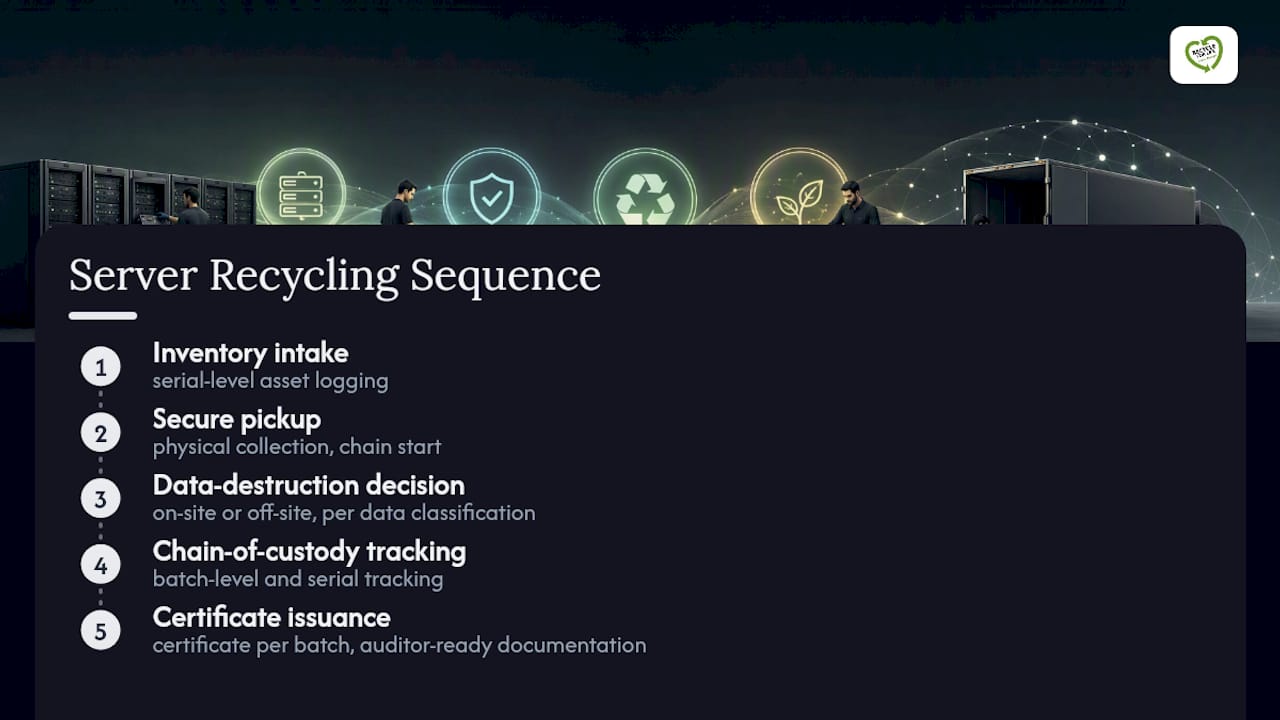
Quotes are generally built around actual inventory rather than a generic per-unit average, and asset recovery is calculated transparently so you know what portion of resale value comes back to you. The goal is a disposition that leaves you with documentation an auditor can actually use: serial-level tracking, a certificate for every batch, and a clear paper trail from your rack to final processing.
If you’re planning a fleet retirement or a full decommissioning, requesting a tailored IT asset recovery quote is the fastest way to see where your specific equipment lands on cost versus recovery.
When Server Recycling Is a Cost vs. When It Pays You Back
The mistake most IT managers make is treating server recycling as a single line item with one predictable cost. It isn’t. A rack of five-year-old servers with usable processors is a revenue opportunity in disguise, and treating it as a flat disposal fee leaves real money on the table. A stack of dead, decade-old units with sensitive data on failed drives is a pure cost center, and pretending otherwise just delays the destruction decision you need to make anyway.
The right move is to sort your inventory before you call anyone. Batch what you can, demand itemized quotes on everything, and require certificates of destruction regardless of whether a unit is resold or shredded. If your organization reports on ESG or environmental compliance, that documentation isn’t optional paperwork. It’s the evidence that backs up whatever sustainability claim your company makes publicly.
— Keith
Get a Straight Answer on What Your Server Fleet Is Actually Worth
Most vendors quote server recycling as a single flat number and hope you don’t ask what happens to the resale value on the back end. Quotes can be built around actual inventory, itemizing transport, destruction, and recovery separately so you can see exactly what you’re paying for and what’s coming back to you.

Whether you’re retiring a handful of aging units or decommissioning an entire data hall, the process starts the same way: secure pickup, a data-destruction method matched to your compliance needs, and a certificate for every device processed. Some providers handle related equipment across a decommissioning project, from batteries to full electronic waste removal, reducing the need to coordinate multiple vendors for an office cleanout.
To see estimates for your own fleet, request an IT asset recovery disposition quote to get an itemized breakdown before committing to anything.
Sources
- ITAD Cost Benchmarking: What Should You Really Be Paying? | ITAD Intelligence
- ITAD Cost Calculator – Electronics Recycling & Data Destruction Pricing | ITAD Finder
- ITAD Quote Calculator – Enterprise IT Disposal (2026)
- Data Center Decommissioning Guide: With Costs, ROI Insights, and Leadership-Level Perspectives – The Digital Merchant
FAQ
How much does it cost to recycle a server?
Basic per-server recycling typically costs $50 to $200 depending on data-sanitization requirements, while large-scale decommissioning projects often price by weight ($0.25 to $1.50 per pound) or as a flat project bid. Newer, resalable servers can offset or eliminate that cost through revenue-share arrangements.
What is the current recycling rate for electronics in the United States?
National e-waste recycling rates for electronics remain well below total volume generated each year, which is a key reason regulators and manufacturers continue pushing certified ITAD programs and take-back requirements for businesses.
What electronics should never be thrown away with regular trash?
Servers, hard drives, batteries, and UPS units should never go in regular trash because they contain hazardous materials and unencrypted data; they require certified e-waste handling and, in the case of storage media, documented data destruction.
How much do scrap yards typically pay for old computers?
Scrap value for outdated computers is usually minimal since most value comes from working components rather than raw material weight, which is why revenue-share models on resalable servers typically outperform scrap pricing on a per-unit basis.
Why do some states charge electronics recycling fees?
Several states, including California, charge point-of-sale electronic waste recycling fees to fund state-run collection and recycling programs, since electronics contain materials that are costly and environmentally risky to process without dedicated funding.
Does UsedCartridge provide certificates of destruction for server recycling?
Usedcartridge issues certificates of destruction and chain-of-custody documentation as part of its data destruction services, giving businesses an audit-ready record for every device processed.