
Environmental standards in e-waste are defined as mandatory regulatory frameworks that govern the safe collection, handling, transport, and disposal of electronic waste containing hazardous substances like mercury, lead, and brominated flame retardants. The role of environmental standards in e-waste extends far beyond basic disposal rules. Frameworks like the Basel Convention, Extended Producer Responsibility (EPR) schemes, and R2v3 certification set the legal and operational boundaries within which businesses must operate. For organizations generating or managing electronic waste, understanding these standards is not optional. Non-compliance carries enforcement risk, reputational damage, and direct liability for environmental harm.
What key environmental standards govern e-waste management?
The Basel Convention is the primary international treaty controlling transboundary movement of hazardous waste, including e-waste. It classifies e-waste as hazardous when it contains toxic substances such as mercury, lead, and brominated flame retardants, and prohibits illegal dumping and uncontrolled cross-border shipments. This classification directly affects how businesses must document, label, and route end-of-life electronics.
The Convention’s Prior Informed Consent (PIC) mechanism is the operational core of cross-border compliance. Before any hazardous e-waste shipment can cross a border, the exporting country must notify and obtain consent from the importing and transit countries, providing details on waste type, quantity, transport route, and disposal method. Missing a single element in this process can stall or block a shipment entirely.
A significant regulatory shift took effect in 2025. Basel amendments now apply PIC procedures to all e-waste, including types previously classified as non-hazardous. This closes a long-standing loophole that allowed developed nations to export lower-grade electronics to countries without the capacity to process them safely. For businesses with international supply chains, this change expands compliance obligations considerably.
At the national level, EPR regulations place legal responsibility on producers to fund and manage the end-of-life collection and recycling of their products. The table below compares key frameworks businesses encounter:

| Framework | Scope | Core Obligation |
|---|---|---|
| Basel Convention | International | PIC for hazardous and all e-waste shipments |
| Extended Producer Responsibility (EPR) | National/Regional | Collection targets, recycler registration, reporting |
| R2v3 Certification | Facility-level | EHS management, downstream accountability, documentation |
| India E-Waste Management Rules | National | Producer registration, recycling targets, formal recycler use |
Each framework operates at a different level, but they interact. A business exporting IT assets internationally must satisfy Basel PIC requirements while also meeting domestic EPR obligations and selecting recyclers with valid certifications like R2v3.
How do environmental standards shape corporate governance in e-waste?
Environmental standards do more than impose penalties. They restructure how companies manage environmental risk internally. Evidence from China’s Zero-Waste City Pilot program illustrates this clearly. A DID model analysis covering 2009 to 2023 found that firms operating under the pilot’s stricter waste consumption regulations showed measurable improvements in environmental management, green innovation, and sustainability outcomes. The effect was strongest in private enterprises and heavily polluting industries, where regulatory pressure translated directly into executive-level commitment.
The mechanism is straightforward. When standards set explicit targets and assign clear responsibilities, corporate governance structures adapt to meet them. Sustainability officers gain authority, procurement teams revise vendor selection criteria, and logistics departments build compliance checkpoints into standard operating procedures. Standards create the internal pressure that voluntary sustainability commitments rarely generate on their own.
Key governance changes businesses typically implement in response to e-waste standards include:
- Appointing dedicated compliance officers responsible for tracking regulatory changes across all operating jurisdictions
- Revising procurement contracts to include EPR obligations and recycler certification requirements
- Establishing internal audit cycles aligned with certification renewal timelines, such as R2v3 annual reviews
- Integrating e-waste metrics into corporate sustainability reporting frameworks like GRI or CDP disclosures
Pro Tip: Don’t wait for a regulatory audit to discover governance gaps. Map your e-waste flows against current Basel and EPR requirements annually, and treat that mapping as a board-level risk document, not an operational checklist.
What operational requirements do businesses face under e-waste standards?
R2v3 certification sets the most detailed operational requirements for recyclers and, by extension, for the businesses that contract them. R2v3 requires written agreements, environmental health and safety documentation, and vendor qualification processes for all downstream handlers of higher-risk materials. This means your compliance obligation does not end when you hand off equipment to a recycler. It extends through the entire downstream chain until materials reach their final disposition.
Documentation and traceability are the practical backbone of compliance. Accurate classification and documentation must precede any e-waste shipment, and errors in categorization can trigger Basel PIC enforcement delays regardless of whether the receiving recycler holds valid certification. Logistics and procurement teams need to treat e-waste documentation with the same rigor applied to controlled substances or export-controlled goods.
India’s e-waste framework exposes a structural challenge that many businesses underestimate. India has 7,226 registered producers but only a small number of officially recognized recyclers and refurbishers. The informal sector, which handles the majority of actual collection, has no formal standing under the rules. This creates a compliance gap: producers must meet collection targets, but the collectors doing the work are invisible to the regulatory system.
The comparison below shows how formal and informal e-waste handling differ operationally:
| Dimension | Formal Recycler | Informal Collector |
|---|---|---|
| Regulatory recognition | Registered, auditable | Unrecognized under EPR rules |
| Documentation capability | Full audit trail | Typically none |
| EHS standards | Certified (e.g., R2v3) | Variable, often absent |
| Collection reach | Limited to urban centers | Broad, including rural areas |
| Compliance risk for business | Low if certified | High without contractual controls |
To manage this gap, businesses operating in markets with large informal sectors must use contractual traceability measures that bring informal collectors into the audit trail. Without these controls, the actual material handling will not match the documentation, creating direct non-compliance exposure.
How do standards produce measurable outcomes in emerging economies?
South Africa’s experience in 2024 and 2025 demonstrates what structured EPR rollout can achieve in a developing market. South Africa generates over 360,000 tonnes of e-waste annually, and the 2026 Eastern Cape pilot is designed to create accessible collection points, increase community participation, and generate measurable data on volumes collected and pollution reduced. The pilot is a direct product of EPR policy pressure translating into infrastructure investment.
The outcomes that well-designed e-waste standards produce in emerging markets follow a recognizable sequence:
- Regulatory mandate establishes collection targets and producer obligations
- Infrastructure investment follows as producers fund collection networks to meet targets
- Community engagement increases as accessible collection points reduce the cost of participation
- Data generation improves as formal collection systems produce auditable volume records
- Pollution reduction becomes measurable as informal burning and dumping decline
The informal sector remains the critical variable. NGO initiatives in both India and South Africa are actively working to integrate informal collectors into formal EPR frameworks, recognizing that collection targets cannot be met without them. For businesses sourcing recycling services in these markets, selecting partners who have formalized relationships with informal collectors is both a compliance requirement and a practical necessity.
Pro Tip: When evaluating recycling partners in emerging markets, ask specifically how they document material flows from informal collection points. A partner who cannot answer that question clearly is a compliance liability, not an asset.
What practical steps align businesses with e-waste compliance requirements?
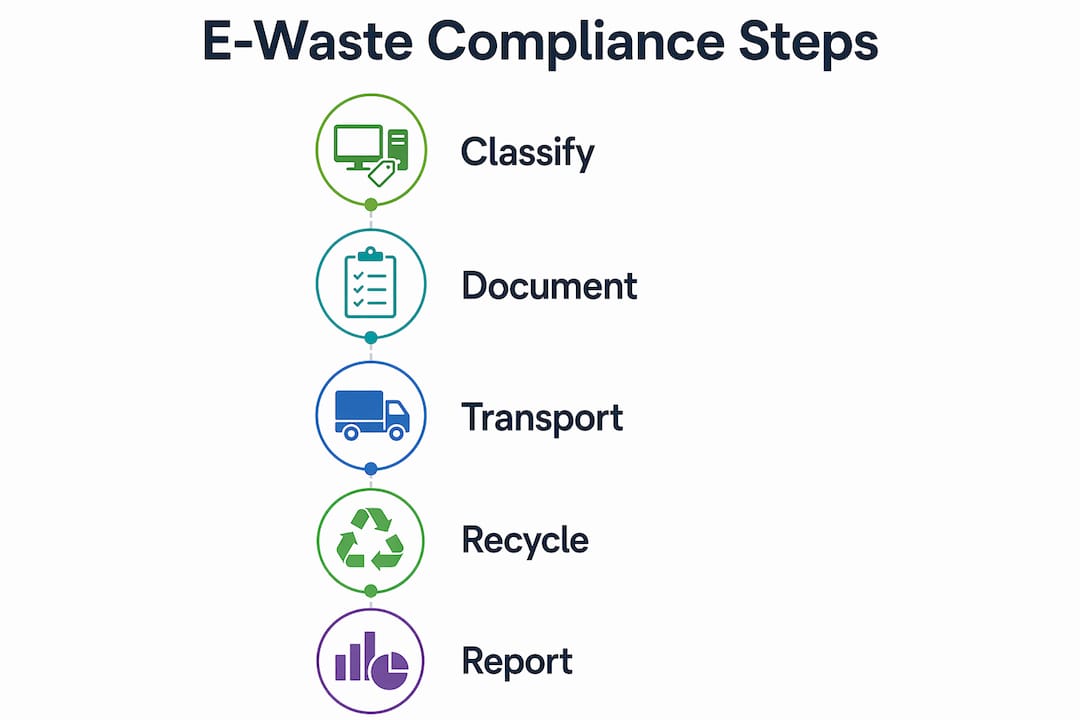
Compliance with e-waste management standards requires a structured internal process, not a one-time vendor selection. Effective e-waste compliance documentation starts before equipment leaves your facility and must follow the material through to final disposition. The following steps reflect current best practice under Basel, EPR, and R2v3 frameworks:
- Classify all e-waste accurately before shipment, using Basel Annex categories and national hazardous waste codes to prevent PIC procedure delays
- Select only certified recyclers, prioritizing R2v3 or equivalent certification with current audit documentation and downstream vendor agreements
- Build traceability into contracts with all recycling partners, including informal sector intermediaries where applicable, to maintain complete audit trails
- Integrate EPR obligations into procurement by requiring suppliers and OEMs to demonstrate compliance with applicable producer responsibility schemes
- Conduct annual internal audits of e-waste flows, documentation completeness, and recycler certification status before regulatory review cycles
Effective e-waste logistics management also requires that compliance responsibilities are assigned to specific roles, not left as shared organizational obligations. When no one owns the process, documentation gaps accumulate until an audit makes them visible.
Pro Tip: Treat your recycler’s R2v3 certification expiration date as a procurement trigger. If their certification lapses and you continue using them, your own compliance position is compromised regardless of your internal documentation quality.
Key takeaways
Environmental standards define the legal, operational, and governance requirements that make compliant e-waste management possible, and businesses that treat them as a framework rather than a checklist consistently outperform those that do not.
| Point | Details |
|---|---|
| Basel Convention scope expanded | 2025 amendments apply PIC procedures to all e-waste, closing the non-hazardous export loophole. |
| Corporate governance improves under standards | China’s Zero-Waste City data shows firms under stricter rules achieve measurable green governance gains. |
| Documentation is non-negotiable | Incorrect classification stalls Basel PIC shipments even when downstream recyclers are fully certified. |
| Informal sector requires contractual controls | In markets like India, businesses must contractually integrate informal collectors to maintain valid audit trails. |
| Certification extends downstream | R2v3 requires end-to-end documentation through all downstream handlers, not just the primary recycler. |
The compliance gap most businesses still ignore
The conversation around e-waste standards tends to focus on which regulations apply and which certifications to require. That is necessary but not sufficient. What I have seen consistently, working with organizations across multiple sectors, is that the compliance gap is almost never about ignorance of the rules. It is about the distance between policy and practice inside the organization.
Procurement teams select certified recyclers. Logistics teams generate the required documentation. But no one reconciles the two. The recycler’s downstream vendor list changes, a certification lapses mid-contract, or informal collectors in a developing market handle materials that never appear in the audit trail. The paperwork looks complete. The actual material flow does not match it.
The Basel PIC process makes this concrete. Compliance under Basel PIC requires procurement and logistics teams to be proactive from the moment of export or import. Permissions and documentation must be in place before shipment, not only when selecting recyclers. That sequencing discipline is where most organizations fall short.
The businesses that handle this well treat e-waste compliance as a supply chain integrity problem, not a regulatory checkbox. They apply the same traceability logic to end-of-life electronics that they apply to raw material sourcing. That shift in framing changes everything about how documentation, vendor selection, and internal audit cycles are structured.
The circular economy direction that standards like EPR and R2v3 are pushing toward will only increase this demand for end-to-end accountability. Organizations that build that capability now will find future regulatory tightening far less disruptive than those still treating compliance as a paperwork exercise.
— Keith
How Usedcartridge simplifies e-waste compliance for businesses
Meeting the documentation, certification, and traceability requirements of Basel, EPR, and R2v3 frameworks is operationally demanding. Usedcartridge provides certified e-waste recycling services designed specifically for businesses that need compliant, auditable disposal of IT assets and electronic equipment. Services include secure data destruction with official certification, R2v3-aligned recycling processes, and complete documentation packages that satisfy both domestic EPR obligations and international shipment requirements.

For organizations managing IT asset retirement at scale, Usedcartridge also offers IT asset recovery with free quotes and pickup options, making it straightforward to align end-of-life IT processes with current environmental standards without building an internal compliance infrastructure from scratch.
FAQ
What is the role of environmental standards in e-waste management?
Environmental standards define how e-waste must be classified, handled, transported, and recycled to prevent toxic substances like lead and mercury from causing environmental and health harm. Frameworks like the Basel Convention and EPR schemes set the legal obligations businesses must meet throughout the e-waste lifecycle.
How does the Basel Convention affect business e-waste shipments?
The Basel Convention requires Prior Informed Consent from importing and transit countries before any hazardous e-waste crosses a border, with full documentation of waste type, quantity, route, and disposal method. Since 2025, these requirements apply to all e-waste, including previously non-hazardous categories.
What is R2v3 certification and why does it matter for compliance?
R2v3 is a facility-level certification that requires recyclers to maintain environmental health and safety management systems, written downstream vendor agreements, and end-to-end documentation for all regulated materials. Businesses that contract R2v3-certified recyclers reduce their own compliance exposure under both domestic and international e-waste regulations.
How do EPR regulations create compliance obligations for producers?
EPR regulations require producers to register with national authorities, meet annual collection and recycling targets, and fund the infrastructure needed to manage their products at end of life. In markets like India, the gap between registered producers and available formal recyclers means businesses must also address informal sector traceability to meet their targets.
What documentation do businesses need for e-waste compliance?
Businesses need accurate waste classification records, Basel PIC approvals for cross-border shipments, recycler certification documentation, downstream vendor agreements, and material disposition records that reconcile inventory with actual recycling proof. Gaps in any of these areas create enforcement risk regardless of the recycler’s certification status.