
Secure IT pickup is defined as the controlled, documented retrieval of IT equipment by authorized personnel, following verified identity checks and chain-of-custody procedures that protect sensitive data throughout the handoff. The industry term for this practice is IT asset retrieval, and it sits at the center of any credible IT asset lifecycle management program. Organizations that skip formal verification during equipment collection expose themselves to data breaches, regulatory penalties under frameworks like GDPR and ISO 27001, and significant reputational damage. Understanding what is secure IT pickup, and how to execute it correctly, is the first line of defense when retiring hardware.
What is secure IT pickup and why does it matter?
Secure IT pickup is the process of removing IT equipment from a business location under documented, controlled conditions that prevent unauthorized access to the devices or the data they contain. Secure pickup means that only verified personnel access assets, following documented policies at every step of the handoff. This is not simply a logistics task. It is an operational security event.
The stakes are high. Package theft losses exceed $12 billion annually in North America, a figure that illustrates how uncontrolled handoffs create real financial exposure. When IT equipment carries sensitive corporate or customer data, the cost of a failed handoff multiplies far beyond the hardware value.

Secure IT services frameworks, including those aligned with ISO 27001 and GDPR, treat asset retrieval as a compliance event, not a convenience. ISO 27001 and GDPR compliance require that IT asset retrieval and disposal follow documented security controls. That means every pickup must generate a paper trail, and every person handling equipment must be verified before they touch a single device.
What are the essential components of a secure IT pickup process?
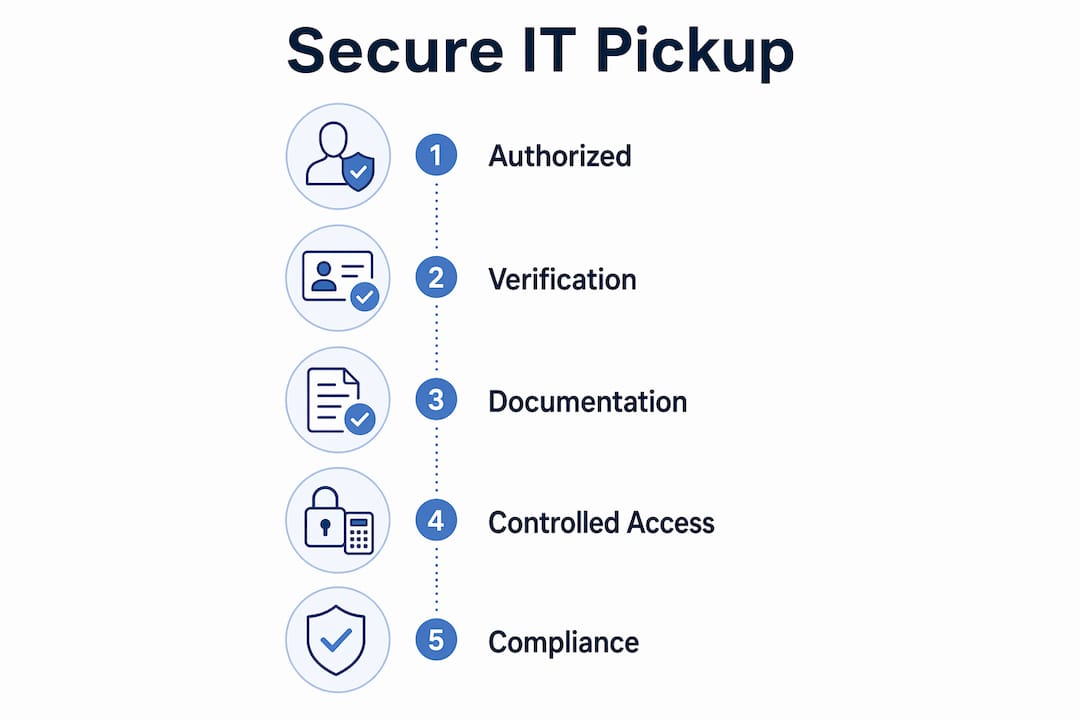
A secure IT pickup process rests on five foundational elements. Each one addresses a specific point of failure that organizations commonly overlook.
- Identity verification. Every pickup technician must present formal photo identification before receiving any equipment. This check must happen every time, without exception, regardless of how familiar the person appears.
- Chain-of-custody documentation. A written or digital record must follow the equipment from the moment it leaves your facility to its final destination, whether that is a recycling center, data destruction facility, or storage site. Gaps in this record create compliance exposure.
- Pre-agreed scope of work. Before any pickup occurs, the authorized equipment list must be defined and signed off. The technician’s scope must match that list exactly. Any deviation requires escalation, not improvisation.
- Secure transport methods. Equipment must travel in locked, tamper-evident containers or vehicles. Open transport in unmarked vehicles is not acceptable for devices that may contain sensitive data.
- Operational discipline. Consistent enforcement of every step above, every single time, is what separates a secure process from a policy document that nobody follows.
Controlled access and verification at staffed secure pickup points reduce theft and unauthorized access to under 0.1%, compared to rates exceeding 5% at unattended locations. That gap exists entirely because of process discipline, not technology.
Pro Tip: Create a laminated pickup checklist that technicians and your internal staff both sign at the point of handoff. A dual-signature requirement takes 90 seconds and creates an immediate accountability record.
Effective secure IT pickup is not just a physical security measure. It is an operational trust and visibility challenge that requires documented procedures and active oversight to function reliably.
How do security failures occur during IT equipment pickup?
The primary cause of security failures during IT equipment handoffs is operational drift. Operational drift is the gradual erosion of process discipline over time, where steps that were once followed rigorously begin to be skipped because they feel unnecessary or inconvenient.
Operational drift is the leading cause of security failures during equipment handoffs. Failure to consistently enforce ID checks or verify scope of work is the direct mechanism through which unauthorized access occurs. The failure rarely looks dramatic. It looks like a technician who has visited your office a dozen times being waved through without showing ID, or a pickup that includes two extra laptops because “they were right there anyway.”
The following sequence describes how most IT pickup security failures unfold:
- Initial compliance. The process launches correctly. ID checks happen. Documentation is completed. Everyone follows the protocol.
- Familiarity sets in. Regular pickups create routine. Staff begin to recognize technicians and skip verification steps as a courtesy.
- Scope creep begins. Technicians or staff start making informal decisions about what gets picked up, outside the pre-agreed list.
- An incident occurs. A device goes missing, or data surfaces where it should not. The organization cannot reconstruct what happened because the audit trail has gaps.
- The investigation stalls. Without consistent documentation, accountability is impossible to assign.
Security experts emphasize that consistent enforcement of ID checks and scope matching is the single most effective control for preventing unauthorized equipment removal. Training alone is not enough. The process must be audited regularly, and deviations must carry consequences.
Formal identification checks and scope verification against pre-approved checklists are the expert-recommended minimum for every pickup event. Organizations should conduct quarterly audits of pickup records to identify where drift is occurring before it becomes a breach. Training refreshers tied to those audits keep the process sharp.
For guidance on managing data security during handoffs, expert frameworks recommend treating every pickup as a new event, regardless of how established the vendor relationship is.
What practical steps can businesses take to implement secure IT pickup?
Implementing a reliable IT equipment pickup process requires building structure around four operational areas: personnel authorization, verification technology, documentation, and vendor selection.
Authorized personnel lists
Every organization should maintain a current list of individuals authorized to collect IT equipment on behalf of approved vendors. This list must include the person’s name, photo ID reference, and the vendor they represent. When a technician arrives, staff check the list before proceeding. Photo IDs, signatures, and verification codes reduce the risk of unauthorized access and create a verifiable record of who handled equipment.
Verification technology
Digital verification tools have replaced paper sign-in sheets in most compliant organizations. Tablet-based check-in apps allow staff to photograph ID documents, capture signatures, and timestamp the event automatically. Some organizations use unique authorization codes issued per pickup event, which expire after use. Incorporating photo verification and digital checklists enhances both reliability and auditability of the process.
Documentation and incident logs
Every pickup event must generate a record that includes the date, time, technician identity, equipment serial numbers collected, and the staff member who authorized the release. Incident logs and release verification flows maintain audit trails and support accountability when anomalies arise. These records must be retained for a minimum period consistent with your data protection obligations, typically three to seven years depending on jurisdiction.
| Workflow element | Minimum standard | Recommended practice |
|---|---|---|
| Identity verification | Photo ID check | Photo ID plus authorization code |
| Equipment documentation | Serial number list | Serial numbers plus condition photos |
| Handoff record | Single signature | Dual signature with timestamp |
| Incident escalation | Verbal report | Written incident log within 24 hours |
| Audit frequency | Annual review | Quarterly spot audit |
Pro Tip: Assign one internal staff member as the designated pickup coordinator for each location. A single point of accountability prevents the “someone else checked” problem that creates gaps in your audit trail.
Choosing the right vendor matters as much as your internal process. Work with certified IT disposal and recycling partners who provide their own chain-of-custody documentation and can demonstrate compliance with applicable data protection standards. Usedcartridge offers secure e-waste pickup services built around these exact protocols, including documented handoff procedures and certified data destruction options.
How does secure IT pickup connect to compliance and asset disposal?
Secure IT pickup does not exist in isolation. It is the first step in a chain that runs from equipment collection through data destruction and responsible recycling. Every link in that chain carries compliance implications.
- Data protection laws. GDPR in Europe and equivalent state-level laws in the United States require that personal data be protected throughout its lifecycle, including during physical asset removal. A failed pickup process is a data breach trigger, not just an operational inconvenience.
- ISO 27001 alignment. This international standard for information security management requires documented controls over physical assets, including their removal and disposal. Secure pickup procedures are a direct control requirement under this framework.
- E-waste regulations. Many jurisdictions impose legal obligations on how electronic equipment is disposed of. Partnering with a certified recycler ensures that your pickup process feeds into a compliant disposal chain. Usedcartridge’s IT asset recovery services are designed to satisfy both data security and environmental compliance requirements.
- Liability reduction. A documented, auditable pickup process gives your organization a defensible position if a data incident is ever investigated. Organizations without records cannot demonstrate due diligence.
- Reputation protection. Data breaches linked to physical asset mishandling are increasingly covered in business press. The reputational cost of a preventable pickup failure far exceeds the cost of implementing proper controls.
Proper IT disposal documentation is the mechanism that connects secure pickup to compliance audits. Without it, even a well-executed pickup leaves your organization exposed.
Key Takeaways
Secure IT pickup succeeds only when identity verification, chain-of-custody documentation, and consistent process discipline are enforced at every equipment handoff without exception.
| Point | Details |
|---|---|
| Define the process formally | Secure IT pickup requires documented policies, not informal agreements, to meet GDPR and ISO 27001 standards. |
| Verify identity every time | Photo ID checks and authorization codes must apply to every technician, regardless of familiarity or frequency of visits. |
| Maintain chain-of-custody records | Serial numbers, signatures, and timestamps must be captured at every handoff and retained for compliance audits. |
| Audit for operational drift | Quarterly spot audits catch process erosion before it becomes a security incident or a compliance failure. |
| Connect pickup to full disposal chain | Secure pickup is the first step. It must feed into certified data destruction and compliant e-waste recycling to close the loop. |
Why operational discipline is the real differentiator in secure IT pickup
I have reviewed a lot of IT asset disposal programs over the years, and the ones that fail almost never fail because of bad intentions. They fail because of comfort. A vendor relationship becomes routine, and routine becomes invisible. Nobody decides to skip the ID check. They just stop noticing that they are skipping it.
The organizations that get this right treat every pickup as if it is the first one. They do not rely on memory or familiarity. They rely on a checklist that gets signed, a log that gets filed, and a coordinator who owns the outcome. That sounds bureaucratic until the day a device goes missing and you need to reconstruct exactly what happened.
Technology helps, but it is not the solution by itself. I have seen organizations deploy digital verification tools and still drift, because the tool becomes a formality rather than a genuine check. The culture has to support the process. That means leadership has to treat a missed ID check as a real event, not a minor oversight.
The businesses that treat safe IT asset disposal as a strategic priority, rather than a back-office task, are the ones that avoid the expensive lessons. Start with the process. Audit it. Protect it from drift. The compliance and liability benefits follow automatically.
— Keith
Usedcartridge: secure IT pickup and compliant asset disposal
Businesses that need a verified, compliant partner for IT equipment collection and disposal have a clear option in Usedcartridge.

Usedcartridge provides electronic waste recycling and secure data destruction services built around documented chain-of-custody procedures, certified technicians, and compliance with applicable data protection standards. Every pickup includes proper verification protocols and generates the documentation your organization needs for audits. Whether you are retiring a single workstation or clearing an entire data center, Usedcartridge handles the process from collection through certified disposal. Request a quote directly through the site to get a clear scope of work before any equipment moves.
FAQ
What is secure IT pickup in plain terms?
Secure IT pickup is the controlled retrieval of IT equipment by verified, authorized personnel following documented identity checks and chain-of-custody procedures. Its purpose is to protect sensitive data and meet compliance requirements during the handoff.
What causes most IT pickup security failures?
Operational drift is the primary cause. Consistent enforcement of ID checks and scope verification erodes over time as familiarity replaces process discipline, creating gaps that allow unauthorized access.
What documentation is required for a compliant IT pickup?
A compliant pickup record includes the technician’s verified identity, a list of equipment serial numbers collected, dual signatures, a timestamp, and an incident log if any deviation from the pre-agreed scope occurs.
How does secure IT pickup relate to GDPR and ISO 27001?
Both GDPR and ISO 27001 require documented controls over physical IT assets throughout their lifecycle. Secure pickup procedures are a direct compliance requirement under these frameworks, and gaps in the process can constitute a reportable data breach.
How often should businesses audit their IT pickup process?
Quarterly spot audits are the recommended standard. Annual reviews catch major failures, but quarterly checks identify operational drift early, before it creates a security incident or a compliance gap.