
E-waste disposal is not just an environmental obligation. For IT and compliance managers, it’s one of the most underestimated data security risks in the organization. Every decommissioned laptop, retired server, or outdated storage array carries sensitive information that doesn’t disappear when the device leaves your building. A formal e-waste audit is the structured process that verifies your organization actually handled those assets securely, maintains traceable chain-of-custody records, and generates the documented evidence you’ll need during a regulatory review. This guide maps out exactly what e-waste audits cover, why they’re non-negotiable, and how to run them effectively.
Table of Contents
- What is an e-waste audit?
- Why organizations need e-waste audits: Risks and requirements
- Data sanitization in e-waste audits: Beyond simple erasure
- How to conduct an effective e-waste audit: Steps and best practices
- The uncomfortable truth: Most e-waste audits fall short
- E-waste audit and compliance solutions for your organization
- Frequently asked questions
Key Takeaways
| Point | Details |
|---|---|
| E-waste audits defined | E-waste audits systematically verify electronics disposal for both environmental and data security compliance. |
| Compliance is multi-layered | Achieving compliance means managing traceability, secure destruction, and robust audit-ready documentation. |
| Vendor certification helps, but does not absolve | Certified recyclers strengthen assurance but do not eliminate your organization’s responsibility for auditable controls. |
| Data destruction requires programs | Relying on tools or one-off actions is not enough—audits must validate consistent, NIST-aligned sanitization at scale. |
| Continuous improvement wins | The best e-waste programs are adaptive, consistently tested, and documented for easy compliance and risk reduction. |
What is an e-waste audit?
Most IT teams think of e-waste as a logistics problem: box up the old hardware, call a recycler, done. That framing misses the point entirely. An e-waste overview makes clear that electronic waste spans computers, mobile devices, storage media, networking equipment, and a wide range of other assets, all of which may contain residual data. The audit is the quality-control layer that ensures none of that data survives the disposal process.
An e-waste audit is a structured review of an organization’s end-of-life electronics handling to verify environmental compliance and, for IT assets, secure data sanitization and destruction with auditable evidence. In practical terms, this means a trained reviewer checks four foundational areas:
- Asset inventory and traceability: Every item scheduled for disposal is cataloged with serial numbers, asset tags, and condition notes before it leaves your control.
- Chain of custody: A continuous, documented record tracks who handled each device from your site to its final destination, whether that’s secure destruction, refurbishment, or recycling.
- Data sanitization and destruction verification: Proof that data was rendered unrecoverable using a recognized method, not simply deleted or formatted.
- Compliance documentation: Certificates of destruction, recycler certifications, environmental disposal reports, and any regulatory filings required by your jurisdiction or industry.
| Audit component | What it verifies | Why it matters |
|---|---|---|
| Asset inventory | All devices accounted for | Prevents unreported loss |
| Chain of custody | Traceable handling records | Limits liability exposure |
| Data destruction | Sanitization standard met | Protects sensitive data |
| Documentation | Audit-ready evidence | Satisfies regulators |
“Treating e-waste disposal as an environmental-only issue is a costly mistake. The compliance and data security dimensions are equally serious and equally regulated.”
Both dimensions reinforce each other. Weak documentation of environmental disposal often signals equally weak data security controls. When auditors ask for evidence, they expect all four components to be present, current, and internally consistent.
Why organizations need e-waste audits: Risks and requirements
Now that you know what an e-waste audit is, let’s look at why it’s a critical mandate, not a checkbox or formality.
The stakes are concrete. Improper disposal of data-bearing assets has triggered regulatory fines under HIPAA, GDPR for organizations with EU data subjects, and various state-level privacy laws. Beyond fines, a confirmed data breach traced to improperly destroyed hardware creates lasting reputational damage that no press release can fully repair. Organizations that can’t produce chain-of-custody records during an audit are effectively unable to prove that sensitive data was destroyed, which regulators and insurers treat as equivalent to a breach.
Regulatory pressure is rising. A growing number of industries face explicit requirements around IT asset disposal. Healthcare organizations must comply with HIPAA’s physical safeguard rules. Financial services firms operate under GLBA and SEC record-keeping standards. Defense contractors follow NIST guidelines tied to CMMC certification. Even organizations outside highly regulated industries face exposure through state consumer privacy laws, which are proliferating rapidly across the US.
Certified electronics recyclers operating under R2 (Responsible Recycling) or e-Stewards certification programs are required to undergo independent audits and maintain ongoing oversight, and they explicitly include data destruction expectations for processors. This is significant. It means your recycling vendor’s certification adds a documented, third-party-audited layer to your own compliance posture.
| Approach | Audit rigor | Organizational liability | Documentation quality |
|---|---|---|---|
| Uncertified recycler | None required | High | Inconsistent |
| R2-certified recycler | Annual third-party audit | Reduced but not eliminated | Standardized |
| e-Stewards certified | Stricter standards, ongoing oversight | Reduced but not eliminated | Comprehensive |
| Internal IT disposal | Self-assessed | Full organizational ownership | Varies widely |
There’s a critical nuance here: recycler certification reduces your exposure but does not eliminate it. Your organization is still responsible for verifying that the recycler’s practices matched what you contracted for. You also need e-waste security controls that begin inside your own building, before the device ever leaves your custody. The handoff moment is where most chain-of-custody failures occur.
For compliance managers building an IT disposal compliance guide, the practical takeaway is that third-party audits of your vendor are a starting point, not a complete solution. Your own audit program must verify the end-to-end picture.
Data sanitization in e-waste audits: Beyond simple erasure
With compliance drivers in view, let’s examine the most technically challenging part: ensuring data is truly unrecoverable when you dispose of electronic assets.
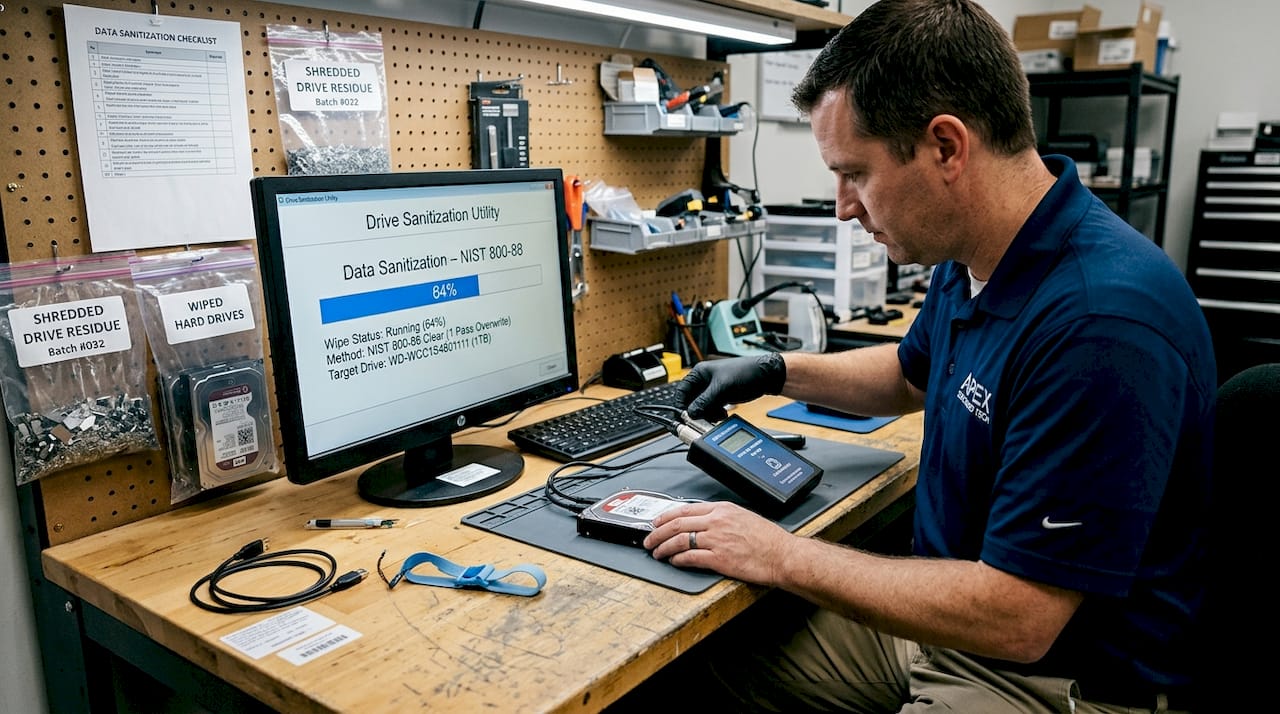
Basic deletion doesn’t cut it, and most IT professionals already know this. What’s less commonly understood is the difference between ad hoc sanitization (wiping a drive when you happen to think of it) and a programmatic sanitization control (a repeatable, verified process applied to every asset, every time). E-waste audits test for the latter.
The governing standard in the US is NIST SP 800-88, which provides guidelines for media sanitization including verification requirements and program-level controls. The standard defines three levels of sanitization: Clear (logical techniques that protect against simple recovery), Purge (physical or logical techniques that defeat laboratory recovery), and Destroy (physical destruction that renders the media unusable). The choice between these methods depends on the classification of the data the device held and the intended disposition of the hardware.
What “render access infeasible” actually means: it’s not enough that data is hard to retrieve. Under NIST standards, access must be infeasible using state-of-the-art laboratory techniques. For most enterprise environments handling sensitive or regulated data, Purge or Destroy is the appropriate method.
Here’s how an e-waste audit verifies data sanitization in practice:
- Pre-disposal classification: Every asset is classified by data sensitivity before sanitization begins. Drives that held confidential HR records get treated differently than a network switch.
- Method selection and documentation: The sanitization method (software wipe, degaussing, shredding) is selected based on the classification and documented in a work order.
- Tool verification: Sanitization tools must be validated. The audit checks whether tools were current, properly configured, and applied to every sector of the storage medium.
- Certificate of destruction: A formal certificate is issued, linking the specific asset (by serial number) to the sanitization method and date.
- Program-level review: The audit doesn’t just check individual devices. It verifies that your organization has a repeatable process, trained personnel, and documented procedures, not just a vendor relationship you trust informally.
Pro Tip: Don’t rely on vendor certificates alone as proof of sanitization. Build your own intake verification step that confirms each asset was received by the vendor, matched to your inventory, and processed according to your contracted specification. A vendor certificate for a batch of 200 drives doesn’t tell you which specific drives from your organization were included.
For detailed guidance on certified hard drive destruction, the process should produce asset-level evidence, not just batch-level summaries. If your vendor can’t provide serial-number-level certificates, that’s a gap worth addressing. Organizations that need to understand proper electronics recycling methods can also confirm what level of detail their recycler’s destruction records actually include before signing a service agreement.
How to conduct an effective e-waste audit: Steps and best practices
Understanding requirements is essential, but application matters most. Here’s how to put e-waste audit best practices into action in your organization.
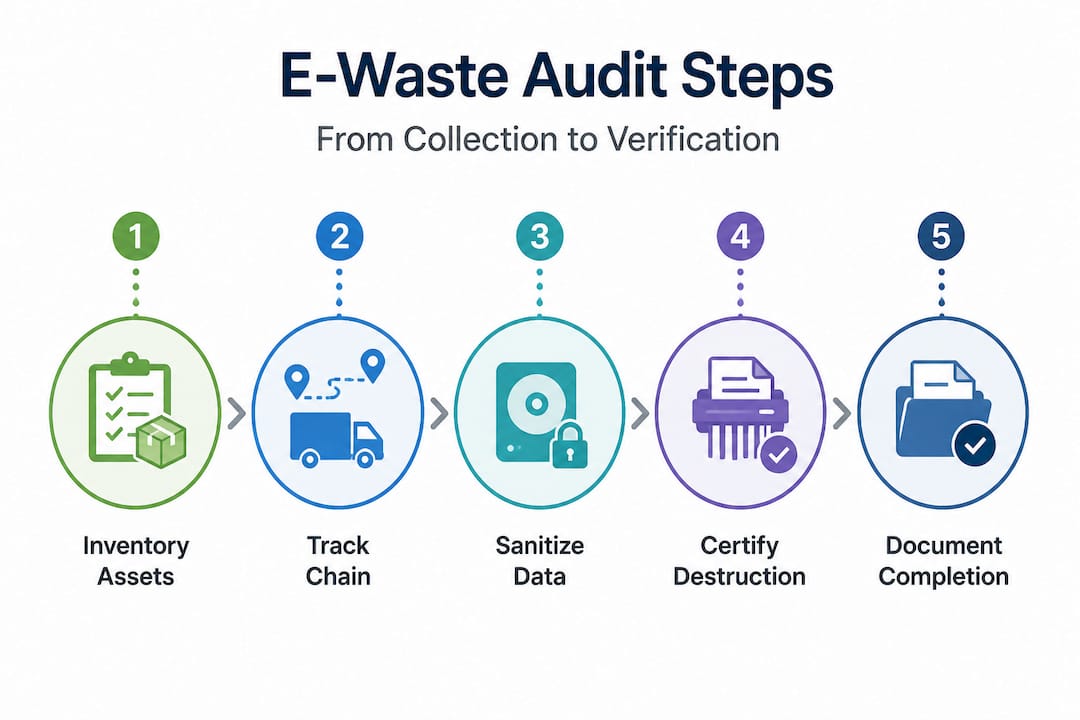
A well-structured e-waste audit follows a five-stage framework:
- Pre-audit preparation: Define scope (which asset types, which time period, which locations), gather existing disposal records, confirm vendor certifications are current, and brief relevant IT and facilities staff. Establish the audit criteria upfront so everyone knows what “pass” looks like before the review begins.
- Execution: Conduct the physical or remote review of disposal records. Match decommissioned assets against your IT asset inventory. Verify that every item scheduled for disposal has a corresponding disposal record. Flag any assets that were decommissioned without a matching destruction certificate.
- Evidence collection: Gather certificates of destruction, chain-of-custody logs, vendor invoices, environmental compliance reports, and any data sanitization work orders. Organize these by asset, not just by vendor batch, so you can answer specific regulatory questions about specific devices.
- Gap analysis and review: Document every finding, both what was handled correctly and where gaps exist. Common gaps include missing serial numbers on certificates, breaks in chain-of-custody at the point of vendor handoff, and assets that show as decommissioned in IT records but have no corresponding disposal record.
- Optimize and repeat: Build a corrective action plan for any gaps, update your disposal procedures accordingly, and schedule the next audit. Annual audits are a minimum. High-volume or high-risk environments may need quarterly reviews.
A key nuance for compliance managers: recycler certification provides audited assurance, but it does not fully replace the organization’s own accountability. Your audit still needs to verify your end-to-end program, including chain-of-custody and documentation you can produce during internal and external audits. Think of recycler certification as a prerequisite, not a replacement for your own controls.
Best practices that separate strong programs from weak ones include maintaining a live asset register that is updated at the moment of decommissioning (not retroactively), requiring vendors to provide manifests before pickup rather than only after destruction, and conducting periodic reconciliation checks between IT asset records and disposal logs. Your secure electronics recycling process should incorporate these steps into a repeatable workflow, not rely on individual employees remembering to do them.
Pro Tip: Test your vendors beyond annual certification reviews. Send a small sample batch with uniquely identified placeholder drives periodically and verify that the serial numbers appear on the destruction certificates you receive. This spot-check approach surfaces process failures that annual audits may miss.
The uncomfortable truth: Most e-waste audits fall short
Even with a framework to follow, the reality on the ground is often less robust than IT teams expect. After working with organizations across industries, a pattern emerges. The gap between “we have an e-waste program” and “we have an e-waste program that would survive regulatory scrutiny” is wider than most teams realize, and it usually shows up in two specific places.
First, chain-of-custody breaks at the handoff. The internal decommissioning is documented. The vendor certificate arrives eventually. But the moment in between, when the device leaves your loading dock and arrives at the recycler’s facility, is often unverifiable. No timestamped manifest. No carrier tracking linked to specific assets. Just a box that left and a certificate that arrived. That gap is exactly where a data breach would occur and exactly what a sharp auditor will probe.
Second, data destruction is treated as a one-time transaction rather than a program. NIST SP 800-88r2 emphasizes establishing an enterprise media sanitization program with ongoing controls, alignment with cybersecurity standards, and trust verification in vendor implementation. Most organizations do the opposite. They choose a vendor, sign a contract, and assume the problem is solved. The program becomes the vendor relationship, which means every control weakness the vendor has becomes your undetected compliance gap.
The fix is a mindset shift toward continuous improvement. Map your entire disposal workflow and mark every point where custody transfers or documentation is generated. Test each of those points at least annually, and build automated alerts for assets that are decommissioned without triggering a corresponding disposal record within a defined window. Explore modern sustainable practices that build security and traceability into the recycling workflow from the start rather than bolting them on afterward.
The organizations that handle this well treat e-waste disposal the same way they treat access provisioning: with defined workflows, role-based accountability, automated tracking, and regular audits that produce documented findings. That level of rigor isn’t excessive. It’s the baseline your data security program requires.
E-waste audit and compliance solutions for your organization
Armed with clear best practices and insight, you can strengthen your compliance posture with partners who deliver verified security and sustainability.

UsedCartridge.com provides specialized e-waste recycling and IT asset disposal services built for organizations that need more than a recycler. Our e-waste services include certified hard drive destruction, secure chain-of-custody logistics, and comprehensive documentation designed to satisfy internal and external audit requirements. Every disposal engagement generates asset-level certificates of destruction and traceable manifests, giving your compliance team the evidence they need without having to chase paperwork after the fact. For organizations ready to take the next step, request a detailed asset recovery quote and our team will outline a program tailored to your volume, data classification requirements, and regulatory environment.
Frequently asked questions
What documents should an e-waste audit produce for compliance?
At a minimum, audits should generate certificates of destruction, traceable inventory logs, chain-of-custody evidence, and recycling and disposal reports. These audit documentation records should be organized at the asset level and retained according to your industry’s record-keeping requirements.
Are certifications like R2 or e-Stewards required for all organizations?
Certifications aren’t always legally required, but using certified recyclers provides evidence-backed assurance and is favored for compliance purposes. R2 and e-Stewards require independent audits and ongoing oversight, which strengthens your overall disposal program.
How do e-waste audits address data security?
They require verification that all data-bearing devices are sanitized to recognized standards, with auditable evidence retained on file. NIST SP 800-88 is the primary US standard, requiring both verification of individual devices and program-level controls.
Does using a certified recycler cover all audit needs?
No. Certification does not replace the organization’s own accountability. You must still retain your own chain-of-custody documentation and be able to produce it independently during an internal or external audit.