
Your organization’s end-of-life devices are not just old hardware — they are potential data breach waiting to happen. Knowing how to set up secure e-waste storage is one of the most consequential decisions an IT manager or compliance officer can make, yet most organizations treat storage as an afterthought between device retirement and disposal. This guide walks you through every stage of that process: understanding your regulatory obligations, configuring your physical facility, executing documented workflows, and preparing for audits that increasingly have real teeth. Get this right, and you protect your organization from both data liability and regulatory fines.
Table of Contents
- Understanding the requirements for secure e-waste storage
- Preparing your facility and policies for secure e-waste storage
- Executing secure storage operations: handling, tracking, and sanitization workflows
- Verifying compliance and preparing for audits in secure e-waste storage
- Why mastering state control and documentation is the true key to secure e-waste storage
- Partner with experts for secure, compliant e-waste storage and disposal
- Frequently asked questions
Key Takeaways
| Point | Details |
|---|---|
| Formal sanitization program | Establish a formal media sanitization program that defines policies and acceptable methods to render data unrecoverable. |
| Physical segregation | Separate and label unsanitized and sanitized e-waste in restricted, logged-access zones to prevent data mixing. |
| Comprehensive documentation | Maintain chain-of-custody logs, verification reports, and sanitization certificates linked to device IDs for compliance. |
| Regulatory planning | Account for Basel Convention rules increasing documentation and lead times when planning storage and shipment. |
| State control approach | Manage e-waste assets as discrete states in your workflow to ensure operational discipline and audit readiness. |
Understanding the requirements for secure e-waste storage
Before you move a single device, you need a policy framework that tells everyone in your organization what “secure” actually means. Without that foundation, even good physical controls break down.
The most authoritative starting point is NIST SP 800-88 Rev. 2, which requires you to create a formal media sanitization program that defines policies for repurposing, transfer, and disposal, with sanitization rendering data access infeasible. That last phrase matters. “Infeasible” is a legal and technical standard, not just a best effort. Your program needs to name the methods approved for each media category: overwriting for functional HDDs, cryptographic erasure for self-encrypting drives, and physical destruction for damaged or high-security media.
Your storage security must also be auditable with device-level tracking and chain-of-custody documentation from the moment a device enters your possession. That means every handoff, zone change, and sanitization event needs a timestamp and a responsible party.
Here is what your foundational requirements checklist should cover:
- A documented media sanitization policy approved by leadership
- Clear classification of which data categories require destruction versus erasure
- Access controls that limit who can handle unsanitized devices
- Segregated physical storage zones for unsanitized and sanitized assets
- Device-level inventory tracking linked to serial numbers or asset IDs
- Chain-of-custody records that survive an audit
For a broader look at how these requirements connect to your broader disposal strategy, the secure IT disposal compliance guide covers the full lifecycle. And if you are concerned about data exposure during the handling process itself, the e-waste security during disposal resource addresses those specific risks in detail.
Preparing your facility and policies for secure e-waste storage
Once your policy framework is in place, the physical environment needs to match it. Most audit failures do not come from bad policies. They come from facilities that contradict them.
R2v3-aligned SOPs require restricted, controlled storage areas with logged access and physical segregation between unsanitized and sanitized units. In practice, this means separate cages, locked rooms, or clearly delineated floor zones, not just different shelves in the same room.
Color coding is your best low-cost control. Red labels and signage for unsanitized devices, green for sanitized, yellow for devices awaiting verification. Any staff member walking into your storage area should immediately understand the status of every bin and cage without reading a manifest.

| Zone | Label color | Access level | Contents |
|---|---|---|---|
| Intake / Unsanitized | Red | Restricted (logged) | Devices not yet processed |
| Processing / In-progress | Yellow | Restricted (logged) | Devices being sanitized |
| Sanitized / Cleared | Green | Controlled | Verified, sanitized devices |
| Destruction queue | Black | Restricted (logged) | Devices flagged for physical destruction |
CCTV coverage of all storage zones is not optional if you want to pass a serious audit. Cameras should cover entry points and cage interiors. Access logs, whether electronic badge records or physical sign-in sheets, must correlate with CCTV timestamps. That correlation is exactly what an auditor will check.
Your documentation structure should include:
- An intake manifest for each batch of devices received
- An individual asset record linked to the device serial number
- A cage or zone log recording every entry and exit
- A chain-of-custody form that travels with each device through state transitions
Pro Tip: Build your intake SOP around a simple rule — no device enters the facility without a completed intake form. Make the form a physical requirement for unlocking the unsanitized cage. That single friction point prevents the most common gap: devices that get set down “temporarily” with no record.
For guidance on secure equipment recycling policies that align with these controls, or step-by-step detail on how to prepare devices for recycling before they reach your storage facility, both resources will strengthen your facility setup. You should also review your e-waste chain of custody requirements to confirm your documentation meets the standard expected by certifying bodies.
Executing secure storage operations: handling, tracking, and sanitization workflows
Policy and facility are the stage. Operations are the performance. This is where most organizations lose points, not because they lack rules, but because daily workflows do not enforce them consistently.
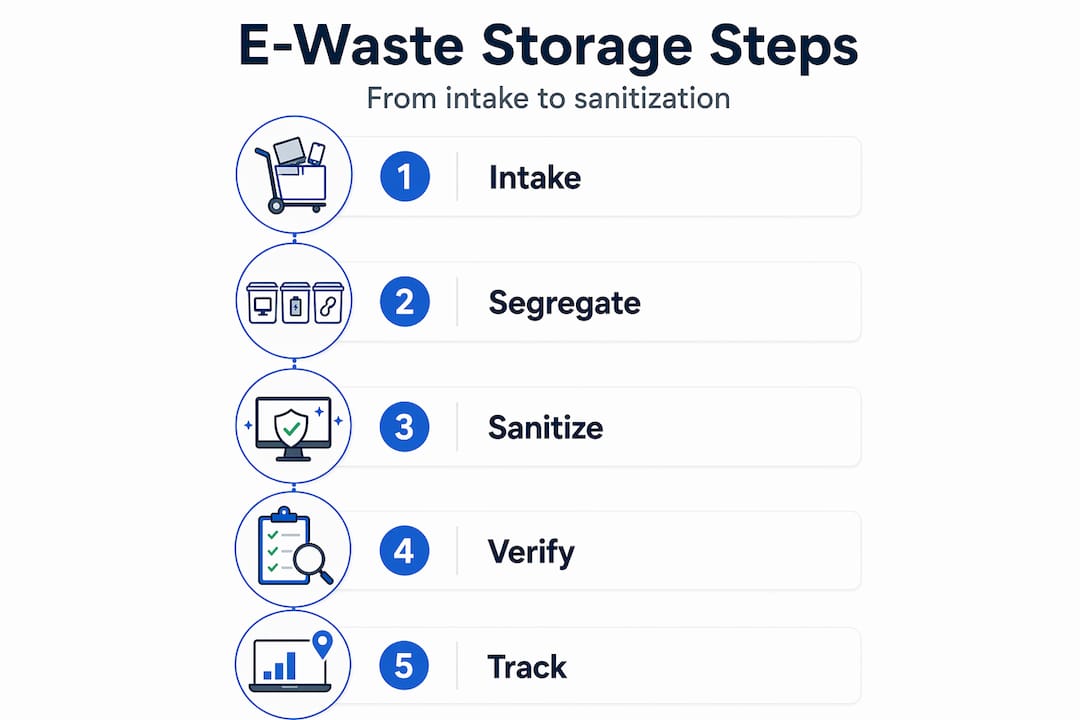
Here is the step-by-step process for sound execution:
- Assign a unique asset ID or barcode to every incoming device at the point of receipt, before it enters any storage zone.
- Complete the intake log immediately: device type, make, model, serial number, receiving date, and the name of the person accepting custody.
- Place the device in the UNSANITIZED zone and update your inventory system to reflect its current state.
- Schedule sanitization based on device type and data classification, following NIST guidelines for the appropriate method.
- Perform and document sanitization, recording the method used, tool version, technician name, and outcome (pass or fail).
- Generate a verification report and sanitization certificate linked to the device’s asset ID and serial number.
- Move the device to the SANITIZED zone and update the inventory system to reflect the new state.
- Retain all records in a format that supports audit retrieval: searchable, backed up, and access-controlled.
Per-device tracking and audit-ready logs are not optional extras — they are what make your program defensible when a regulator asks you to prove a specific device was handled correctly six months ago.
The single most operationally dangerous mistake is mixing device states. R2v3 SOPs explicitly warn against mixing unsanitized and sanitized devices because once states are confused, the entire audit trail for that batch becomes questionable. A sanitized device placed back in the red zone effectively becomes unsanitized again from a documentation standpoint.
| Workflow stage | Key action | Document generated |
|---|---|---|
| Intake | Assign asset ID, log device details | Intake manifest |
| Storage (unsanitized) | Place in red zone, update inventory | Zone placement log |
| Sanitization | Apply approved method, record technician | Sanitization work order |
| Verification | Confirm success, generate certificate | Verification report, certificate |
| Storage (sanitized) | Move to green zone, update inventory | Zone transfer log |
| Disposition | Transfer to recycler or destruction | Chain-of-custody transfer form |
Pro Tip: Run a weekly “state audit” where someone physically checks that every device in each zone matches the inventory system’s recorded state. Catching a mismatch on Tuesday is a two-minute correction. Catching it during an external audit is a very different conversation.
For deeper detail on e-waste data disposal security at each workflow stage, and how IT hardware recycling workflows connect to downstream asset recovery, both resources are worth reviewing before finalizing your procedures.
Verifying compliance and preparing for audits in secure e-waste storage
Audits feel stressful when your documentation is a patchwork. They feel manageable when your records tell a clear, consistent story. The goal is to make your paper trail (or digital trail) as clean as your physical operations.
R2v3 documentation requirements make clear that regulators need evidence that documentation matches workflow, including chain-of-custody and verification reports. That word “matches” is doing a lot of work. An auditor will pull a random device serial number and trace it through every document you have. If there is a gap, a date discrepancy, or a missing signature, that gap becomes a finding.
Your audit-readiness checklist should include:
- Complete intake manifests for all devices received in the audit period
- Sanitization logs with method, tool, technician, and timestamp for each device
- Verification reports confirming sanitization success
- Certificates of sanitization or destruction linked to serial numbers
- Cage access logs covering the full audit period
- Personnel training records showing staff were briefed on current procedures
The most overlooked audit preparation step: reconcile your inventory system against your physical cage counts at least 30 days before any scheduled audit. Discrepancies you find then are problems you can fix. Discrepancies an auditor finds are findings you have to explain.
If your organization ships e-waste across national borders, Basel Convention amendments have meaningfully increased documentation and planning requirements. Prior informed consent from receiving countries, extended lead times, and more detailed manifest requirements now apply. That means your secure staging storage needs to accommodate longer dwell times while shipment documentation clears regulatory review.
Staff training is often the weakest link. Technical controls are only as good as the people operating them. Conduct training at onboarding, annually, and whenever a significant regulatory change occurs. Document each session and retain attendance records as part of your audit package.
For an overview of electronic waste secure management at the organizational level, and secure e-waste management practices that connect compliance to sustainability goals, both resources will round out your audit preparation.
Why mastering state control and documentation is the true key to secure e-waste storage
Here is what most guides on secure e-waste storage get wrong: they treat it as a technology problem. Better wiping software. Stronger cages. More cameras. Those tools matter, but the organizations that consistently pass audits and avoid data incidents are not necessarily the ones with the best equipment. They are the ones that treat every device as having an explicit, tracked state at all times.
Think of it like a software state machine. A device is either unsanitized, in-process, verified, or destroyed. Every transition between those states must be documented, dated, and tied to a responsible person. Secure storage succeeds or fails based on enforcing those state transitions with physical segregation and labeled zones. If you cannot look at a device and immediately know its state from its physical location and label alone, your system has a gap.
The documentation piece is where organizations tend to treat paperwork as a burden rather than a control. Every “we’ll fill that in later” is a potential audit finding. Every undocumented handoff is a broken chain of custody. The irony is that rigorous documentation actually reduces workload over time, because it prevents the investigations, corrections, and explanations that sloppy records create.
Operational discipline, not technology, is the differentiator. Invest in staff training, clear SOPs, and daily verification routines. The technology supports the people. It does not replace them.
For a broader look at how these principles connect to your regulatory posture, the IT disposal compliance insights resource is worth bookmarking.
Partner with experts for secure, compliant e-waste storage and disposal
Building a secure e-waste storage program from scratch takes time, expertise, and ongoing attention as regulations evolve. For many IT teams, the most practical path is partnering with a certified provider who already has the infrastructure, documentation systems, and compliance credentials in place.

UsedCartridge.com offers end-to-end electronic waste solutions built around the controls covered in this guide — secure intake, physical segregation, certified data destruction, and audit-ready documentation. Whether you need scheduled pickups, on-site destruction, or certified recycling with chain-of-custody paperwork, the process is designed to support your compliance requirements, not add to your workload. Partnering with a provider who understands business sustainability with e-waste recycling also means your disposal program advances your environmental goals alongside your data security obligations. Request a free quote and review the full secure IT disposal and compliance guide to see exactly what a certified partnership looks like in practice.
Frequently asked questions
What is a media sanitization program and why is it important for secure e-waste storage?
A media sanitization program defines formal policies and approved methods for rendering data unrecoverable on storage media before disposal, forming the policy backbone of any secure e-waste storage procedure. Per NIST SP 800-88 Rev. 2, it must cover repurposing, transfer, and disposal scenarios with sanitization making data access infeasible, not just difficult.
How can I physically segregate unsanitized and sanitized e-waste in storage?
Use separate locked cages or clearly delineated floor zones with distinct color-coded signage and bins labeled specifically for each device state. R2v3-aligned SOPs require logged access to restricted areas so every entry is tied to an authorized individual and a timestamp.
What documentation is essential to demonstrate compliance during e-waste storage audits?
You need intake manifests, sanitization work orders, verification reports, certificates of destruction linked to device serial numbers, cage access logs, and staff training records. R2v3 documentation requirements require that all documentation matches your actual workflow, meaning a random device serial number must trace cleanly through every record from intake to disposition.
How do Basel Convention amendments affect planning for e-waste storage and shipment?
Basel Convention amendments increase documentation requirements and lead times for cross-border e-waste shipments, requiring prior informed consent from receiving countries. Organizations must plan for longer secure staging storage periods while shipment documentation clears regulatory review, making compliant interim storage a logistical necessity rather than a temporary fix.