
Electronic waste creates three interlocking crises: it poisons ecosystems with persistent toxic chemicals, damages human health across generations, and concentrates the worst harms on the world’s most vulnerable communities. The Global E-waste Monitor 2024 puts the scale in sharp relief: the world generated an estimated 62 million tonnes of e-waste in 2022, yet only 22.3% was formally documented as collected and recycled. The World Health Organization) classifies e-waste as one of the fastest-growing waste streams on the planet, with children and pregnant women facing the gravest risks. The U.S. EPA has documented unsafe handling and export practices that shift harm from wealthy nations to communities with far fewer protections.
The core problems, in brief:
- Environmental contamination: Lead, mercury, cadmium, and brominated flame retardants leach into soil and groundwater, travel through air as toxic fumes, and bioaccumulate up the food chain.
- Human health harms: Neurological damage, reproductive harm, respiratory disease, endocrine disruption, and elevated cancer risk are all documented in populations near informal recycling sites.
- Social and economic harm: Millions of informal workers, including children, dismantle electronics by hand or burn them in open fires, absorbing toxins with no protective equipment and no legal recourse.
- Resource loss: Recoverable metals (gold, copper, rare earth elements) worth billions of dollars are destroyed or lost every year because collection and processing systems are inadequate.
Table of Contents
- What counts as e-waste, and how large is the problem?
- How e-waste harms the environment
- What the numbers say about scale, resource loss, and the financial case for action
- What regulations and international agreements govern e-waste?
- What actually works to prevent and manage e-waste harms
- How informal recycling harms communities: child labor and economic dependency
- Rich nations generate it; poorer nations process it
- New technology in e-waste recycling and material recovery
- How a product’s lifecycle shapes its e-waste impact
- Key Takeaways
- Why the conventional wisdom on e-waste is incomplete
- Usedcartridge handles the compliance and recovery work your team shouldn’t have to manage alone
- Sources and further reading
What counts as e-waste, and how large is the problem?
E-waste, also called e-scrap or end-of-life electronics, covers any discarded product with a plug, battery, or circuit board. The EPA and UN use the term “waste electrical and electronic equipment” (WEEE) in formal contexts, though “e-waste” is the common shorthand in the United States. The category spans consumer electronics (smartphones, laptops, televisions), IT equipment (servers, networking gear), large household appliances, batteries, and, increasingly, photovoltaic solar panels.
The scale is hard to overstate. According to the Global E-waste Monitor 2024, global generation reached 62 million tonnes in 2022, a figure that has grown roughly 2–3 million tonnes per year over the past decade. A UNU press release summarizing GEM trends warns that documented recycling is falling further behind generation, not catching up, and that without intervention the gap will widen significantly by 2030.
| Metric | Figure | Source |
|---|---|---|
| Global e-waste generated (2022) | 62 million tonnes | Global E-waste Monitor 2024 |
| Documented collection/recycling rate | 22.3% | Global E-waste Monitor 2024 |
| Net benefit of reaching 60% collection by 2030 | Exceeds US$38 billion | Global E-waste Monitor 2024 |
| Chemical substances released during unsound recycling | Up to 1,000 | MDPI integrated review |
Key policy milestones: the Basel Convention opened for signature in 1989 and became the central international instrument for controlling transboundary movement of hazardous waste. The U.S. EPA began formal e-waste initiatives in the early 2000s, with multi-stakeholder capacity-building programs expanding through 2009–2011. The Global E-waste Monitor has published successive editions tracking generation and recycling trends, with the 2024 edition representing the most comprehensive dataset to date.
How e-waste harms the environment
The environmental damage from mismanaged electronics follows three main pathways: leaching into soil and groundwater, airborne emissions from open burning, and contamination of sediments and food chains.
Soil and groundwater contamination
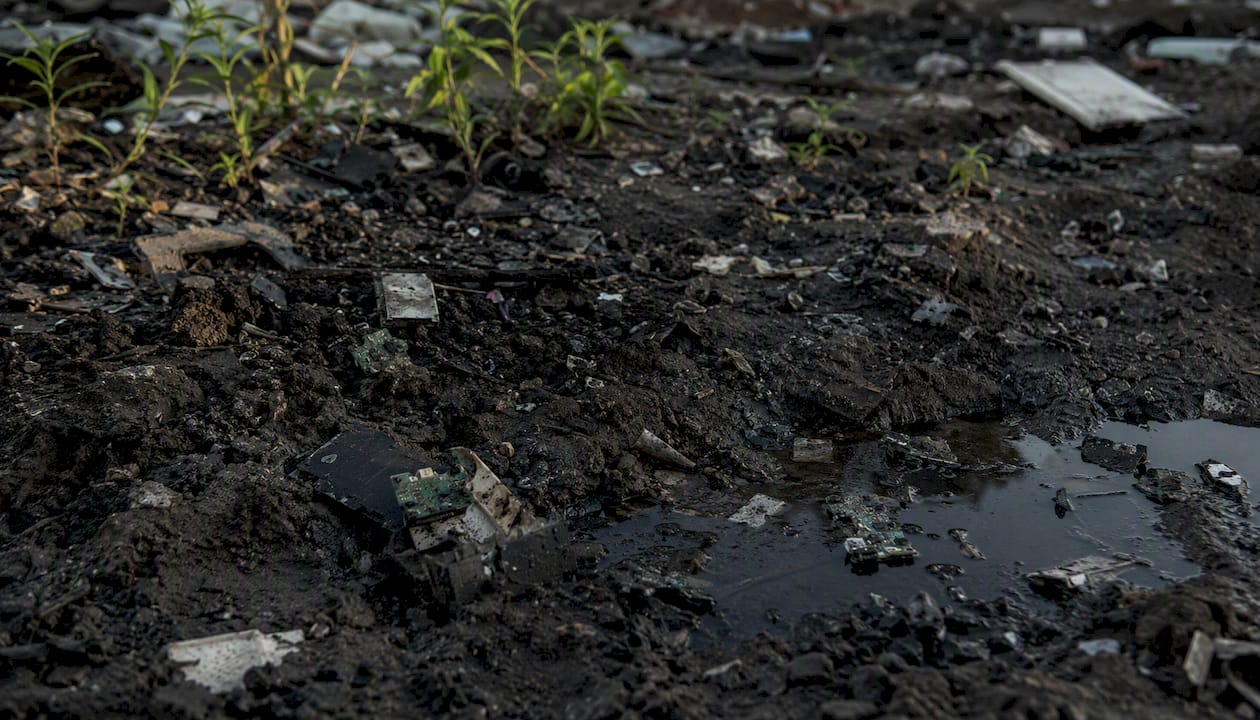
When electronics are landfilled or dismantled without controls, lead from solder and cathode-ray tubes, cadmium from rechargeable batteries, and mercury from fluorescent backlights dissolve into leachate and migrate into surrounding soil and aquifers. These metals persist for decades. Farmland near informal recycling sites in parts of Asia and West Africa has shown heavy-metal concentrations far above safe thresholds, rendering soil unfit for food production long after the recycling activity has moved on.
Air pollution from open burning
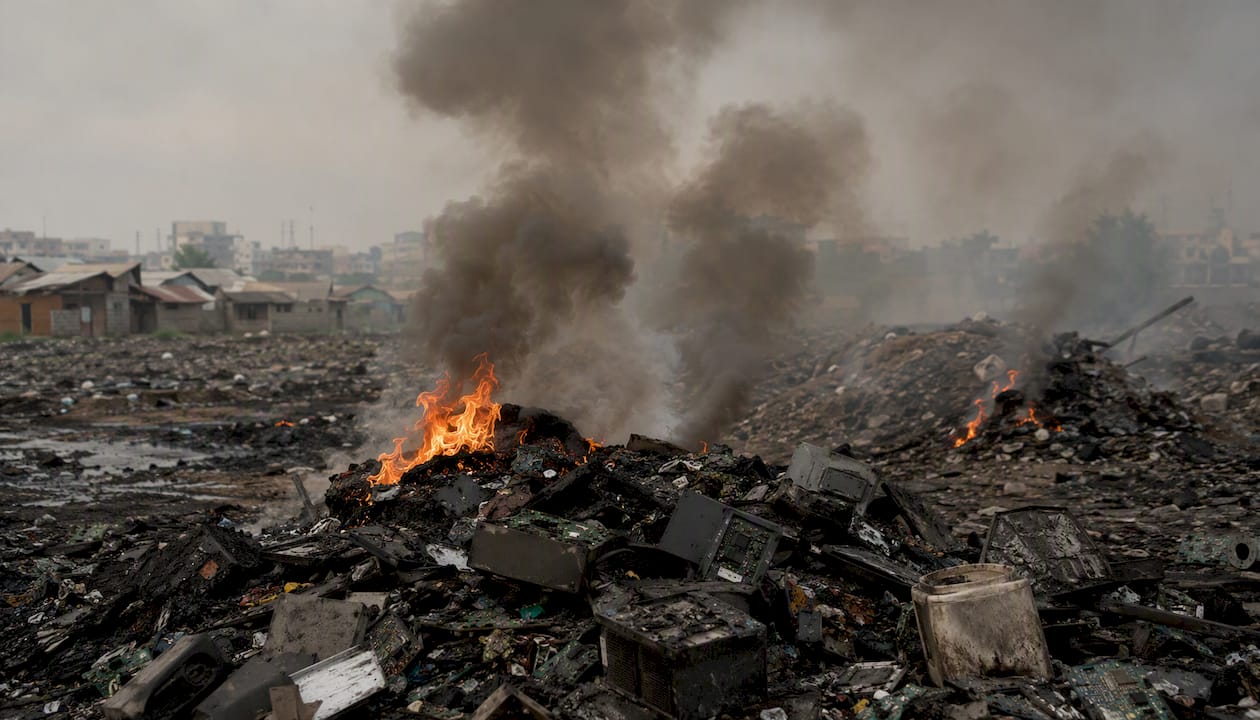
Burning circuit boards and wire insulation to recover copper is common in informal operations. The process releases dioxins, furans, and polycyclic aromatic hydrocarbons (PAHs), all of which are classified as persistent organic pollutants. They travel on wind currents, deposit on crops and water surfaces, and enter the food chain. Research published in MDPI documents that unsound recycling can release up to 1,000 different chemical substances, many of them with no safe exposure threshold.
Climate and resource loss
Producing new electronics from virgin materials is energy-intensive. Every tonne of e-waste that bypasses formal recycling represents both a direct loss of recoverable copper, gold, iron, and rare earth elements and an indirect greenhouse gas cost from the mining and smelting needed to replace those materials. The landfilling of electronics also generates methane from organic components and releases refrigerants from discarded cooling equipment, compounding the climate footprint.
Brominated flame retardants (BFRs) deserve special mention. Used in plastic casings and circuit boards, they are highly persistent, bioaccumulate in fatty tissue, and are linked to thyroid disruption and neurodevelopmental harm. When BFR-containing plastics are burned, they generate brominated dioxins, which are among the most toxic compounds known.
What the numbers say about scale, resource loss, and the financial case for action
The economic argument for better e-waste management is straightforward once you see the numbers. The Global E-waste Monitor 2024 estimates that raising global collection and recycling rates to 60% by 2030 would produce net economic benefits, from health risk mitigation and resource recovery combined, exceeding US$38 billion above implementation costs. That figure does not include the avoided long-term health-care costs in affected communities, which would push the real benefit higher.
The resource loss side is equally striking. Electronics contain iron, copper, aluminum, gold, silver, palladium, and rare earth elements. When e-waste bypasses formal recycling, those materials are either destroyed or lost to landfill, and new mining must replace them. The advantages of proper digital device recycling extend well beyond compliance: recovered materials re-enter manufacturing supply chains, reducing both extraction costs and the carbon footprint of new production.
| Indicator | Value |
|---|---|
| Global e-waste generated (2022) | 62 million tonnes |
| Formally documented recycling rate | 22.3% |
| Estimated net benefit at 60% collection by 2030 | >US$38 billion |
| Chemical substances released by unsound recycling | Up to 1,000 |
The UNU press release on surging e-waste frames the trend plainly: generation is accelerating while documented recycling stagnates. Without structural changes in product design, collection infrastructure, and international enforcement, the gap will keep widening.
What regulations and international agreements govern e-waste?
Multiple international frameworks address e-waste, but participation, enforcement, and scope vary considerably. No single instrument covers the full problem.
| Instrument / Actor | Geographic scope | What it controls | Business implication |
|---|---|---|---|
| Basel Convention | — | Transboundary movement of hazardous waste, including e-waste | U.S. exporters operate outside Basel obligations; due diligence still required |
| UNEP / Global E-waste Monitor | Global | Tracks generation, recycling rates, policy trends | Benchmark data for corporate reporting |
| ILO | Global | Worker safety standards in recycling and waste sectors | Informs occupational health requirements |
| U.S. EPA national strategy | United States | Domestic recycling goals, export concerns, greener design | Compliance baseline for U.S. businesses |
| Extended producer responsibility (EPR) laws | State-by-state (U.S.) | Manufacturer takeback and recycling obligations | Affects procurement and disposal planning |
The U.S. EPA has documented concerns about unsafe handling and exports of used electronics and has led multi-stakeholder capacity-building projects aimed at improving domestic recycling and reducing harmful exports. Its national strategy goals center on greener product design, increased domestic collection, and reducing the export of e-waste to countries with inadequate processing capacity. The role of environmental standards in shaping these outcomes is growing as state-level EPR programs expand and federal reporting expectations tighten.
The Basel Convention remains the most significant international instrument, but U.S. non-ratification means American exporters are not bound by its hazardous-waste transfer controls. That gap creates real compliance risk: equipment exported as “used goods” can become subject to destination-country regulations that the exporter never anticipated.
What actually works to prevent and manage e-waste harms
Prevention is a combination of design change, better end-of-life logistics, safe recycling, and regulatory enforcement. No single lever is sufficient.
For businesses and organizations, a prioritized checklist:
- Assess your device inventory before any disposal cycle. Categorize assets by age, condition, and data sensitivity.
- Pursue IT asset recovery before recycling. Devices with residual value can be refurbished and resold, recovering cost and extending product life.
- Require certified data destruction for every device leaving your organization, whether it is recycled, donated, or sold. The Global E-waste Monitor 2024 PDF flags misclassification of waste as “used equipment” as a significant liability risk. Certified destruction with an audit trail eliminates that exposure.
- Choose certified recycling partners that meet recognized standards (R2, e-Stewards) and can provide documentation of downstream processing.
- Maintain audit-ready records of all disposal transactions, including certificates of destruction and recycling manifests.
For individuals:
- Extend device life through repair and software updates before replacing.
- Choose products rated for repairability (iFixit scores, manufacturer repair programs).
- Use manufacturer takeback programs or certified municipal collection events.
- Never place electronics in curbside recycling or household trash.
Policy levers that move the needle: extended producer responsibility laws that require manufacturers to fund collection and recycling, public drop-off infrastructure in underserved communities, and capacity-building grants for formal recycling facilities in lower-income countries.
Pro Tip: Combining IT asset recovery with certified data destruction in a single vendor engagement reduces administrative overhead, captures residual asset value, and produces a single audit trail. That combination is the most cost-effective approach for most mid-size organizations.
The circular economy principles applied to technology offer the most durable long-term solution: design products for disassembly, use fewer hazardous materials, and build recovery into the product’s business model from the start.
How informal recycling harms communities: child labor and economic dependency
The social damage from informal e-waste recycling is concentrated and severe. Millions of people in West Africa, South and Southeast Asia, and Latin America depend on informal electronics dismantling for income. The work is often the only accessible livelihood in communities with high unemployment, which creates a dependency that is difficult to break even when the health consequences are well documented.
Children are disproportionately present at informal sites. They sort components, strip wire insulation, and burn plastics, absorbing lead, cadmium, and mercury at developmental stages when the neurological damage is most severe and least reversible. The WHO and ILO) have both documented this pattern and emphasized that public health interventions must be paired with alternative livelihood programs, because removing income without replacement simply pushes families into deeper poverty.
Economic dependency also distorts local policy. Communities that rely on informal recycling income resist formal regulation that would shut down operations, even when residents understand the health risks. Effective solutions require investment in formal processing infrastructure that can employ the same workers under safe conditions, not just enforcement against informal practices.
Rich nations generate it; poorer nations process it
The global disparity in e-waste generation versus processing capacity is one of the starkest environmental justice problems of the current era. The United States, Europe, and East Asia generate the vast majority of the world’s e-waste. Formal recycling infrastructure is concentrated in those same regions. Yet a substantial share of discarded electronics ends up processed in countries with far lower incomes, weaker environmental enforcement, and minimal occupational health protections.
This is not accidental. The economics favor it: labor costs for manual dismantling are lower in lower-income countries, and environmental compliance costs are lower where enforcement is weak. The result is a system where the benefits of cheap electronics accrue to wealthy consumers and the health costs are exported to communities that had no role in generating the waste.
Closing this gap requires both stronger export controls in generating countries and investment in formal processing capacity in receiving countries, so that local workers can handle e-waste safely rather than informally.
New technology in e-waste recycling and material recovery
The technology for recovering materials from e-waste has advanced considerably, though deployment at scale remains uneven.
Hydrometallurgical processes use aqueous chemistry (controlled acid leaching, solvent extraction, electrowinning) to recover gold, silver, palladium, and copper from circuit boards at purities comparable to primary mining. Unlike open acid baths used informally, industrial hydrometallurgy operates in closed systems with waste treatment.
Pyrometallurgical smelting at dedicated facilities can process mixed metal fractions at high temperatures, recovering base and precious metals while capturing off-gases in scrubbing systems. Companies like Umicore operate large-scale precious-metal recovery from e-waste using this approach.
Automated disassembly using robotics and AI-guided sorting is emerging for high-volume streams like smartphones and laptops, improving material separation before shredding and increasing the purity of recovered fractions.
Bioleaching, using bacteria such as Acidithiobacillus ferrooxidans to dissolve metals from circuit boards, is an active area of research. It offers lower energy requirements and reduced chemical inputs compared to conventional hydrometallurgy, though it is not yet widely deployed commercially.
The green e-waste management practices that formal processors use today are already far cleaner than informal alternatives. The next decade’s challenge is scaling these methods to handle the volumes the GEM projects.
How a product’s lifecycle shapes its e-waste impact
E-waste impacts do not begin at disposal. They accumulate across a product’s entire lifecycle, and understanding where the leverage points are matters for both policy and procurement decisions.
Raw material extraction: Mining for lithium, cobalt, tantalum, and rare earth elements carries its own environmental and human-rights costs. Products designed to use less of these materials, or to use recycled content, reduce upstream harm.
Manufacturing: The energy and chemical inputs for semiconductor fabrication and battery production are substantial. A device that lasts five years instead of two requires roughly half the manufacturing impact per year of use.
Use phase: Energy consumption during use is the dominant lifecycle impact for many large appliances and data center equipment. Efficiency improvements here reduce both operating costs and carbon footprint.
End of life: This is where the problems of electronic waste concentrate most visibly. A device designed for disassembly (modular components, labeled materials, accessible fasteners) can be repaired, upgraded, and eventually recycled far more efficiently than one sealed with adhesive and proprietary screws. The EU’s Right to Repair directive and similar U.S. state-level efforts are pushing manufacturers toward designs that reduce end-of-life harm.
The lifecycle perspective makes clear that the most powerful interventions happen at design and procurement, not at the recycling stage. By the time a device reaches end of life, most of its environmental impact is already locked in.
Key Takeaways
Electronic waste is the world’s fastest-growing waste stream, and only 22.3% of the 62 million tonnes generated in 2022 was formally recycled, leaving billions of dollars in recoverable materials lost and millions of people exposed to preventable toxic harm.
| Point | Details |
|---|---|
| Scale of the problem | 62 million tonnes of e-waste generated globally in 2022; only 22.3% formally recycled. |
| Health risks are documented | Systematic reviews link e-waste exposure to neurological damage, reproductive harm, and genotoxic markers, especially in children. |
| Informal recycling drives harm | Open burning and acid leaching release up to 1,000 chemical substances; informal workers and nearby communities bear the health costs. |
| Economic case for action | Raising global collection substantially by 2030 could produce net economic benefits from health risk mitigation and resource recovery that exceed implementation costs. |
| Usedcartridge for businesses | Certified e-waste recycling, secure data destruction, and IT asset recovery reduce liability and recover value from end-of-life equipment. |
Why the conventional wisdom on e-waste is incomplete
Most coverage of e-waste focuses on the recycling rate and stops there, as if getting to 22.3% formally recycled is the whole story. The number matters, but it obscures something more uncomfortable: even the 77.7% that is not formally recycled does not simply disappear. It gets processed, just badly, by people who cannot afford to say no.
The framing of e-waste as primarily a recycling logistics problem misses the point. It is a design problem, a trade policy problem, and an economic justice problem that happens to manifest at the recycling stage. Telling consumers to “recycle responsibly” while manufacturers continue to produce devices that are nearly impossible to repair or disassemble is like telling people to drive safely on a road with no guardrails.
For organizations, the practical implication is this: certified recycling and secure data destruction are not just compliance checkboxes. They are the mechanism by which your discarded equipment does not end up burned in an open fire by a child in another country. That is a concrete outcome, not a marketing claim, and it is worth treating it as such.
Usedcartridge handles the compliance and recovery work your team shouldn’t have to manage alone
Businesses that take e-waste seriously face a real operational problem: managing certified disposal, secure data destruction, and IT asset recovery across dozens or hundreds of devices requires documentation, logistics, and vendor oversight that most IT and facilities teams are not staffed to handle internally.

Usedcartridge provides e-waste recycling and secure data destruction as a managed service for businesses and organizations. On-site and off-site data destruction options come with certified audit trails, so your compliance documentation is complete before the equipment leaves your facility. IT asset recovery includes value assessment and direct payout for equipment with residual worth, turning a disposal cost into partial cost recovery. Every engagement is designed to meet regulatory requirements and produce the records your auditors will ask for.
If your organization has end-of-life IT equipment, servers, laptops, or other electronics to manage, request an IT asset recovery and disposition quote to see what your equipment is worth and what certified disposal will cost.
Sources and further reading
| Source | What it covers |
|---|---|
| Global E-waste Monitor 2024 | Global generation totals, documented recycling rates, economic modeling, and policy trends. The primary dataset for e-waste scale and trajectory. |
| WHO: Electronic waste (e-waste) | Health impacts on children and pregnant women, informal recycling hazards, and WHO recommendations. |
| PMC: Health consequences of e-waste exposure (systematic review) | Epidemiological evidence linking e-waste to heavy-metal burdens, developmental harm, endocrine disruption, and genotoxic markers. |
| MDPI: Integrated approach to e-waste management | Hazardous substances, environmental pathways, governance frameworks, and circular-economy mitigation strategies. |
| U.S. EPA: Cleaning up electronic waste | U.S. national strategy, international cooperation efforts, and EPA concerns about unsafe handling and exports. |
| UNU press release: Global e-waste surging | Summary of GEM trend data and urgency framing from the United Nations University. |
| Global E-waste Monitor 2024 (PDF) | Full technical report including classification guidance, operational risks, and data destruction liability issues. |
| Basel Convention | International framework for transboundary hazardous waste controls, including e-waste export restrictions. |