
Business e-waste pickup typically costs somewhere between free and a few hundred dollars per collection, with per-item fees for specific hardware types layered on top. A single office clearing out 20 old desktops might pay nothing if a municipal program qualifies them, while a 200-device server room decommission could net a payout instead of a bill once resale value gets factored in.
The price anchors you’ll run into most often:
- Free pickup for qualifying volumes through some municipal or nonprofit programs
- Per-item fees for hard drives, printers, and CRT monitors, often a few dollars to around twenty dollars per unit
- On-site logistics charges of roughly $150 to $500 per collection for pickup and access complexity, according to ITAD pricing data
- Net credits when working laptops or servers outweigh the junk in the load
Your next move: build a simple inventory (device counts, condition, age) and get a written quote that spells out data-destruction terms and any recovery credit. That single document is what separates a fair price from a padded one.
Key Takeaways
Business e-waste pickup cost depends less on a fixed price list and more on device condition, volume, and how much security and logistics work the job requires.
| Point | Details |
|---|---|
| Ballpark range | Costs run from free to several hundred dollars per pickup, plus per-item fees for hard drives, printers, and CRTs. |
| Device condition drives net cost | Working laptops and servers under four years old often produce a refund; older or broken units usually cost money. |
| Logistics add up fast | On-site pickup and difficult building access can add $150 to $500 beyond per-device fees. |
| Itemized quotes prevent surprises | Ask vendors to separate transportation, destruction, and recovery credits instead of quoting a lump sum. |
| Usedcartridge bundles the whole job | Pickup, certified data destruction, and IT asset recovery come with audit-ready documentation in one scheduled visit. |
Table of Contents
- What Drives the Cost of Commercial E-Waste Pickup?
- How Much Does E-Waste Pickup Cost Per Device?
- What’s Included in a Quoted Price, and What Costs Extra?
- How Do You Get an Accurate E-Waste Pickup Quote?
- How Can Businesses Lower Their E-Waste Pickup Costs?
- How UsedCartridge.com Handles Business E-Waste Pickup
- Frequently Asked Questions
- Sources
What Drives the Cost of Commercial E-Waste Pickup?
Vendors price a pickup the way movers price a job: weight, distance, and difficulty. Volume and total weight set the baseline. Device type matters just as much. A pallet of monitors costs more to handle than a pallet of laptops because CRTs contain leaded glass that requires specialized processing, while modern LCD screens don’t.
Asset condition and resale potential swing pricing hard in either direction. A four-year-old fleet of working laptops can turn a “disposal job” into a “recovery payout.” Security requirements add cost too. On-site hard drive shredding, witnessed destruction, and chain-of-custody documentation all carry a premium over standard off-site processing.
Location and access round out the list. A ground-floor loading dock is cheap to service. A fifth-floor walkup with no elevator is not, since reverse logistics guides point to lift and access requirements as one of the biggest hidden cost drivers in commercial pickups.
Secondary factors nudge the price too:
- Scheduling urgency (same-week pickup vs. a flexible window)
- Building access, floor count, and whether palletizing is required
- State or municipal handling rules for specific materials
Pro Tip: Group your high-value devices (recent laptops, networking gear) with your low-value junk (old monitors, cables) into one pickup. Vendors often blend the economics, and your net cost drops.
How Much Does E-Waste Pickup Cost Per Device?
Real numbers help more than percentages here, so look at what municipal programs and commercial ITAD (IT asset disposition) vendors actually charge or pay per unit.
A representative municipal drop-off program illustrates the other end of the spectrum: Recycle Ann Arbor’s fee schedule charges a daily residential gate fee plus a separate hard-to-recycle fee, with individual electronics priced by item size. That’s a useful benchmark, but it’s built for walk-in drop-off, not a scheduled commercial pickup with multiple pallets and a certificate of destruction attached.
Some community programs go further in the other direction. Zero Waste Silicon Valley, for instance, offers free pickup to businesses with a minimum number of qualifying e-waste items, charging a modest fee for smaller loads. Pricing swings that widely because municipal programs, nonprofit collectors, and commercial ITAD vendors are solving different problems: one wants materials diverted from landfills, the other is managing liability, data security, and resale value at scale.
What’s Included in a Quoted Price, and What Costs Extra?
A standard quote usually bundles transportation, basic handling, sorting, and a certificate of recycling or destruction. Most reputable vendors include at least a baseline chain-of-custody document at no extra charge, since it’s part of how they demonstrate compliance.
What isn’t always included is where budgets get blown. Watch for these common add-ons:
- On-site hard drive shredding (versus off-site, which is usually cheaper)
- Heavy-appliance handling for items like UPS batteries or large printers
- CRT monitor surcharges tied to leaded-glass processing
- Per-pound hazardous-handling fees for batteries or fluorescent components
- Small-item per-unit charges that add up fast across hundreds of cables or peripherals
Pro Tip: Ask for a fully itemized quote, not a lump sum, and get a written explanation of how asset recovery value gets applied against your invoice. A vague “we’ll credit you for anything valuable” clause is where disputes happen later.
How Do You Get an Accurate E-Waste Pickup Quote?
Vendors can’t price what they can’t see, and vague inventory descriptions are the number one reason quotes come back higher than expected once the truck shows up.
Give any vendor these details before asking for pricing:
- Device counts broken down by type (laptops, desktops, monitors, printers, servers)
- Working condition for each category, even a rough estimate
- Serial numbers or asset tags if you want ITAD-level resale tracking
- Whether batteries are still installed or already removed
- Pickup access details: loading dock, elevator availability, floor count
Then ask the vendor these questions directly, and compare answers across at least two providers:
- Are you R2 or e-Stewards certified, and can you provide documentation?
- Will you deliver a certificate of destruction and chain-of-custody paperwork for every load?
- Do you offer a guaranteed minimum recovery on larger projects?
- What’s the price difference between on-site and off-site data destruction?
- What insurance and liability coverage applies during transport and processing?
- What’s your realistic timeline from scheduling to completed pickup?
Pro Tip: On any asset recovery project involving 100 or more devices, push for a guaranteed minimum recovery clause with a clear profit split above that floor. Without it, refurb pricing is entirely at the vendor’s discretion, and you have no way to check their math.
How Can Businesses Lower Their E-Waste Pickup Costs?
The biggest lever most businesses ignore is timing. Bunching everything into one large pickup instead of several small ones spreads the fixed logistics cost across more devices, which lowers your cost per unit.
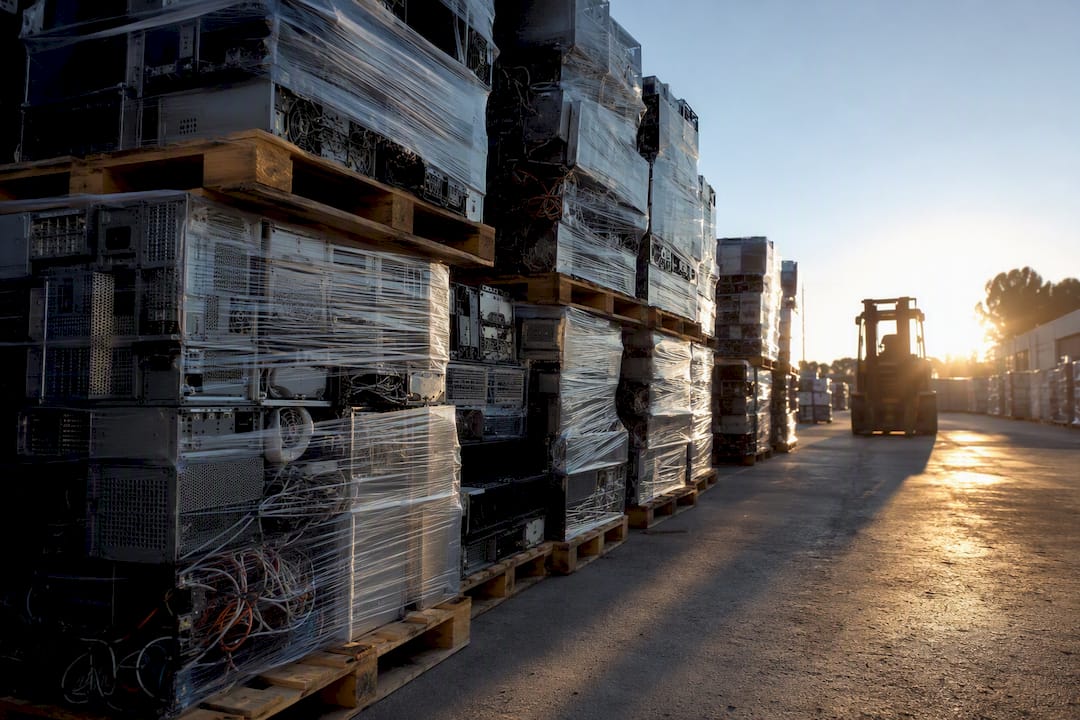
Segregating working assets from dead weight matters just as much. Pull anything under four years old and still functional into its own group for remarketing, since those are the devices most likely to swing your total bill from a cost to a credit. Strip out non-electronic waste and loose batteries ahead of time too. Vendors often charge more to sort mixed loads than to process clean ones.
Municipal programs are worth checking before you call a commercial vendor, especially for smaller volumes like those handled by Melbourne City Rubbish.
- Bulk your pickup into one scheduled visit instead of several small ones
- Separate high-value working assets from obsolete junk before the truck arrives
- Remove batteries and non-electronic materials in advance
- Check municipal or nonprofit programs for free-pickup thresholds
Pro Tip: Run a five-minute triage before you call anyone: any device four years old or newer and still powering on is a candidate for a positive return. Everything else is a straight disposal cost. Knowing that split before you get a quote tells you whether you’re negotiating a bill or a payout.
Why certified, documented service matters for businesses
Cheap pickup that skips certification is a liability, not a savings. Demand R2 or e-Stewards certification, a certificate of destruction for every drive, tracked chain-of-custody, and insured transport every time. Documented recovery also strengthens ESG reporting and cuts regulatory exposure. Keep every certificate on file. Auditors will eventually ask for it.
How UsedCartridge.com Handles Business E-Waste Pickup
Usedcartridge is the alternative to piecing together a municipal drop-off, a separate data-destruction vendor, and a third company for asset resale. One scheduled pickup covers e-waste collection, secure on-site or off-site hard drive destruction, and IT asset recovery, with audit-ready certificates delivered for every load.

That matters most on the two things this article keeps circling back to: documentation and net cost. Usedcartridge issues chain-of-custody paperwork and certificates of destruction as standard, so you’re never scrambling before an audit. On the cost side, working laptops, servers, and networking gear get evaluated for resale value before anything hits the recycling stream, which is how a pickup that looks like an expense on paper sometimes turns into a payout.
If you’re ready to see where your fleet lands, request a free quote and bring the inventory details from the checklist above: device counts, condition, and access notes. That’s the fastest path to a number you can actually trust.
Frequently Asked Questions
Is business e-waste pickup ever completely free?
Sometimes. Programs like Zero Waste Silicon Valley offer free pickup to businesses with three or more qualifying items, and some commercial vendors waive fees when resale value from working devices covers the processing cost.
Why do CRT monitors cost more to recycle than laptops?
CRTs contain leaded glass and other hazardous components that require specialized processing, which is why municipal fee schedules and commercial vendors both charge more for them than for standard laptops or desktops.
How long does the whole pickup process usually take?
From initial quote request to completed pickup, most businesses can expect anywhere from a few days to two weeks, depending on volume, scheduling availability, and whether on-site data destruction is required.
What’s the difference between municipal and commercial e-waste pricing?
Municipal programs price by item and are built for walk-in or small-volume drop-off, while commercial ITAD vendors evaluate your whole fleet for resale value, data security needs, and logistics, which usually produces a more accurate net cost for larger loads.
Do I need R2 or e-Stewards certification for compliance?
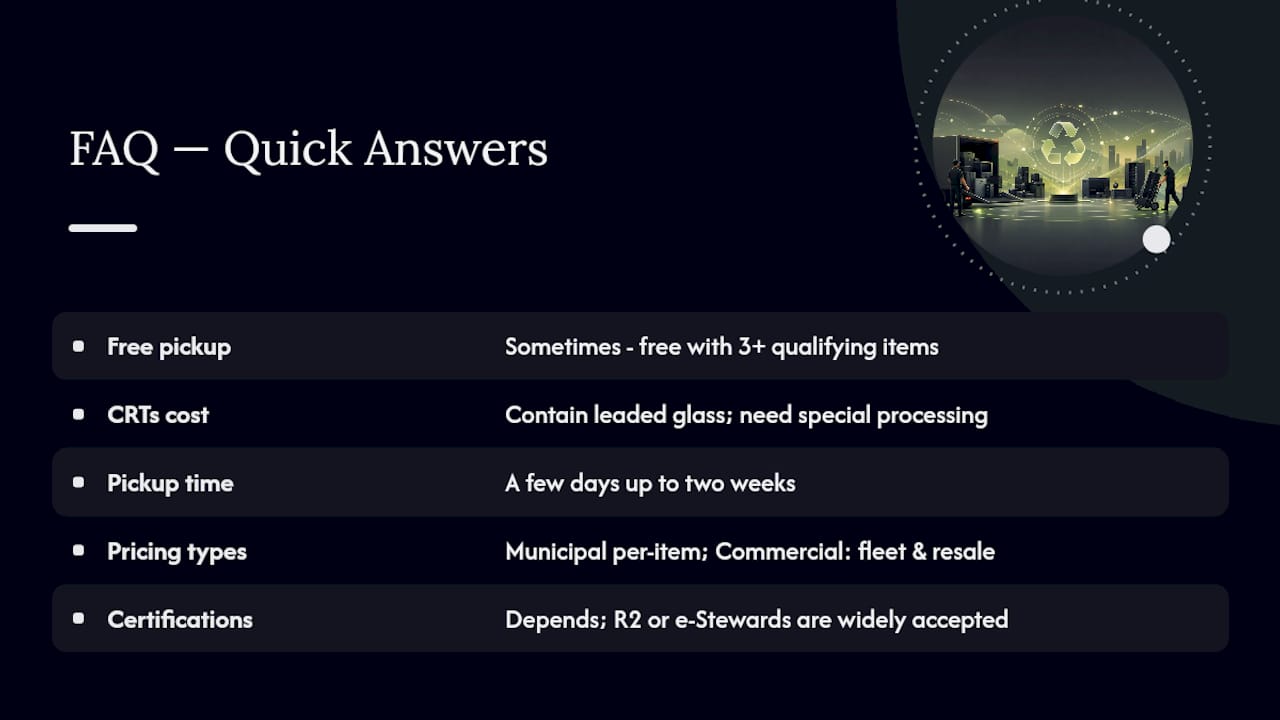
It depends on your industry and data sensitivity, but certification through frameworks tracked by Sustainable Electronics is widely considered the standard for demonstrating responsible, audit-ready disposal practices.
Sources
- CVWMA Electronics Recycling Collection Fees (RVA DPW fee schedule)
- Drop-Off Station prices (Recycle Ann Arbor)
- Sustainable Electronics (SERI)
- Corporate e-waste costs per device (PremierSS blog)