
Balancing strict data destruction requirements with genuine environmental responsibility is harder than most disposal guides let on. You’re navigating a patchwork of federal standards, state regulations, and competing registration schemes, all while trying to avoid liability for either a data breach or an improper disposal audit finding. Get it wrong on the data side and you face regulatory penalties and reputational damage. Get it wrong on the environmental side and you contribute to hazardous waste streams while potentially voiding your sustainability commitments. This guide cuts through the noise with a clear, evidence-based list of secure disposal methods and the decision framework to match each one to your specific risk profile.
Table of Contents
- How to select secure disposal methods
- Detailed list of secure disposal methods
- Comparing registrations and facility-level standards
- Situational recommendations and edge cases
- Hard lessons from secure disposal: What most guides miss
- Connect with secure disposal partners
- Frequently asked questions
Key Takeaways
| Point | Details |
|---|---|
| Choose compliant facilities | Select EPA-registered, DTSC-regulated partners that provide Certificates of Destruction and Recycling. |
| Match method to risk | Use physical destruction for high-security needs and failed erasures; logical wipes and crypto erase for lower-risk assets. |
| Beware greenwashing | Scrutinize collection and recovery rates to ensure real environmental benefit, not just marketing claims. |
| Handle edge cases directly | For devices with erasure failures or damage, escalate to witnessed destruction and maintain regulatory documentation. |
How to select secure disposal methods
Before you choose a method, you need to understand what’s driving your decision. For most IT managers and compliance officers, that means three converging forces: regulatory mandates, data sensitivity risk, and environmental accountability.
Regulatory mandates set the floor. These aren’t suggestions. Federal contractors, healthcare organizations operating under HIPAA, and financial institutions under GLBA are expected to apply the appropriate category based on the classification level of the data involved. State regulations layer additional requirements on top. California’s SB 1386 and its successors, for instance, impose breach notification obligations that make inadequate disposal a direct legal liability. If your organization operates across multiple states, you’re managing a genuine regulatory patchwork with no single rule covering everything.
Ask yourself three questions before selecting any disposal method:
- What is the sensitivity classification of the data on this device?
- What is the condition of the device? Can it complete a successful logical sanitization?
- What level of auditability does your compliance program require?
A laptop that held only publicly available documents carries a different risk profile than a server that processed personally identifiable information or financial records. Device condition matters more than most organizations realize. A drive with bad sectors may appear to complete a software overwrite while leaving residual data in remapped areas.
Eco criteria close the loop. Recycling electronic waste responsibly means more than dropping equipment at a compliant facility. Greenwashing is a real problem in the e-waste industry. Some vendors advertise high “collection rates” while actually sending a significant portion of collected material to unregulated overseas processors. Compliant facilities with verifiable material recovery rates are the standard you should require.
These dual registrations address data security and environmental compliance simultaneously, closing the gap that single-standard vendors leave open.
Detailed list of secure disposal methods
With the selection framework in place, here is how each disposal method works in practice, where it fits, and where it falls short.
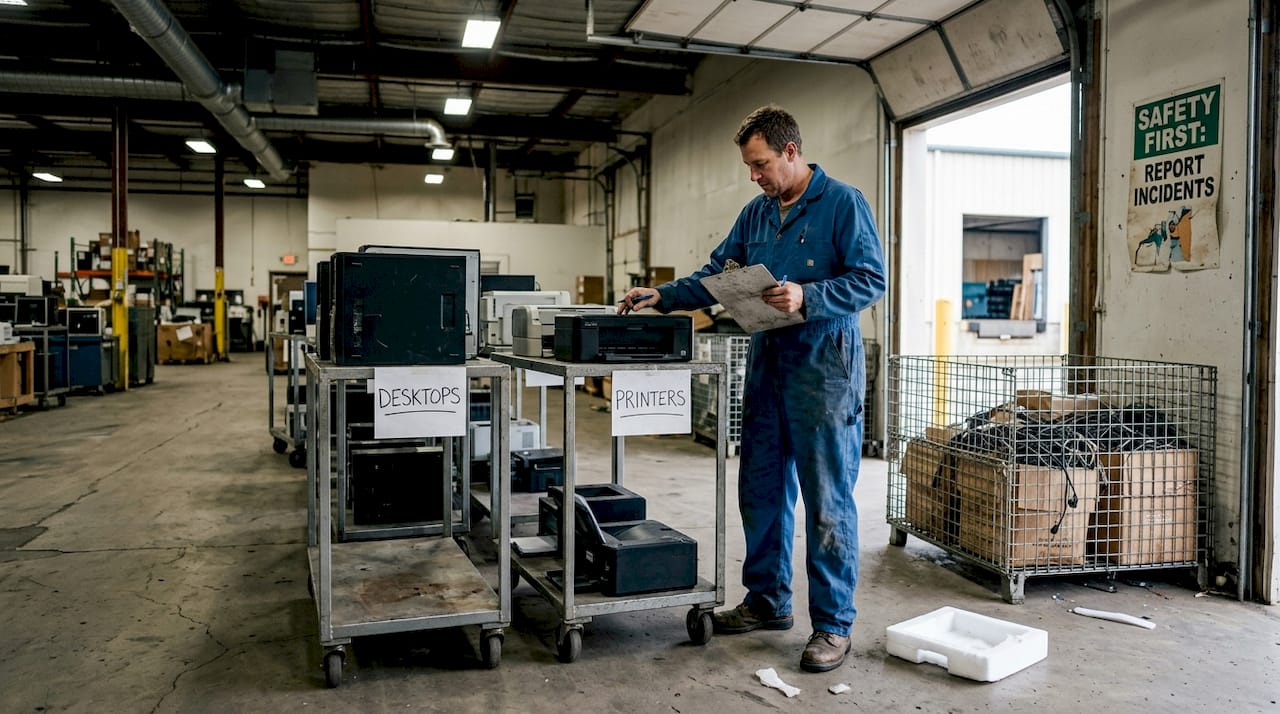
1. Logical erase (Clear)
Overwriting storage media with non-sensitive data patterns is the most basic form of sanitization. Software tools perform multiple write passes to eliminate residual magnetic signatures on HDDs. Clear is appropriate for devices that will be redeployed internally or donated to low-risk recipients. It is not adequate for high-sensitivity data or classified environments. The key limitation is that Clear does not address bad sectors, remapped blocks, or host-protected areas where data can persist unaffected by overwrite commands.
2. This method is elegant and fast, but the word “if verified” carries enormous weight here. You must confirm that the drive was genuinely encrypted before the asset entered service, that the key management system is intact, and that the erase command completed successfully. Documentation of key destruction is your audit evidence.
3. Advanced firmware wipe tools go further by issuing ATA Secure Erase or NVMe format commands directly to the drive controller. Purged assets may remain physically functional, making them candidates for resale or refurbishment. However, Purge requires post-process verification. You cannot visually confirm that Purge worked. Audit tools and documented test results are mandatory.
4. Physical destruction (Destroy)
Destruction, crushing, and incineration eliminate recovery risk entirely. This is the required approach for classified data, failed erasure attempts, and physically damaged drives that cannot complete a logical or firmware-based sanitization. Destruction produces media fragments that comply with specific particle size requirements under NSA/CSS EPL standards. Witnessed destruction with video documentation and a certificate of destruction is good practice; serial numbers can be listed when you supply your list before pickup.
Physical destruction is irreversible. That is both its greatest strength and the reason it eliminates residual value from hardware that might otherwise be recovered, refurbished, and resold.
Special note on SSDs: Hard drive destruction guidance for solid-state media is fundamentally different from HDD protocols. SSDs use wear leveling and over-provisioning that can retain data in areas inaccessible to standard overwrite commands.
A critical operational reality: firmware bugs can cause Secure Erase to fail on some SSD models, making post-sanitization verification non-negotiable for every device, not just high-risk ones.
Pro Tip: Always run post-sanitization verification with an independent audit tool. A certificate from your own sanitization software is not sufficient evidence if the same tool experienced the failure.
Secure equipment recycling works best when the disposal method and the downstream processing facility are matched from the start of the workflow, not retrofitted after the fact.
Comparing registrations and facility-level standards
Individual methods only deliver compliance value when executed by qualified vendors operating under verified registration frameworks.
What compliant facilities actually deliver
E-waste recycling benchmarks matter because they separate facilities that process responsibly from those that simply collect and transfer liability. Compliant enterprise IT facilities achieve collection rates of 80-99%, material recovery rates of 85-97%, and refurbishment reuse rates between 30-75%. Perhaps most significantly for sustainability reporting, compliant reuse programs avoid approximately 150-400 kgCO2e per laptop compared to manufacturing a new replacement.
Key things to verify when auditing a vendor’s environmental claims:
- Ask for material recovery rates, not just collection rates. Collection is logistics. Recovery is the actual environmental outcome.
- Request downstream vendor lists. Know where your material goes after it leaves the primary facility.
- Confirm that electronic waste compliance documentation covers the full chain, not just the intake step.
Greenwashing alert: A vendor advertising “100% diversion from landfill” may be diverting material to overseas processors operating below regulatory standards. Diversion is not the same as responsible recovery. Push for verified material recovery percentages and named downstream processors.
Situational recommendations and edge cases
Compliance frameworks describe ideal conditions. Real IT asset disposition happens in conditions that are far from ideal. Here is how to handle the cases that standard guides gloss over.
Failed erasure due to firmware bugs
Firmware bugs affect secure erase completion at rates that many IT managers find shocking. The mandatory response is escalation to physical destruction. Do not attempt a second erasure pass as your primary mitigation. Document the failure, isolate the device, and route it directly to a witnessed destruction process.
Damaged devices
Physically damaged drives, including those with failed read heads, corrupted firmware, or physical media damage, cannot reliably complete any software-based sanitization. Skip the logical methods entirely. Route damaged devices directly to physical destruction. The data security during disposal risk from a damaged drive is actually higher than from a functional one, because the damage may have occurred in a way that preserves readable data in specific sectors.
High-security and classified environments
TOP SECRET and above classified data requires physical Destroy per NSA/CSS guidelines, with no exceptions for Crypto Erase or Purge regardless of how confident you are in the implementation. Onsite witnessed destruction with a certificate of destruction and video documentation is a strong option.
Multi-state compliance
| Scenario | Recommended method | Key documentation |
|---|---|---|
| Multi-state PII data, functional device | Purge or Destroy | State-specific retention and destruction log |
| Failed erasure, any state | Physical Destroy | Failure audit log, destruction certificate |
| Classified federal data | Destroy only (onsite) | NSA/CSS compliant certificate, witness record |
| Functional device, low-risk data | Clear or Crypto Erase | Overwrite log, verification report |
| Damaged device, any classification | Physical Destroy | Condition assessment, destruction certificate |
Eco-friendly recovery tips are available for organizations that want to maximize value recovery from functional assets before committing them to destruction. The goal is always to apply the least destructive method that fully satisfies the data security requirement, because preservation of hardware value and material recovery are genuine environmental and financial wins.
They are your defense in a regulatory audit or a breach investigation. Every step in the disposal process should generate a timestamped, serialized record that links the device to the person who handled it, the method applied, and the outcome confirmed.
Hard lessons from secure disposal: What most guides miss
After years of working through real IT asset disposition engagements, the pattern that consistently surprises organizations is not the complexity of the methods themselves. It is the gap between what vendors claim and what the audit record actually shows.
Collection rates are the most commonly inflated metric in the e-waste industry. A vendor can legitimately claim 99% collection while sending the majority of collected material to overseas processors operating outside any recognized registration framework. The number sounds impressive. The environmental outcome is poor. Always demand material recovery rates, not collection percentages.
One-time registration audits give a false sense of security. Treat vendor registration as a starting point for due diligence, not a conclusion. Secure e-waste pickup guidance should include recurring vendor audits built into your ITAD contract, not just an initial credentialing check.
For high-risk assets, witnessed destruction is the single practice that closes more compliance gaps than any other. A certificate of destruction from a vendor you have never observed operating tells you almost nothing about what actually happened to your drives. Witnessed destruction with video documentation gives your compliance team evidence that can withstand regulatory scrutiny.
Connect with secure disposal partners
Navigating registrations, disposal methods, and multi-state compliance requirements is exactly the kind of challenge that compliant ITAD partners handle every day. At Recycle for Life, we connect IT teams with vetted, audited disposal workflows that address both data security and environmental accountability.
Whether you are managing electronic waste logistics for a fleet of retiring servers or need witnessed on-site destruction with a Certificate of Destruction, we can match your needs to the right compliant process. Request a free IT asset recovery quote to get a tailored workflow for your compliance requirements. Our team also provides detailed guidance on device disposal security to help you build defensible disposal programs that satisfy auditors and protect your organization.
Frequently asked questions
How do SSDs differ from HDDs in secure disposal?
SSDs require specialized methods because wear leveling retains data in areas standard overwrites cannot reach.
What benchmarks or recovery rates should IT managers expect from compliant e-waste facilities?
Ask the vendor for its own figures in writing, including how it measures them, rather than relying on industry averages. At a minimum, confirm the recycler is EPA-registered and regulated by the state (in California, the DTSC), and that you receive a Certificate of Recycling for every pickup.
What should I do if a device fails secure erasure due to firmware bugs?
Treat it as a failed wipe: set the device aside, record its serial number, and send it for physical destruction rather than retrying until it appears to pass.