
Compliance officers and IT managers face a deceptively complex problem: disposing of end-of-life devices in a way that fully protects sensitive data, satisfies legal privacy mandates, and doesn’t create an environmental liability. Drop the ball on any one of those three requirements and you’re looking at regulatory fines, breach exposure, or reputational fallout. Secure recycling methods address all three simultaneously, and the organizations that recognize this early are building real strategic advantage. This article walks through the core benefits, the evidence behind them, and the practical steps your team can act on immediately.
Table of Contents
- Meet legal privacy standards with secure recycling
- Protect sensitive data throughout the recycling process
- Environmental benefits of secure electronics recycling
- Comparing secure recycling and conventional approaches
- The real ROI: Secure recycling as strategic advantage
- Get started with secure recycling and IT asset recovery
- Frequently asked questions
Key Takeaways
| Point | Details |
|---|---|
| Legal compliance advantage | Secure recycling ensures organizations meet strict privacy standards for data and device disposal. |
| Superior data protection | Physical shredding and NIST-compliant data sanitization make sensitive information unrecoverable. |
| Environmental responsibility | Materials recovery and pollution avoidance make secure recycling eco-friendly. |
| Strategic risk reduction | Secure recycling reduces legal and reputational exposure for IT departments. |
Meet legal privacy standards with secure recycling
Legal mandates around data destruction are not optional guidelines. Regulations such as HIPAA, FACTA, GLBA, and state-level privacy laws explicitly require that organizations destroy data on decommissioned devices in a way that makes recovery impossible. Generic drop-off recycling programs simply don’t satisfy those requirements, and the burden of proof falls on your organization.
Secure recycling closes that gap by applying structured, documented methodologies. The NIST framework defines three escalating levels of data sanitization, which collectively form the foundation of any defensible disposal program:
- Clear — Overwriting data using software-based methods so it cannot be retrieved with standard tools.
- Purge — Using degaussing or cryptographic erase techniques to defeat more sophisticated recovery attempts.
- Destroy — Physical destruction of the media itself, rendering any recovery technically impossible regardless of available tools.
Each step provides a higher assurance level. For regulated industries such as healthcare or financial services, the Destroy tier is often the only defensible choice when handling devices that stored protected health information or personally identifiable financial data.
“Organizations that select vendors without documented sanitization procedures are effectively transferring their compliance liability to an unverified third party. That’s an audit waiting to happen.”
Operational safeguards matter just as much as technical methods. Vetted employees, controlled facility access, and documented chain-of-custody procedures are what separate compliant secure recycling from everyday e-waste drop-off. Your secure IT disposal guide covers how each of these operational controls maps to specific regulatory requirements. Understanding e-waste security during disposal is equally important, because the risk doesn’t begin at destruction. It starts the moment a device leaves your inventory.
Non-compliance carries a steep price. HIPAA civil penalties range from $100 to $50,000 per violation, with annual caps up to $1.9 million per violation category. Beyond fines, a publicized data breach tied to improper disposal can permanently damage your vendor relationships and your organization’s public standing.
Protect sensitive data throughout the recycling process
Beyond meeting legal standards, secure recycling also delivers comprehensive protection for your organization’s sensitive data. Here’s how.
The protection is not a single event. It’s a stepwise process, and every stage introduces a specific control designed to prevent unauthorized access. Consider what happens when a device leaves your premises without a structured protocol: it may pass through multiple hands, sit in unsecured storage, or get resold with data still intact. Secure recycling eliminates each of those gaps.
Here’s how a well-structured secure recycling process flows:
- Intake and logging — Every device is cataloged with a unique identifier. Serial numbers, asset tags, and device types are recorded so nothing goes unaccounted for.
- Data sanitization — Software-based clearing and purging are applied first. Physical shredding to unrecoverable particle sizes follows for drives that require complete destruction, reducing media to fragments small enough that reconstruction is physically impossible.
- Chain-of-custody documentation — Every transfer, every action, and every individual who touches the device is recorded. This documentation is what you present during an audit.
- Certificate of destruction — A formal document confirming destruction method, date, and device details. This is your legal evidence of compliance.
- Environmental processing — What remains after data destruction is properly separated and processed according to environmental regulations.
Employee vetting deserves specific attention. Insider threats are a real factor in data breach incidents, and they’re not limited to active employees at your organization. Recycling facility staff with unsupervised access to unprocessed devices represent a risk vector that many compliance programs simply don’t account for. A vetted workforce, background-checked and bound by documented confidentiality protocols, reduces that exposure significantly.
The detailed breakdown of hard drive destruction steps and the specifics around secure device recycling steps give you a practical checklist to verify vendor procedures before you sign a contract.
Pro Tip: Before engaging any recycling vendor, request their certificate of destruction template, their employee vetting policy, and a documented description of their facility security controls. If they can’t produce all three quickly, that tells you everything you need to know.
Environmental benefits of secure electronics recycling
While data protection is essential, secure recycling also brings undeniable environmental advantages. And for organizations with ESG (Environmental, Social, Governance) commitments, those advantages directly support your sustainability reporting goals.
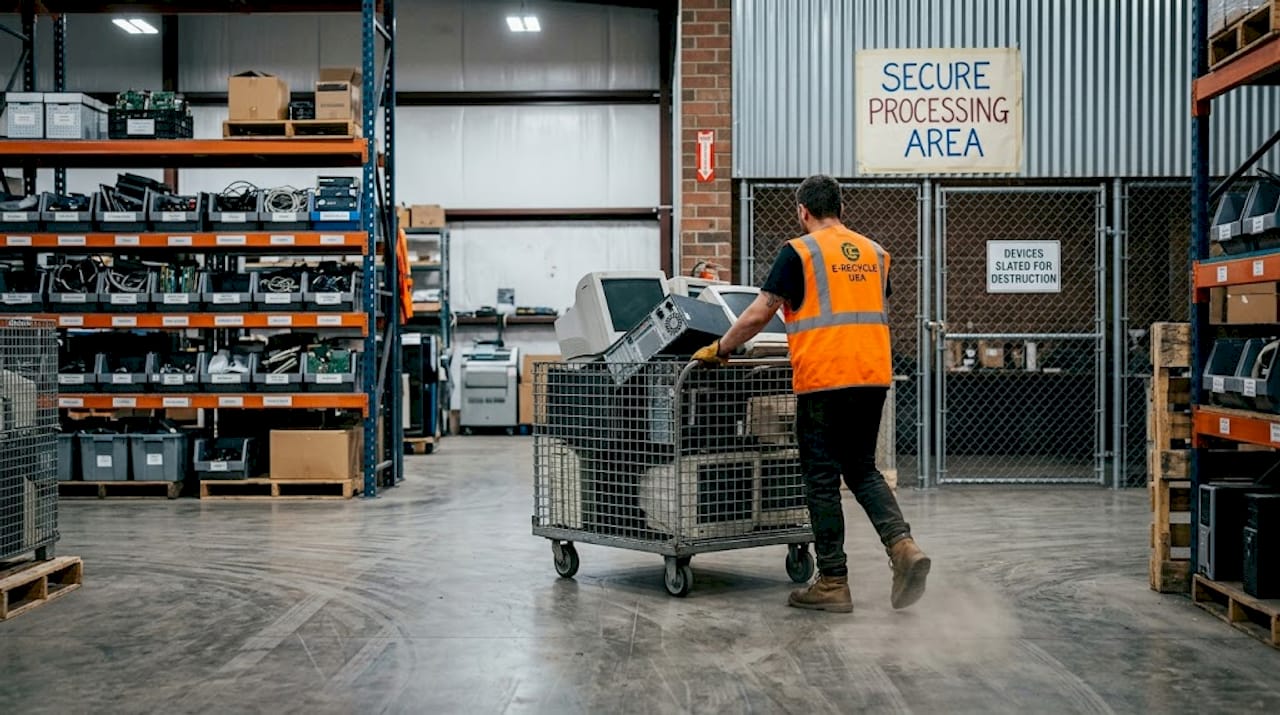
Electronic devices contain hazardous materials including lead, mercury, cadmium, and chromium. When improperly disposed of, these substances leach into soil and groundwater, creating long-term ecological damage that communities around landfill sites disproportionately bear. Secure recycling prevents that outcome by ensuring devices go through regulated materials processing rather than uncontrolled disposal.
Key environmental advantages include:
- Hazardous materials diversion — Lead from CRT monitors, mercury from backlights, and cadmium from batteries are captured and processed by licensed hazardous waste handlers rather than entering the waste stream.
- Materials recovery — Precious metals including gold, silver, palladium, and copper are extracted and returned to manufacturing supply chains, reducing the need for energy-intensive primary mining.
- Carbon footprint reduction — Reusing recovered materials requires significantly less energy than mining and refining raw materials, contributing to lower lifecycle carbon emissions.
- Regulatory compliance with environmental law — Proper recycling keeps your organization compliant with the Resource Conservation and Recovery Act (RCRA) and state-level e-waste regulations, which carry their own penalty structures.
Statistic callout: According to best available estimates from the e-waste industry, structured IT recycling programs can reduce toxic waste output by up to 80% compared to conventional disposal methods. That is not a marginal improvement. It’s a fundamental shift in your organization’s environmental footprint.
Understanding proper e-waste recycling helps your team make decisions that satisfy both your data security officer and your sustainability team in a single process. If you’re new to the space, a solid primer on what is e-waste lays the groundwork for understanding why these materials require specialized handling.
The environmental and data security goals of secure recycling are not in tension. They reinforce each other. A vendor capable of meeting NIST destruction standards is also, by design, operating with the procedural discipline needed to handle hazardous materials responsibly.
Comparing secure recycling and conventional approaches
Now, let’s see how secure recycling stacks up against traditional e-waste approaches. The differences are more significant than most organizations initially expect, particularly when you look at the compliance, security, and environmental dimensions together.
| Feature | Secure recycling | Conventional disposal |
|---|---|---|
| Data destruction method | NIST-compliant Clear/Purge/Destroy | Varies; often none or unverified |
| Certificate of destruction | Provided as standard | Rarely available |
| Physical media shredding | Yes, to particle-size specifications | Not standard |
| Employee vetting | Background-checked staff required | Typically not enforced |
| Facility security | Controlled access, monitored environments | Often general warehouse conditions |
| Chain-of-custody documentation | Full documentation at every stage | Usually absent |
| Regulatory compliance | HIPAA, FACTA, GLBA, state law aligned | Compliance not guaranteed |
| Environmental processing | Certified hazardous materials handling | May include landfill or export |
| Audit readiness | Documentation package ready for auditors | Cannot support audit requests |
| IT asset value recovery | Often included; value offset available | Rarely offered |
Facility security and employee vetting are the two controls most commonly absent in conventional disposal. That gap is where breaches happen. A retired server sitting in an unsecured loading dock while waiting for a general waste pickup is not a hypothetical risk. It’s exactly the scenario that generates breach notifications and regulatory investigations.
The last row in the table is worth noting. Secure recycling vendors often offer IT asset value recovery, which means your organization may recoup residual value from devices that still have functioning components or resale potential after data has been destroyed. That financial offset is not available through conventional disposal channels. Learning to master the secure recycling process helps IT teams structure programs that capture this value systematically rather than leaving it on the table.
The practical conclusion from this comparison is straightforward. If your organization is subject to any form of data privacy regulation, conventional disposal is not a viable option. The risk-adjusted cost of non-compliance far exceeds the price differential between secure and conventional services.
The real ROI: Secure recycling as strategic advantage
Here’s a perspective that most compliance frameworks miss entirely: secure recycling is not just a risk mitigation tool. It’s a trust-building asset, and organizations that treat it that way are getting returns that don’t show up in a standard compliance audit.
Most organizations evaluate e-waste disposal programs purely on cost and checkbox compliance. Does the vendor meet NIST standards? Check. Do we have certificates of destruction? Check. Move on. That framing is understandable, but it leaves significant value uncaptured.
Think about what your clients, auditors, and partners actually see when they examine your data governance practices. A documented, certified, and environmentally responsible recycling program signals that your organization takes data stewardship seriously at every stage of the asset lifecycle, not just when data is actively in use. That signal matters in enterprise sales conversations, in vendor due diligence processes, and in regulatory examinations. It’s the kind of operational maturity that builds long-term trust.
The reputational risk of insecure disposal is also consistently underestimated. When a data breach occurs due to improper device disposal, the public narrative is not “the recycling vendor failed.” It’s “the organization that generated that data failed to protect it.” Your organization owns that story. Secure recycling is one of the most cost-effective ways to make sure that story never gets written.
From an internal operations perspective, a well-run secure recycling program also simplifies audit preparation significantly. When every device disposal event generates a documented chain-of-custody record and a certificate of destruction, your compliance team can respond to regulatory inquiries in hours rather than days.
For organizations working on their responsible computer recycling strategy, the key shift is treating disposal events the same way you treat data processing agreements. They require vendor selection criteria, documented procedures, and periodic review. That level of discipline is what transforms recycling from a facilities management afterthought into a genuine organizational capability.
Proactive secure recycling programs also create easier stakeholder engagement opportunities. ESG investors, sustainability-focused clients, and regulatory bodies increasingly want evidence of responsible end-of-life device management. An organization that can present audited recycling records, certified destruction documentation, and environmental impact data is telling a story of operational excellence that differentiates it from peers who are still managing this reactively.
Get started with secure recycling and IT asset recovery
Ready to turn insight into action? Secure recycling starts here.
If your organization is still relying on informal disposal processes or unverified drop-off programs, the compliance and environmental gaps covered in this article represent real, addressable risks. UsedCartridge.com provides certified secure recycling, data destruction, and IT asset recovery services built specifically for organizations that need documented compliance outcomes alongside responsible environmental stewardship.

Our programs support recycling for business sustainability by combining NIST-aligned destruction procedures, chain-of-custody documentation, and certified hazardous materials processing into a single managed service. We handle the full scope of electronic waste logistics from pickup through final processing, so your team gets both the compliance documentation and the environmental accountability your stakeholders expect. Contact us for a free quote and find out what a properly structured program looks like for your organization’s device volume and regulatory requirements.
Frequently asked questions
What standards should secure recycling processes meet?
Secure recycling should follow NIST guidelines for data sanitization, specifically the Clear, Purge, and Destroy framework, to satisfy most regulatory compliance requirements. Vendors should be able to document which method was applied to each device and provide a certificate of destruction.
How does secure recycling protect company data?
It uses physical shredding paired with data sanitization to eliminate any possibility of data recovery, regardless of what forensic tools are applied. The combination of software-based erasure and physical media destruction is the industry standard for high-assurance environments.
Is secure e-waste recycling environmentally responsible?
Yes. Secure recycling ensures hazardous materials don’t enter landfills by routing devices through certified processing facilities that capture and manage substances like lead, mercury, and cadmium under environmental regulations. It also enables materials recovery that reduces the demand for primary resource extraction.
What should organizations look for in a secure recycling vendor?
Prioritize vendors with NIST-compliant procedures and employee vetting, documented facility security controls, full chain-of-custody tracking, and a standard certificate of destruction. Any vendor unwilling to share those credentials before you sign a contract is not the right partner for regulated data environments.