
Every organization retiring IT equipment carries a liability most executives don’t see until it’s too late. A single improperly wiped hard drive, handed off to the wrong vendor, can expose customer records, trigger regulatory fines, and land your company in the headlines for all the wrong reasons. The good news: a structured, certified electronics recycling process eliminates those risks while recovering real value from retiring assets. This guide walks IT managers and business executives through every requirement, every step, and every verification checkpoint needed to recycle electronics securely, compliantly, and profitably.
Table of Contents
- Essentials you need before recycling electronics
- Step-by-step electronics recycling process explained
- Ensuring data destruction and compliance during recycling
- Verifying outcomes: tracking, reporting, and eco-impact
- Why most organizations overlook secure recycling—and how to fix it
- Secure your organization’s electronics recycling with trusted solutions
- Frequently asked questions
Key Takeaways
| Point | Details |
|---|---|
| Follow certified standards | Certified recyclers ensure data security, compliance, and environmental responsibility every step. |
| Track and document every asset | Comprehensive asset tracking and reporting reduce risk and support audit-readiness. |
| Prioritize secure data destruction | Proper data wiping or destruction eliminates risks of breaches or regulatory penalties. |
| Measure impact and ROI | Use recovery rates and audit reports to demonstrate sustainability and cost savings. |
Essentials you need before recycling electronics
Before a single device leaves your building, you need a foundation that supports both security and legal defensibility. Skipping this phase is where most organizations create liability, not eliminate it.
Understanding certification standards
Not all recyclers are equal. The two primary standards you’ll encounter are R2v3 (Responsible Recycling, administered by SERI) and e-Stewards (administered by the Basel Action Network). Certified recyclers operate under EPA-recognized standards, ensuring chain-of-custody documentation, no landfill disposal of hazardous waste, and downstream audits of their subcontractors. R2v3 takes a market-driven, flexible approach, while e-Stewards enforces stricter export bans and requires NAID AAA data security certification. For organizations in regulated industries like healthcare or finance, e-Stewards often provides the stronger compliance posture.
Building your pre-recycling checklist
Here’s what needs to be in place before collection begins:
- Complete device inventory with serial numbers, model numbers, and assigned users
- Data mapping showing what sensitive information resides on each asset class
- Chain-of-custody forms ready for signature at every transfer point
- Internal sign-off from legal, IT security, and compliance teams
- Confirmed vendor certification documentation on file
| Document | Purpose | Who Maintains It |
|---|---|---|
| Asset inventory | Tracks every device by serial number | IT asset manager |
| Data map | Identifies data types per device class | IT security team |
| Chain-of-custody form | Records every handoff | Vendor and internal staff |
| Certificate of destruction | Proves data was eliminated | Certified recycler |
| Vendor certification | Confirms R2v3 or e-Stewards status | Procurement/legal |
Selecting the right partner
An authorized recycling partner should provide written proof of their certification, name their downstream vendors, and offer full audit support. Ask for sample certificates of destruction and reference clients in your industry before signing any agreement. Look specifically for vendors who offer on-site data destruction as an option, since this eliminates the security gap that occurs during transport.
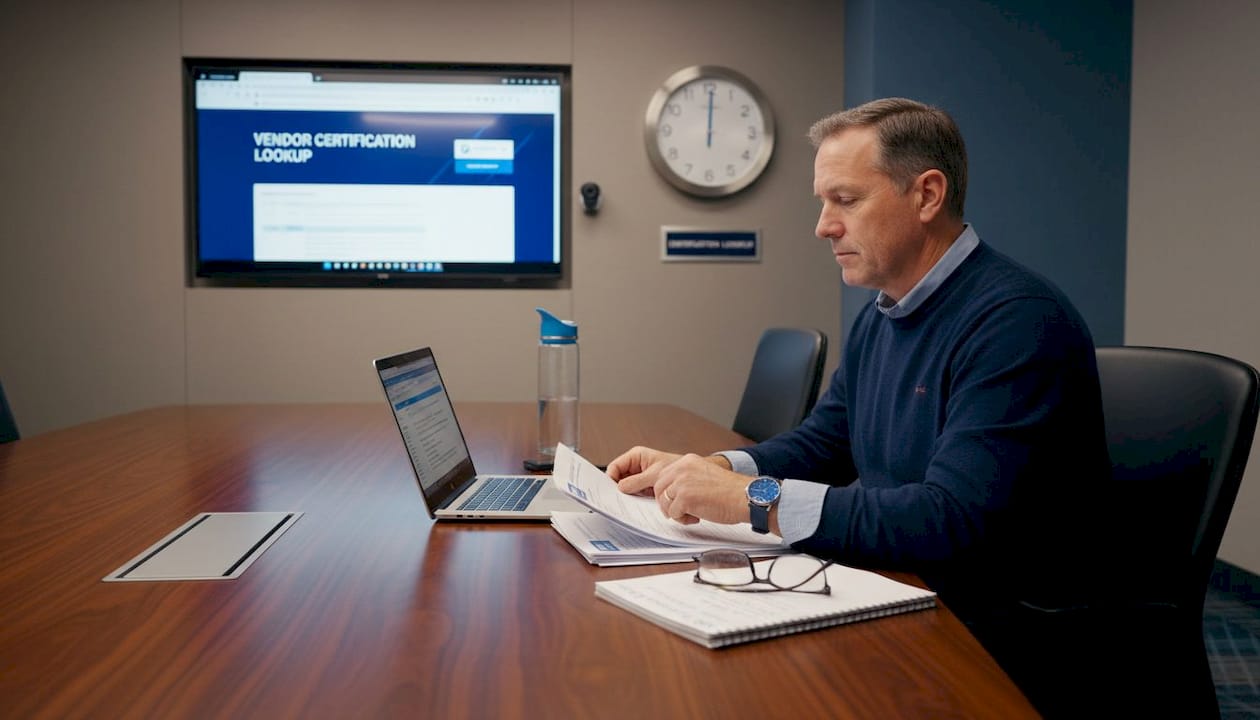
Pro Tip: Before preparing devices securely for pickup, always cross-reference your vendor’s certification number directly on the SERI or BAN registry. Certificates can be forged; registry entries cannot.
Step-by-step electronics recycling process explained
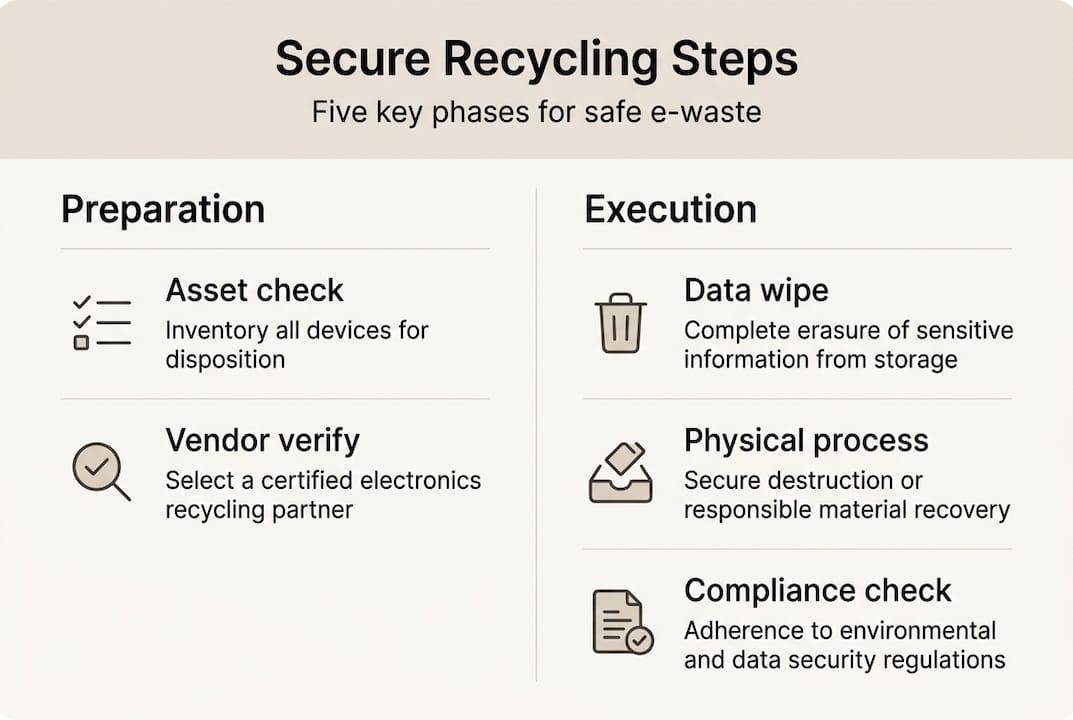
With your prerequisites gathered, you can move into execution with confidence. The process has five distinct phases, each with its own security and compliance requirements.
The five core steps
The five key steps in a certified, secure electronics recycling program are: collection and sorting, data destruction or sanitization, shredding or size reduction, material separation, and refining or responsible disposal of residuals. Skipping or compressing any one of them introduces risk into the chain.
-
Collection and sorting. Devices are picked up, logged against your inventory, and sorted by type (laptops, servers, mobile devices, peripherals). Each asset gets a unique tracking identifier tied to your chain-of-custody documentation.
-
Data destruction or sanitization. This is the most legally critical step. Every storage device is flagged for the appropriate destruction method based on sensitivity classification. More on this in the next section.
-
Shredding or size reduction. Devices not suitable for resale or refurbishment are mechanically shredded. Industrial shredders reduce boards and drives to pieces small enough to prevent any data or component recovery.
-
Material separation. Shredded material passes through eddy current separators, magnetic drums, and density separators to isolate ferrous metals, non-ferrous metals, plastics, and glass. This is where material recovery value is generated.
-
Refining and responsible disposal. Separated materials are sent to downstream smelters and refiners. Residuals that cannot be recovered are disposed of in licensed facilities, never in general landfills.
Manual vs. automated sorting: understanding the difference
| Attribute | Manual sorting | Automated sorting |
|---|---|---|
| Speed | Slower, labor-intensive | High throughput |
| Accuracy | High for complex items | High for standardized streams |
| Cost | Lower capital, higher labor | Higher capital, lower labor |
| Best for | Mixed, low-volume streams | High-volume enterprise fleets |
| Chain-of-custody | Easier to document per unit | Requires robust tracking software |
On-site vs. off-site shredding
On-site shredding brings the industrial shredder to your facility. Your team witnesses destruction in real time, and the certificate of destruction is issued the same day. Off-site shredding is more common for large volume, but it requires rigorous chain-of-custody controls during transport. For secure equipment recycling steps involving classified or HIPAA-covered data, on-site shredding is almost always the correct choice.
The global e-waste recycling rate sits at roughly 22%, while certified facilities consistently achieve 85 to 97% material recovery. For context, recycling one million laptops saves enough energy to power approximately 3,500 homes for a year. Those numbers represent both your environmental impact and the residual value sitting in your retiring fleet.
Pro Tip: For recycling e-waste properly, schedule collection during low-traffic hours and station an internal IT staff member at every handoff point to co-sign chain-of-custody forms in real time. This simple step closes the most common audit gap.
Ensuring data destruction and compliance during recycling
After covering process execution, the next priority is eliminating data liability through proven destruction methods. This is where organizations either close their risk exposure completely or leave a door open.
Four proven data destruction methods
-
Software wiping. Overwrites all storage sectors with random data patterns. Appropriate for devices being refurbished or remarketed. Must meet NIST 800-88 standards to be defensible. Produces an audit log per device.
-
Degaussing. Exposes magnetic media (hard drives, magnetic tapes) to a powerful electromagnetic field that erases all data permanently. Does not work on SSDs or flash-based storage. Must be documented per device.
-
Physical shredding. The most definitive and legally defensible method. Hard drives, SSDs, and mobile devices are reduced to particles typically smaller than 2mm. Produces no recoverable data. Certificate of destruction issued immediately.
-
Incineration. Reserved for classified or government-grade destruction. Least common in commercial settings but occasionally required by defense contractors or intelligence-adjacent organizations.
Tracking chain-of-custody for IT assets
Every storage device must have a documented lifecycle from the moment it is decommissioned to the moment its destruction is certified. That means:
- Unique asset tag at decommission
- Signed handoff at every internal transfer
- Vendor receipt confirmation with asset serial numbers
- Destruction log matching serial numbers to method and date
- Final certificate of destruction archived for audit
“EPA-recognized standards like R2v3 and e-Stewards require NAID AAA data security, no landfill disposal of hazardous materials, and downstream audits, making certified recyclers the only defensible choice for organizations handling regulated data.”
Hallmarks of a compliant vendor
Your certified hard drive destruction vendor should provide itemized destruction certificates, not batch certificates. Batch certificates list a count, not individual serial numbers, which creates an audit gap. Ask specifically for serial-number-level documentation. Also verify that the vendor’s downstream processors are named and certified, not just implied. Any vendor unwilling to disclose their downstream chain should be disqualified immediately.
Pro Tip: Before engaging any vendor, review what your organization should know about data destruction knowledge internally so your team can ask the right questions during vendor evaluation. Informed buyers get better contracts and stronger documentation commitments.
Verifying outcomes: tracking, reporting, and eco-impact
With destruction and compliance handled, the final step is proving results. Stakeholders in legal, finance, and sustainability need documented evidence, not assurances.
What certified recyclers should deliver
A quality ITAD (IT asset disposition) partner produces a reporting package that includes the following:
- Serial-number-level certificate of destruction for every storage device
- Asset disposition report showing refurbishment, resale, or shred outcome per device
- Weight-based material recovery report broken down by material category
- Environmental impact summary (CO2 offset, energy saved, landfill diversion)
- Audit trail logs exportable for regulatory submissions
KPI benchmarks to measure your program
| KPI | Global average | Certified facility benchmark |
|---|---|---|
| Material recovery rate | ~22% | 85 to 97% |
| Enterprise ITAD collection rate | N/A | 92 to 99% of inventoried assets |
| Refurbishment and reuse rate | Variable | 30 to 75% depending on device age |
| Energy saved per 1M laptops | N/A | Equivalent to 3,500 homes annually |
| Data destruction documentation rate | Low | 100% with certified vendor |
These benchmarks give your compliance and sustainability teams something concrete to report. If your vendor cannot meet the certified facility benchmarks above, that’s a signal to renegotiate your contract or change providers.
Using reporting for CSR and risk management
Secure e-waste tracking data feeds directly into corporate sustainability reporting frameworks like GRI (Global Reporting Initiative) and CDP. Organizations that can show documented material recovery rates and verified chain-of-custody reduce their ESG audit risk substantially. Beyond CSR, these reports protect you legally. In the event of a data breach investigation, a complete chain-of-custody and destruction audit trail is your primary defense.
Knowing your program’s impact numbers also opens a conversation with finance. Refurbished assets that re-enter the secondary market generate direct revenue. Recovered metals from shredded material produce rebates. For large IT fleets, these numbers add up to meaningful offsets against program costs.
Key reporting outputs your team should review quarterly:
- Percentage of assets handled by certified vendors vs. any ad hoc disposal
- Destruction documentation completeness rate (target: 100%)
- Material recovery weight by category
- Refurbishment rate and resale revenue generated
- Regulatory submissions filed and audit-readiness status
Why most organizations overlook secure recycling—and how to fix it
Here’s an uncomfortable truth: most organizations that cut corners on electronics recycling don’t do it maliciously. They do it because someone decided the certified vendor was too expensive, or because the process looked administratively heavy, or because the devices “had nothing on them anyway.” Each of those assumptions carries real cost.
The global recycling rate of 22% exists largely because informal sectors handle the rest. Informal doesn’t mean illegal everywhere, but it does mean unaudited, undocumented, and unpredictable. Certified processes recover 90% or more of valuable materials including gold, silver, and copper, while informal processes leave most of that value destroyed or unaccounted for.
The other myth worth dispelling: that physical destruction is always the most environmentally responsible choice. Research comparing recycling methods and outcomes shows that pyrometallurgical processing (high-temperature smelting) carries significant energy costs and CO2 emissions, while hydrometallurgical approaches offer better cost-benefit balance. The takeaway for your procurement decisions is that certified over informal always wins on net impact, but the specific methods your vendor uses matter too.
The organizations that treat secure recycling as a strategic process rather than an operational afterthought gain compliance coverage, recover asset value, and build a defensible paper trail. Those that treat it as a line item to minimize create the conditions for breach notification letters and regulatory inquiries. The importance of secure recycling isn’t abstract. It’s the difference between a process that protects you and one that exposes you.
Secure your organization’s electronics recycling with trusted solutions
Managing the entire electronics recycling process in-house, while maintaining certification compliance and full documentation, is a significant operational lift. That’s exactly where a purpose-built partner makes the difference.

UsedCartridge.com provides professionally managed e-waste solutions built specifically for organizations that cannot afford gaps in their data security or compliance chain. From secure pickup and on-site destruction to certified material recovery and full audit documentation, every step is handled by certified specialists. If you’re ready to eliminate the guesswork and the liability, get a secure disposal quote and see exactly what a certified program looks like for your fleet. For teams with active sustainability reporting requirements, explore our business sustainability solutions designed to align ITAD with your CSR and ESG commitments.
Frequently asked questions
What are the five main steps in the electronics recycling process?
The five key steps are collection and sorting, data destruction or sanitization, shredding or size reduction, material separation, and refining or responsible disposal of residuals.
How can my organization ensure e-waste is handled securely and compliantly?
Use certified recyclers operating under EPA-recognized standards like R2v3 or e-Stewards, and require serial-number-level chain-of-custody documentation and data destruction certificates for every device.
What is the average material recovery rate for certified recycling facilities?
Certified facilities achieve 85 to 97% material recovery from electronics, which is dramatically higher than the global informal sector average of approximately 22%.
Why is informal e-waste recycling discouraged for businesses?
Informal recycling lacks audited chain-of-custody, creates data exposure risk, and misses the 90%+ valuable material recovery that certified processes deliver, leaving both security and financial value on the table.
How does electronics recycling benefit corporate sustainability?
Recycling electronics reduces hazardous landfill waste, cuts energy consumption, and generates documented impact data. Recycling one million laptops saves energy equivalent to powering 3,500 homes for a full year, which translates directly into measurable CSR and ESG reporting value.
Recommended
- How to Prepare Devices for Recycling: 5 Secure Steps – E-waste Logistics
- Secure Equipment Recycling: Protect Data and the Environment – E-waste Logistics
- Cómo preparar equipos electrónicos para reciclaje seguro – E-waste Logistics
- Secure E-Waste Pickup: Protect Data & the Environment – E-waste Logistics