
TL;DR:
- Security requirements, including verified sanitization methods and audit rights, should be written into contracts and monitored regularly to maintain compliance.
- Downstream handling and export restrictions must be clearly documented, with vendors revealing their partner network to avoid regulatory and reputation risks.
- Verbal assurances or vague statements are red flags, and refusal of facility visits warrants disqualification.
Table of Contents
- What ITAD vendor due diligence covers and why it matters
- Prioritized checklist for RFPs and vendor calls
- How to verify sanitization claims against recognized guidelines
- Contract clauses and monitoring that prove reasonable diligence
- Records and logistics controls worth insisting on
- Environmental and downstream risk you need in writing
- Common red flags and what to do about them
- How Recycle for Life supports this checklist in practice
- What a realistic minimum standard looks like
- Get a quote for compliant, auditable destruction
- FAQ
- Sources
What ITAD vendor due diligence covers and why it matters
ITAD vendor due diligence is the process of verifying, before and during a contract, that a provider handling your retired IT equipment actually meets the security, environmental, and legal standards it claims.
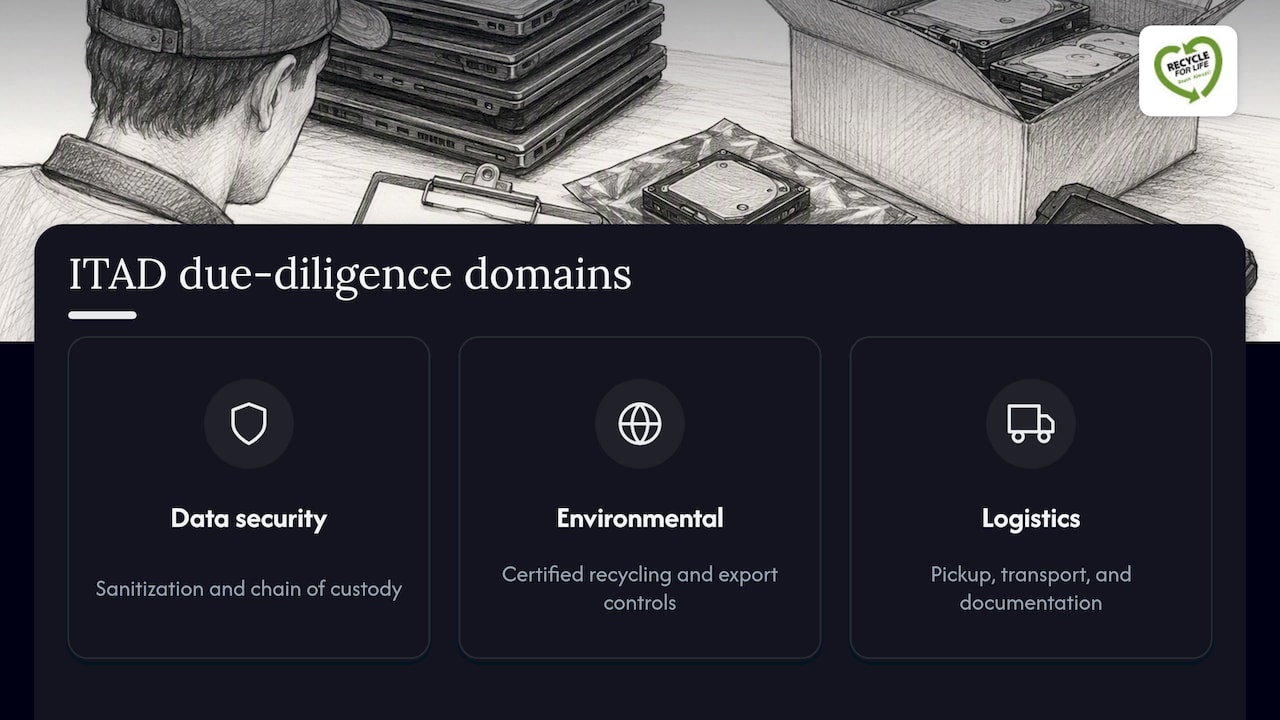
This matters because liability does not disappear when you hand equipment to a vendor. The FTC’s guidance on service providers makes clear that organizations remain responsible for verifying a vendor’s security claims, writing specific requirements into contracts, and monitoring compliance afterward. A vendor’s data breach or illegal dumping becomes your regulatory problem and your headline.
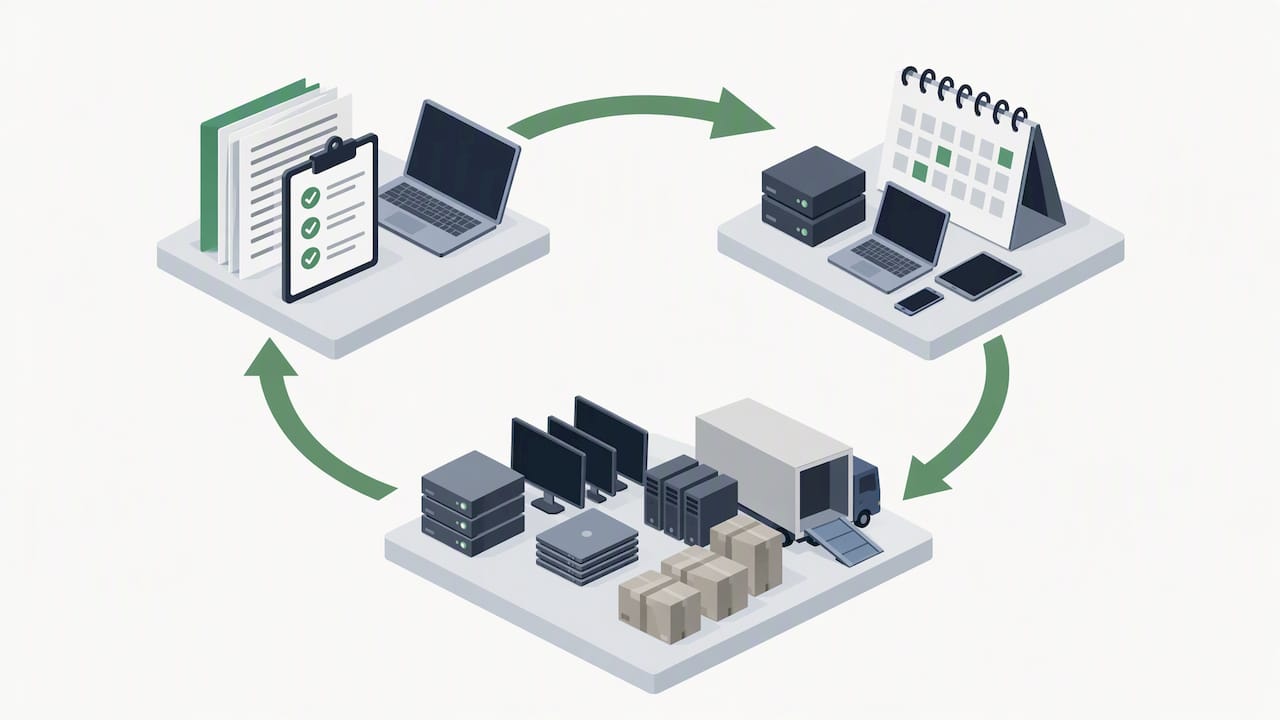
Due diligence is not a one-time box to check. Run it before signing any new ITAD contract or renewing an existing one, on a regular cycle even with an established vendor, and before any large decommissioning project involving sensitive data or high device volumes
Prioritized checklist for RFPs and vendor calls
Build your vendor evaluation around items that function as pass/fail gates, not preferences. The following order reflects risk priority, from non-negotiable to tiered by asset sensitivity.
- Sanitization methods and destruction certificates: the vendor should document which method it applies per media type and attach your serial list to its certificates when you supply one.
- Credentials: check the recycler's EPA ID number and state regulatory status, and verify them directly with the agencies.
- Downstream traceability: a written list of downstream processors or brokers, with proof those partners hold equivalent registrations.
- Insurance and indemnity: data breach and pollution liability coverage sized to your asset volume.
- Pickup and transport security: locked trucks, GPS tracking, and background-checked drivers.
- Personnel vetting and training: background checks for staff with physical access to devices, plus documented sanitization training.
- Asset recovery and value handling: a transparent process for valuing, reporting, and paying out recoverable equipment.
Items 1 through 4 should be treated as disqualifying if a vendor cannot produce them on request. Items 5 through 8 can be negotiated or tiered: a vendor handling low-sensitivity office equipment may warrant lighter scrutiny than one destroying drives from a hospital or financial institution.
Pro Tip: Ask every finalist vendor to walk you through a real certificate from a past job, showing what was destroyed, the method and the date, before you sign anything.
How to verify sanitization claims against recognized guidelines
Request these documents before you accept any sanitization claim:
- The vendor’s written sanitization policy mapped to media type
- Sample destruction certificates showing what was destroyed, the method and the date, with the customer’s serial list attached when one was supplied
Contract clauses and monitoring that prove reasonable diligence
A vendor’s verbal assurances carry no weight with regulators. The FTC’s small business vendor-security guidance recommends putting security requirements directly into contracts, verifying compliance on a schedule, and having a plan for vendor breach notification.
Your contract should specify:
- Certificates delivered within a set number of business days, with your serial list attached when you supply one before pickup
- Audit rights, including the right to inspect facilities and request records on demand
- Subcontractor disclosure, so you know every party that touches your equipment
- Breach notification timelines and liability caps
- Insurance minimums and sample acceptance testing procedures
Monitoring does not end at signature. Schedule periodic audits, verify a sample of destruction certificates against your asset inventory, track vendor KPIs such as certificate turnaround time, and define in writing what triggers suspension or termination of the contract.
Records and logistics controls worth insisting on
Custody breaks are where most ITAD failures happen, usually in transit or during a handoff between facilities. Insist on:
- Tamper-evident seals on transport containers
- GPS tracking on vehicles carrying your equipment
- Witnessed destruction for your highest-sensitivity assets, where your staff observes the process directly
Our device preparation checklist covers how to build your own serial inventory before pickup. For a new vendor relationship, start small: send a batch of 10 to 20 devices with your serial list supplied before pickup, confirm the certificate and attached list match your inventory, and only scale up once that reconciliation checks out.
Environmental and downstream risk you need in writing
Downstream handling is where reputational and regulatory exposure often hides.
- Red flag: a vendor who cannot name its downstream partners or describes them only in general terms
- Red flag: no written restriction on exporting e-waste to unvetted overseas processors
- Ask for: periodic downstream audit reports or the right to request one
Our electronics disposal planning guide covers how to build these requirements into your procurement timeline from the start.
Common red flags and what to do about them
- Vague sanitization language (“we securely wipe all drives”): demand the specific method and standard referenced, in writing.
- Missing certificates: pause future shipments until the vendor produces a certificate for a past job.
- Undisclosed subcontracting: exercise your audit rights immediately and request a full subcontractor list.
- Reluctance to allow a facility visit: treat this as disqualifying for any contract involving sensitive data.
Once you have documented evidence of a gap, escalate to legal and procurement together rather than relying on a single team’s judgment.
How Recycle for Life supports this checklist in practice
We offer onsite data destruction services with a signed Certificate of Destruction, and serial numbers are listed when you supply your list in advance. We provide compliant pickup and processing through our data destruction and hard drive destruction services, with a Certificate of Destruction for your audit records.
What a realistic minimum standard looks like
Re-evaluate every vendor annually, and immediately after any incident or missed deliverable.
Get a quote for compliant, auditable destruction
If this checklist raised gaps in your current vendor relationship, we handle on-site data destruction with a Certificate of Destruction, with serial-number listings available on request, so you are not left reconciling vague assurances later.

Request a quote for onsite data destruction and get pickup scheduling and certificates built into one process.
FAQ
What are some examples of vendor risk?
Vendor risk in ITAD includes data breaches from incomplete sanitization, illegal export of e-waste to unvetted overseas processors, and loss of custody during transport that leaves devices unaccounted for. Financial risk also applies, such as a vendor undervaluing recoverable assets or failing to pay out as agreed.
What is an ITAD company?
An ITAD company handles the secure disposition of retired IT equipment, including data sanitization, physical destruction, recycling, and recovery of resale value from usable components.
What are key steps in a third-party due diligence process?
A third-party due diligence process typically includes verifying registrations and security claims, reviewing contract terms for audit rights and breach notification, and monitoring performance through periodic audits. The FTC’s vendor security guidance recommends writing these requirements into contracts rather than relying on verbal assurances.
What is considered a third-party vendor?
A third-party vendor is any outside organization that performs a service or handles data, equipment, or processes on your behalf, including ITAD providers, cloud hosts, and logistics companies. Responsibility for data security does not transfer entirely to the vendor; regulators expect the hiring organization to verify and monitor vendor practices.
How often should we re-evaluate an ITAD vendor?
Re-evaluate an ITAD vendor at least annually, and immediately following any security incident, missed certificate, or change in the vendor’s subcontractor arrangements. Ongoing monitoring, not a one-time vetting, is what regulators and auditors expect to see documented.