
If you’re evaluating omnitechewaste.com alternatives for your organization, the short answer is this: the providers worth your time combine certified data destruction, serialized chain-of-custody documentation, and asset recovery under one roof. Omnitech E-Waste, based in Los Alamitos, California, handles residential and office drop-offs and offers free pickup for qualifying loads. That works for small, low-compliance situations. For IT managers who need audit-ready documentation, HIPAA or CCPA liability transfer, and on-site witnessed destruction, you need more.
Here is the ranked shortlist:
- Usedcartridge — Best single-vendor partner for audit-ready ITAD: on-site destruction, serialized chain of custody, Certificates of Destruction, and asset recovery in one workflow.
- National-scale recycler (ERI-type) — Best for large distributed fleets needing national logistics and high-volume remarketing capacity.
- Regional on-site specialist (TechWaste-type) — Best for high-security facilities that require witnessed, on-site hard drive shredding above all else.
- Small/local recycler (Reboot-type) — Best for low-volume, low-compliance situations where cost is the primary driver.
Low-cost recycling without verifiable certification keeps liability with your organization, not the vendor. That single fact should anchor every procurement decision you make here.
Table of Contents
- How do the top alternatives compare at a glance?
- What does Usedcartridge offer for audit-ready ITAD?
- What should you expect from a baseline regional incumbent?
- What does a national-scale recycler offer enterprise buyers?
- When does a regional on-site specialist make sense?
- Is a small local recycler ever the right call?
- How do you choose the right ITAD partner for your organization?
- Why does integrated, audit-ready ITAD actually reduce your risk?
- Key Takeaways
- The case for choosing your ITAD partner carefully
- Usedcartridge: a single audit-ready partner for your next device refresh
- Primary sources and standards for procurement and compliance
How do the top alternatives compare at a glance?
| Dimension | Usedcartridge | National-scale (ERI-type) | Regional on-site (TechWaste-type) | Small/local (Reboot-type) |
|---|---|---|---|---|
| Best for | Enterprise audit programs, healthcare, finance | Large distributed fleets, universities, hospitals | High-security facilities needing witnessed destruction | Small offices, low-compliance loads |
| Services offered | On-site/off-site destruction, IT asset recovery, laptop battery & solar panel recycling, logistics | National logistics, large-volume processing, remarketing | On-site shredding, witnessed destruction, regional pickup | Basic shredding or erasure, local drop-off/pickup |
| Certifications & CoD | Audit-ready CoD, serialized chain of custody | R2, e-Stewards, ISO; CoD available | R2 or e-Stewards typical; CoD on request | Certifications vary; CoD often limited |
| Data destruction methods | Physical shredding, degaussing, crypto-erase, on-site witnessed | Shredding, degaussing, physical destruction | On-site shredding, witnessed destruction | Basic erasure or shredding; methods vary |
| Asset recovery | Value assessment and payout | Strong remarketing and material recovery | Limited remarketing reach | Minimal or none |
| Geographic coverage | Nationwide (B2B focus) | Nationwide | Regional | Local/metro |
| Pricing model | Quote-based; asset recovery may offset fees | Per-lb or per-device; volume discounts | Per-device or flat pickup fee | Flat fee or minimum trip charge |
| Turnaround | Coordinated pickup-to-report workflow | Varies by facility load | Fast on-site turnaround | Typically fast for small loads |
| Chain-of-custody reporting | Serialized, integrated into workflow | Available; confirm serial-level reporting | Available; confirm documentation depth | Often limited or ad hoc |
Key certification flags to confirm with any vendor before signing:
- R2 (Responsible Recycling) certification, verified through SERI (Sustainable Electronics Recycling International)
- e-Stewards certification, audited by third-party accredited bodies
- ISO 14001 (environmental management) and ISO 45001 (occupational health) where relevant
- Certificate of Destruction that explicitly links serial numbers to final disposition
Integrated providers that handle logistics, destruction, and remarketing reduce operational risk and simplify environmental compliance reporting. Fragmented, end-of-pipe services remain the primary barrier to sustainable e-waste management, and the tradeoff between national scale and regional responsiveness is real: a national recycler gives you capacity and remarketing depth; a regional specialist gives you faster on-site response and a more direct relationship with the crew handling your equipment.

What does Usedcartridge offer for audit-ready ITAD?
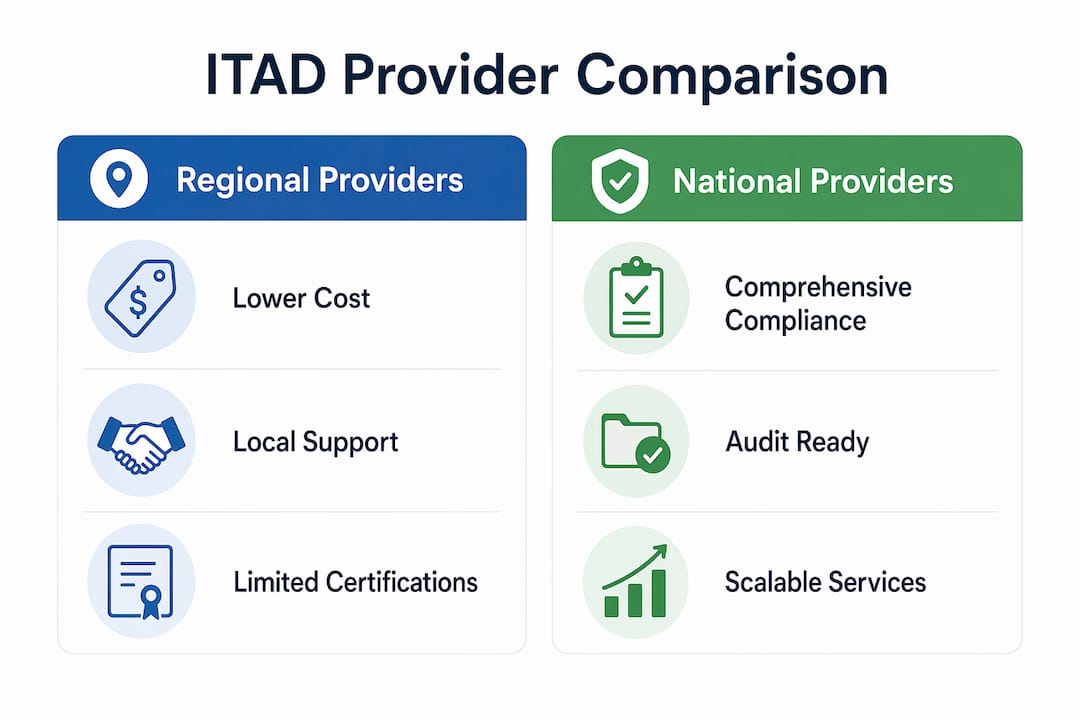
At a glance: Usedcartridge operates as a specialized environmental services provider focused on e-waste recycling, secure data destruction, and IT asset recovery, with an emphasis on responsible disposal processes that are compliant with environmental and data security standards.
Core services:
- On-site and off-site data destruction (physical shredding, degaussing, witnessed destruction)
- IT asset recovery with value assessment and payout options
- Laptop battery recycling and solar panel handling
- Regulatory-compliant electronics disposal with audit-ready certification
- Serialized chain-of-custody documentation and Certificates of Destruction
Key differentiator: The workflow is integrated end-to-end. Serial numbers are tracked from pickup through destruction or remarketing, and the resulting CoD is built into the reporting process rather than generated ad hoc. That distinction matters for auditors who need to trace a specific device to its final disposition.
Pros:
- Single-vendor accountability across logistics, destruction, and recovery
- On-site witnessed shredding available for regulated industries
- Asset recovery can offset disposal costs
- Audit documentation designed for HIPAA, CCPA, and enterprise compliance programs
Cons:
- Quote-based pricing requires a conversation before you know costs
- Not the right fit for one-off, low-volume residential loads
Who it’s for: Enterprise IT programs, healthcare organizations, financial institutions, and any team that needs to hand an auditor a complete, serialized destruction record.
Typical use case: An IT team planning a 200-device office refresh schedules a pickup. Usedcartridge coordinates logistics, performs on-site or off-site destruction, generates a serialized chain-of-custody report, and delivers a Certificate of Destruction. Devices with residual value enter a remarketing workflow, and the payout offsets part of the disposal cost. The IT manager walks away with a complete audit package, not just a receipt.
Pro Tip: Request a sample CoD and chain-of-custody report before signing any ITAD contract. A vendor that cannot produce a clean sample quickly is telling you something about their actual documentation workflow.
What should you expect from a baseline regional incumbent?
Regional legacy providers, the type of vendor Omnitech E-Waste represents for many California-based organizations, typically handle a mix of residential and commercial drop-offs with basic hard drive destruction and asset management services.
At a glance:
- Accepts common electronics: laptops, monitors, printers, hard drives, peripherals
- Hard drive destruction and basic asset management listed as services
- Free pickup offered for qualifying loads (volume or component thresholds apply)
- Regional or metro coverage, not national
Common features: Basic data destruction, drop-off and pickup options, and some asset management capability. Certifications at this tier vary widely. Some regional operators hold R2 or e-Stewards credentials; others do not, and the documentation they provide may be a generic receipt rather than a serialized Certificate of Destruction.
Pros:
- Accessible for small loads and residential drop-offs
- Free pickup can reduce cost for qualifying volumes
- Familiar local presence
Cons:
- CoD documentation often lacks serial-number-level detail
- Certification status requires direct verification
- Limited remarketing or asset recovery capability
- Compliance audit support is typically minimal
Who it fits: Mid-market organizations with low compliance requirements, or as a supplemental option for low-value peripheral disposal alongside a primary certified ITAD partner. A small marketing agency retiring 15 old desktops with no sensitive data on them is a reasonable fit. A hospital retiring 15 workstations with patient records is not.
What does a national-scale recycler offer enterprise buyers?
Large national recyclers, the archetype Electronic Recyclers International (ERI) represents, bring processing capacity and remarketing infrastructure that regional operators cannot match. For IT managers running distributed fleets across multiple states, that scale is genuinely useful.
At a glance:
- Nationwide pickup and processing coverage
- Large processing facilities with high-volume throughput
- Remarketing and material recovery capabilities
- R2 and e-Stewards certifications typical at this tier; ISO accreditations common
Core features to confirm:
- Independent third-party audits on a regular cycle
- Serial-number-level CoD delivery (not just batch-level)
- Track record of CoD delivery for regulated industries
- Secure transport protocols and facility physical security documentation
Key differentiator: Volume capacity and remarketing depth. A national recycler can absorb a 10,000-device hospital decommission and move residual-value assets through established secondary markets. That recovery can be significant for large fleets.
Pros:
- National logistics simplify multi-site programs
- Strong remarketing can generate meaningful asset recovery payouts
- Established certification and audit infrastructure
Cons:
- Less personalized service; you may be one of hundreds of accounts
- Confirm that serial-level reporting is standard, not an add-on
- Pricing complexity increases with volume tiers and material mix
Who it’s for: Large enterprises, hospital systems, and universities managing distributed, high-volume device refreshes where national logistics and remarketing depth outweigh the need for a dedicated account relationship.
Pro Tip: Ask any national recycler for references from clients in your industry, specifically healthcare or finance if that applies. A vendor with 50 enterprise clients but no regulated-industry references is a procurement risk for compliance-driven programs.
When does a regional on-site specialist make sense?
Some facilities cannot send equipment off-site before destruction. Defense contractors, law firms, and healthcare providers with strict data governance policies often require a technician to shred drives on-site, with a staff member present to witness the process. That is where a regional on-site specialist, the TechWaste Recycling Inc. archetype, earns its place.
At a glance:
- On-site hard drive shredding and witnessed destruction as the primary offering
- Regional coverage; not a national logistics network
- Physical destruction via shredding or pneumatic punching, the method that typically satisfies strict audit requirements for sensitive media
Core features:
- Mobile shredding units for on-site, witnessed destruction
- Certificate of Destruction issued at the time of service
- R2 or e-Stewards certification typical; confirm before engaging
- Degaussing available for magnetic media
Key differentiator: Speed and security at the point of destruction. Equipment never leaves your facility before the data is gone, and your staff witnesses the process. That eliminates the chain-of-custody gap that exists whenever a device travels to an off-site facility.
Pros:
- Highest security posture for sensitive data destruction
- Immediate CoD at point of service
- Fast turnaround for on-site events
Cons:
- Remarketing reach is limited; residual asset value may not be fully recovered
- Regional coverage means multi-site programs require multiple vendors or a primary ITAD partner
- Per-event pricing can be higher than off-site alternatives for large volumes
Who it’s for: High-security facilities, legal departments, defense contractors, and healthcare organizations where witnessed, on-site destruction is a non-negotiable requirement.
Pro Tip: For on-site destruction events, request the shredder’s certification documentation and the technician’s chain-of-custody log before the truck leaves your parking lot. Some vendors issue the CoD days later; the best ones hand it to you on-site.
Is a small local recycler ever the right call?
For a small clinic retiring five laptops or a local office clearing out a storage room of old peripherals, a small or local recycler, the Reboot Tech Recycling archetype, can be a practical, cost-effective option. The compliance calculus is different at this scale.
At a glance:
- Low-volume pickup options with flat fees or minimum trip charges
- Basic data erasure or shredding; methods and depth vary by operator
- Limited or no remarketing capability
- Local or metro service area
Core features: Basic electronics recycling, some form of data destruction (confirm the method), and simple pickup or drop-off logistics. Documentation at this tier is often a generic receipt or a basic destruction certificate without serial-number detail.
Pros:
- Lower cost for small loads
- Simple logistics for local pickups
- Accessible for organizations without a formal ITAD program
Cons:
- CoD documentation often lacks the serial-level detail auditors require
- Certification status varies; always verify before engaging
- “Free pickup” is frequently conditional on volume or the presence of high-value components; request the full fee schedule upfront
- No asset recovery payout for most loads
Who it’s for: Small organizations with minimal compliance requirements and low device volumes. If your organization is subject to HIPAA, CCPA, SOX, or any sector-specific data governance requirement, a small local recycler without verified certification is a liability risk, not a cost saving.
How do you choose the right ITAD partner for your organization?
Start with your compliance requirements, not your budget. The vendor question list and red flags below are designed for a short procurement evaluation or RFP check.
Procurement checklist
- Confirm certifications. Require R2 or e-Stewards certification as a minimum. Ask for the certificate number and verify it directly with SERI (for R2) or the e-Stewards program. ISO 14001 is a useful secondary signal.
- Demand a sample CoD. The Certificate of Destruction must link individual serial numbers to final disposition. A batch-level certificate that lists “50 hard drives” without serial numbers does not satisfy most audit requirements.
- Clarify data destruction methods. For regulated data, physical destruction via shredding or pneumatic punching is typically the only method that satisfies strict audit requirements. Confirm whether degaussing, crypto-erase, or software wipe is offered and under what circumstances each is used.
- Understand on-site vs. off-site options. If your security policy requires witnessed destruction, confirm the vendor has mobile shredding capability and can provide a CoD at the point of service.
- Request chain-of-custody documentation. The chain-of-custody record must explicitly connect each serial number to its destruction or remarketing outcome and be integrated into the vendor’s reporting workflow, not generated on request after the fact.
- Get a clear fee schedule. Request separate pricing for disposal services versus asset recovery payouts. Confirm whether minimum trip charges apply for small loads.
- Check insurance and liability. Ask for proof of general liability and environmental liability insurance. Confirm that the vendor’s certification transfers liability for proper disposal to them, not back to you.
- Ask for references. Request two or three client references from organizations in your industry or of similar size.
Vendor questions to ask
- What certifications do you hold, and can I verify them directly with the certifying body?
- Does your CoD include individual serial numbers, or is it batch-level?
- How is chain-of-custody maintained from pickup to final disposition?
- Do you offer on-site witnessed destruction? What does that process look like?
- How do you handle asset recovery, and how is the payout calculated?
- What is your turnaround time from pickup to CoD delivery?
- What are your minimum pickup thresholds, and what fees apply below that threshold?
Red flags
- Vague CoD language (“all media destroyed”) with no serial numbers
- No verifiable third-party certification
- Unclear or bundled pricing with no separation between disposal fees and recovery payouts
- Inability to produce a sample CoD or chain-of-custody report on request
- No independent audit history or ISO accreditation
Pro Tip: Build a two-line contract clause requiring the vendor to deliver a serialized CoD within five business days of service completion. Vendors who push back on that timeline are telling you their documentation workflow is not ready for audit scrutiny.
For a structured starting point, Usedcartridge’s electronics disposal planning guide walks through the pre-engagement steps in detail.
Why does integrated, audit-ready ITAD actually reduce your risk?
The EPA’s sustainable materials management hierarchy places source reduction and reuse ahead of recycling, which means the most impactful ITAD programs are not just disposal programs. They are lifecycle management programs that recover value before destruction and document every step.
Fragmentation of end-of-pipe services is a primary barrier to sustainable e-waste management. Integrated providers that handle logistics, data destruction, and remarketing under one operational framework reduce compliance risk and increase resource recovery rates. Serial-number-level chain-of-custody documentation, integrated into the vendor’s reporting workflow rather than supplied ad hoc, is the standard auditors expect and the standard that transfers liability from your organization to the vendor.
Research published in Sustainability confirms that integrated circular models increase operational efficiency and can generate multiple revenue streams through remarketing and material recovery, compared to linear disposal models. The practical implication: a vendor that only destroys is leaving money and compliance value on the table.
For regulated industries, audit-readiness and transparent processing are the critical differentiators. Low-cost recycling without verifiable certification keeps liability with your organization, not the vendor. That is the core procurement risk most IT managers underestimate until an audit surfaces a gap.
Pro Tip: Ask your auditor what they look for in a CoD before you select a vendor. Most auditors want to see: the vendor’s certification number, individual device serial numbers, destruction method, date of destruction, and an authorized signature. If your current or prospective vendor’s CoD template is missing any of those fields, it will not hold up.
Key Takeaways
Integrated, audit-ready ITAD providers that combine certified data destruction, serialized chain-of-custody documentation, and asset recovery are the only defensible choice for compliance-driven IT programs.
| Point | Details |
|---|---|
| Require serialized CoD | Demand a Certificate of Destruction that links individual serial numbers to final disposition, not a batch-level receipt. |
| Verify certifications directly | Confirm R2 or e-Stewards status with the certifying body before signing; never rely on a vendor’s self-attestation. |
| Prefer integrated providers | Vendors handling logistics, destruction, and remarketing under one workflow reduce compliance gaps and can offset costs through asset recovery. |
| Know your red flags | Vague CoD language, no serial numbers, unverifiable certifications, and bundled pricing with no recovery breakdown are disqualifying signals. |
| Usedcartridge as single-vendor option | Usedcartridge offers on-site destruction, serialized chain of custody, Certificates of Destruction, and asset recovery in one audit-ready workflow for enterprise and regulated-industry buyers. |
The case for choosing your ITAD partner carefully
The conventional wisdom in IT procurement is to treat e-waste disposal as a cost to minimize. That framing is wrong, and it is the reason so many organizations end up with a stack of generic receipts when an auditor asks for destruction records.
The real question is not “who is cheapest?” It is “who can hand me a document that transfers liability and satisfies an auditor?” Those are different vendors, and the gap between them is wider than most IT managers realize until they are sitting across from a compliance officer explaining why a decommissioned laptop with patient data on it ended up at a regional recycler with no certified destruction record.
For most enterprise and regulated-industry buyers, an integrated single-vendor partner is the right call. You get one chain of custody, one CoD format, one account relationship, and one audit package. The edge cases are real, though. If your security policy requires witnessed on-site destruction and your volumes are low, a regional on-site specialist may be the better fit for destruction events, with a separate remarketing partner for residual-value assets. If you are managing a 5,000-device hospital decommission across six states, a national recycler’s logistics infrastructure is hard to replicate.
For procurement, the minimum contract language to require: serialized CoD within five business days of service, chain-of-custody records retained for a minimum of three years, and written confirmation of the vendor’s current certification status at the time of service.
Usedcartridge: a single audit-ready partner for your next device refresh
Most ITAD programs fail at documentation, not destruction. The hard drive gets shredded; the paperwork does not hold up. Usedcartridge is built around the opposite priority: the audit package, including a serialized Certificate of Destruction, a complete chain-of-custody record, and asset recovery documentation, is the deliverable, not an afterthought.

For IT managers who need to hand an auditor a complete, traceable destruction record, Usedcartridge covers the full workflow: pickup coordination, on-site or off-site equipment destruction, value assessment for residual assets, and remarketing where applicable. The payout from recovered assets frequently offsets a portion of disposal costs, which changes the budget conversation with your CFO. Whether you are planning a 50-device office refresh or a multi-site decommission, the starting point is a quote. Request your IT asset recovery and disposition quote and get a clear picture of costs, documentation, and timeline before you commit to anything.
Primary sources and standards for procurement and compliance
Auditors and procurement teams should reference these sources directly and request the corresponding documentation from any vendor under evaluation.
| Source | Why it matters |
|---|---|
| EPA Sustainable Materials Management Hierarchy | Establishes the regulatory framework prioritizing reuse and recovery over disposal; foundational for ITAD program design. |
| EPA Disaster Debris Management Options | Confirms physical destruction as the method satisfying strict audit requirements for data-bearing media. |
| MDPI Sustainability: Zero-Waste Cities | Research basis for integrated circular ITAD models and the fragmentation risk of end-of-pipe services. |
| MDPI Sustainability: Alternatives to Landfilling | Documents audit-readiness and transparent processing as critical B2B ITAD differentiators. |
| NMSU Extension: Reduce, Reuse, Recycle | Explains conditional “free pickup” structures and the importance of requesting full fee schedules. |
Audit document checklist: what to request from every vendor
- Current R2 or e-Stewards certificate (with certificate number for direct verification)
- Sample Certificate of Destruction showing individual serial numbers, destruction method, date, and authorized signature
- Chain-of-custody log template showing how devices are tracked from pickup to final disposition
- Independent audit report (most recent cycle)
- Proof of general liability and environmental liability insurance
- Written confirmation of ISO 14001 or ISO 45001 accreditation, where applicable
Record retention: Propose a minimum three-year retention period for all CoD and chain-of-custody records in your vendor contract. Some regulated industries (healthcare, finance) require longer retention periods under HIPAA or SOX; confirm the applicable requirement for your sector before finalizing contract language.