
On-site hard drive shredding is the physical destruction of storage drives at your facility, verified by a documented chain of custody and closed out with a signed certificate of destruction. Choose it over off-site shredding or software erasure when you handle regulated data, need to defend a destruction event during an audit, or simply can’t risk drives leaving your building intact. Expect three things from any legitimate provider:
- A witnessed destruction event, often on video
- Serial-number tracking from pickup to shred
- A certificate of destruction naming the method, date, and equipment used
If a vendor can’t promise all three, keep looking.
Key Takeaways
On-site hard drive shredding protects data by eliminating transit risk and producing an auditable certificate of destruction backed by serial-number reconciliation.
| Point | Details |
|---|---|
| Choose on-site for regulated data | Skip transit risk entirely when handling healthcare, financial, or legal records subject to audit. |
| Demand particle-size specifics | Ask vendors for their destruction particle size; smaller particles mean stronger data-recovery resistance. |
| Require serial-number reconciliation | A certificate listing device counts only, without serial numbers, won’t survive a real audit. |
| Prep your site before the appointment | Clear loading access and designate a supervised staging area to keep the job on schedule. |
| Use UsedCartridge.com for certified jobs | UsedCartridge.com provides witnessed on-site destruction, reconciled certificates, and eco-compliant recycling with free quotes available. |
Table of Contents
- What Are the Benefits of On-Site Hard Drive Shredding?
- How Does On-Site Hard Drive Shredding Actually Work?
- What Compliance Documents Should You Require?
- What Drives the Cost of On-Site Shredding?
- How Do You Choose the Right On-Site Shredding Vendor?
- Why Procurement Teams Overrate Price and Underrate Proof
- How UsedCartridge.com Delivers Certified On-Site Destruction
- Sources
What Are the Benefits of On-Site Hard Drive Shredding?
The core advantage is simple: drives never leave your custody intact. Off-site shredding requires loading intact drives into a truck and trusting a chain of custody you can’t watch happen. On-site destruction removes that transit window entirely, and it beats software-only erasure on drives that are failing, encrypted with lost keys, or simply too old to trust a wipe utility to finish cleanly.
For regulated industries, on-site shredding also simplifies audit defense. There’s no gap between “picked up” and “destroyed” for an auditor to question, which matters when IT compliance and security reviews ask for a specific timeline of events.
There’s an environmental angle too. Shredded media gets separated into recoverable metals and sent to responsible e-waste recycling streams instead of a landfill.
Common use cases include:
- Data center decommissioning and server refreshes
- Healthcare, finance, and legal organizations bound by strict data-handling rules
- Bulk device retirement after a merger, office closure, or hardware upgrade
Pro Tip: If your organization stores any regulated data (health records, financial account numbers, government IDs), treat on-site witnessed destruction as the default, not the exception. The cost difference versus off-site is usually smaller than the audit risk it removes.
How Does On-Site Hard Drive Shredding Actually Work?
The process follows a consistent sequence regardless of vendor, and knowing the steps helps you spot a shortcut before it becomes your problem.
- Check-in and inventory tagging. Technicians scan or record each drive’s serial number against your asset list before anything gets touched.
- Secure staging. Drives move to the mobile shredding unit or on-site disintegrator under direct observation, not into a separate room or truck bay out of sight.
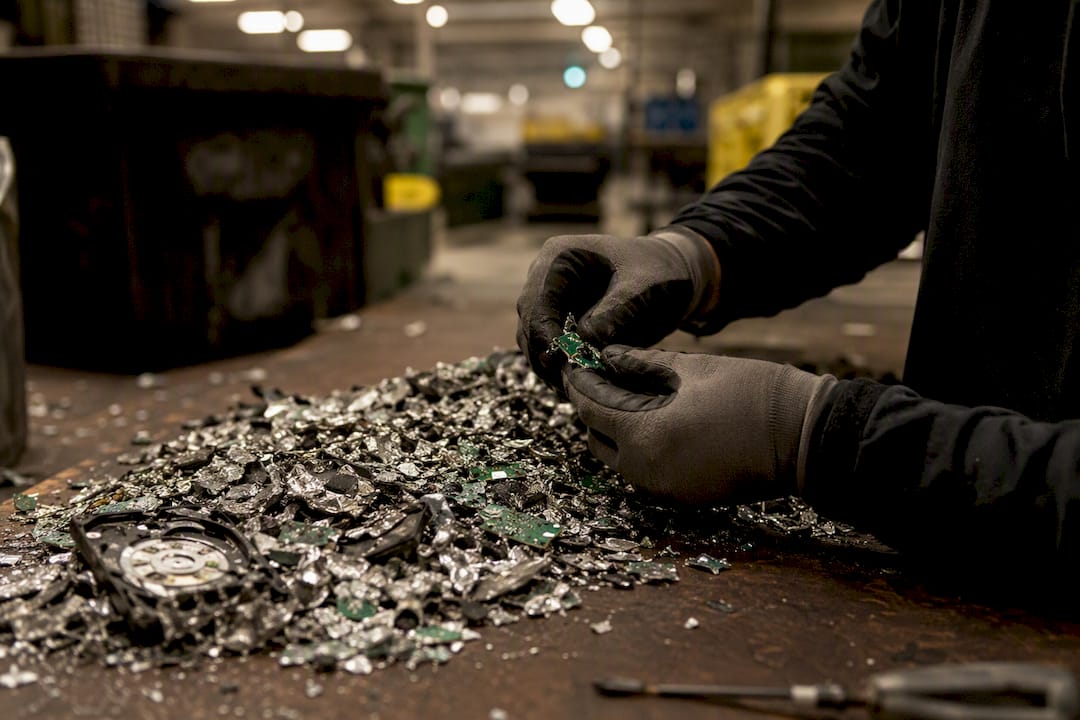
- Physical destruction. A mobile shredder or industrial disintegrator reduces each drive to particles. Some providers target sizes at or below 2 millimeters, a threshold that makes data recovery essentially impossible even with forensic tools.
- Verification. You should be able to watch the shred happen, either in person or via CCTV monitoring, with a witnessed sign-off logged at the time of destruction.
- Documentation. The vendor issues a certificate of destruction along with a reconciled inventory report matching every serial number to its destruction record.
- Post-shred recycling. Shredded material goes through metal separation and enters a recycling process rather than a waste stream.
Smaller particle size isn’t a marketing detail. It’s the actual technical basis for calling the destruction irreversible, since larger fragments can theoretically retain readable platter surface or chip data. If a vendor won’t state a particle-size target, ask why.
What Compliance Documents Should You Require?
A certificate of destruction is only useful if it contains enough detail to survive an audit. Insist on one that lists:
- The destroying company’s name and the technician or witness who signed off
- Date, time, and physical location of destruction
- Destruction method (shredding, disintegration) and equipment used
- A serial-number list matching your submitted inventory, not just a device count
Chain-of-custody documentation should reconcile every drive from pickup or check-in through final destruction, with no gaps. That reconciliation is what makes a certified destruction workflow defensible rather than decorative. Serial-number matching in particular reduces friction during regulatory review, since it lets an auditor trace one specific drive rather than accepting a vendor’s word on volume.
There’s no single federal standard that governs every industry’s retention rules, so check your sector’s own framework, whether that’s HIPAA for healthcare, GLBA for financial services, or a state privacy law. What holds across all of them is the expectation that you can produce destruction records on demand.
Keep certificates and chain-of-custody logs for at least as long as your data-retention policy requires for the underlying data itself, often several years past the destruction date. Store them digitally, separate from the drives’ original asset records, so they survive a system migration or personnel change.
What Drives the Cost of On-Site Shredding?
Pricing depends on a handful of variables that shift from job to job. Drive count and drive type matter most, since SSDs often require different destruction specs than spinning HDDs. Travel time for the mobile unit, any request for witnessed or video-verified destruction, and whether you want recycling credits applied to the invoice all move the number too.
Most providers set a minimum job size, and lead times for scheduling a mobile unit typically run from a few days to a couple of weeks depending on your region and volume. Before the appointment, walk through this checklist:
- Confirm power access if the mobile unit needs it
- Clear a loading dock or parking space close to your building entrance
- Set up a staging area where drives get logged before destruction
- Designate a chain-of-custody location, ideally a single supervised room
Pro Tip: When requesting a quote, ask for a line-item breakdown rather than a flat per-drive rate. It’s the fastest way to spot whether video verification or serial reconciliation is actually included, or billed as an add-on later.
For planning larger jobs across multiple locations, review electronics disposal planning steps ahead of time so your RFP specifies exact drive counts and required documentation up front.
How Do You Choose the Right On-Site Shredding Vendor?
Vendor evaluation comes down to a short list of hard questions. Ask them directly, in this order:
- Are you insured for on-site data destruction, and can you provide proof?
- What particle size does your equipment achieve, and can you document it?
- Do you allow witnessed destruction or live video, and is that included in your base price?
- How do you reconcile serial numbers between intake and the final certificate?
- What happens to the shredded material afterward, and can you name the recycling partner?
Weigh cost against compliance capability, not the other way around. A cheaper quote that skips serial reconciliation or refuses video access will cost more the first time a regulator asks for proof.
Watch for these red flags: certificates that list only a device count instead of serial numbers, reluctance to let you witness the shred, and vague language about “secure destruction” with no stated particle size or method. Any one of those should stall a contract until it’s resolved.
Waste-handling obligations can vary by jurisdiction too. Organizations operating across multiple regions sometimes find it useful to review how local waste regulations shape disposal requirements before assuming one vendor’s process satisfies every location’s rules.
Why Procurement Teams Overrate Price and Underrate Proof
The biggest mistake I see in procurement conversations is treating on-site shredding as a commodity you buy on price per drive. It isn’t. What actually matters is whether the vendor can produce a document that survives contact with an auditor, a regulator, or opposing counsel in a breach investigation. A cheap quote with a vague certificate is not a bargain. It’s a liability with a delayed invoice.
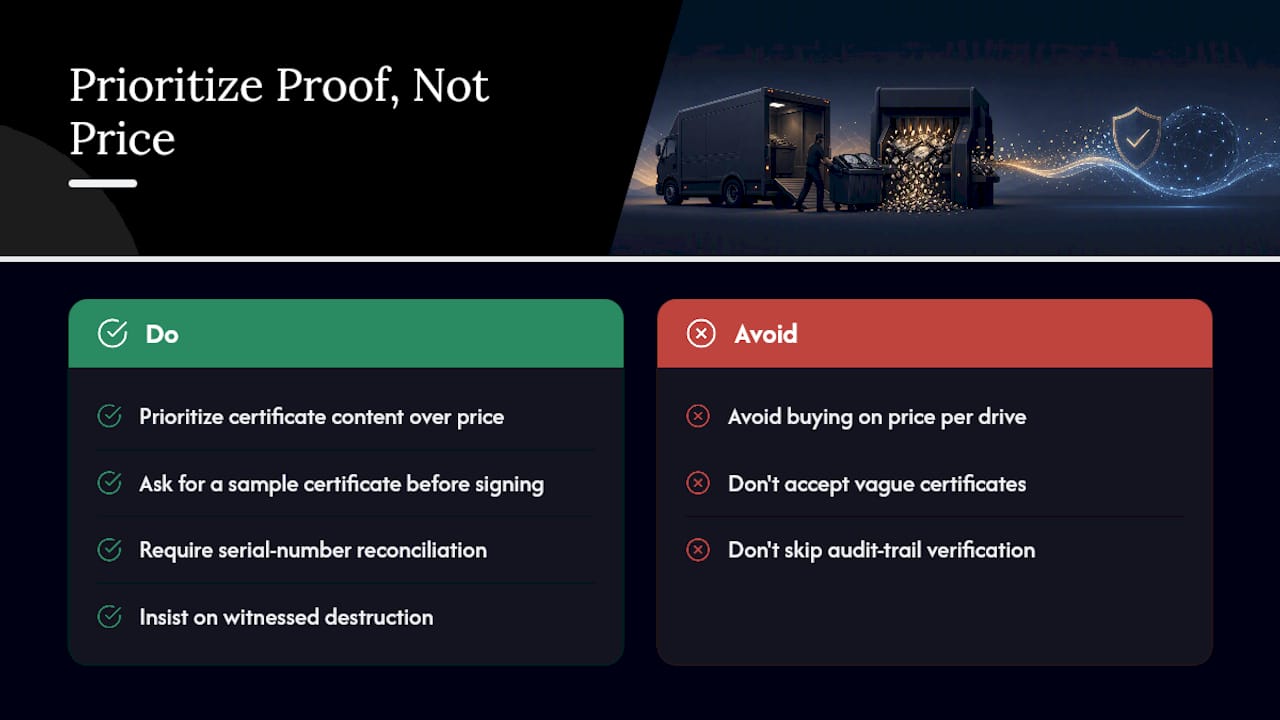
Conventional advice tells buyers to compare per-unit shredding rates and call it done. That advice skips the part that actually protects the organization: serial-number reconciliation and witnessed destruction. Those two elements are what separate a real audit trail from a piece of paper that says “destroyed” without proving it.
If you take one thing from this guide, prioritize the certificate content before the price tag. Ask for a sample certificate before you sign anything. If a vendor hesitates to show you one, that hesitation tells you more than their pricing sheet ever will.
— Keith
How UsedCartridge.com Delivers Certified On-Site Destruction
UsedCartridge.com runs a certified on-site destruction workflow built around the exact standards this guide covers: serial-number tagging at intake, witnessed shredding, and a signed certificate of destruction that reconciles every drive against your original inventory.

You get audit-ready documentation without chasing down a vendor for missing details after the fact. Every job includes eco-compliant recycling of shredded material, so metal recovery and responsible disposal happen automatically rather than as an upsell. UsedCartridge.com also offers free quotes with pickup or on-site scheduling built into the process, so you can compare pricing without committing to a date first.
If your organization is planning a decommissioning project, a compliance-driven purge, or a one-time bulk destruction job, start with a free e-waste and destruction quote and specify your drive count, destruction spec, and documentation requirements up front. That single step gets you an accurate timeline and a price that already accounts for the verification standards your auditors will ask about later.